
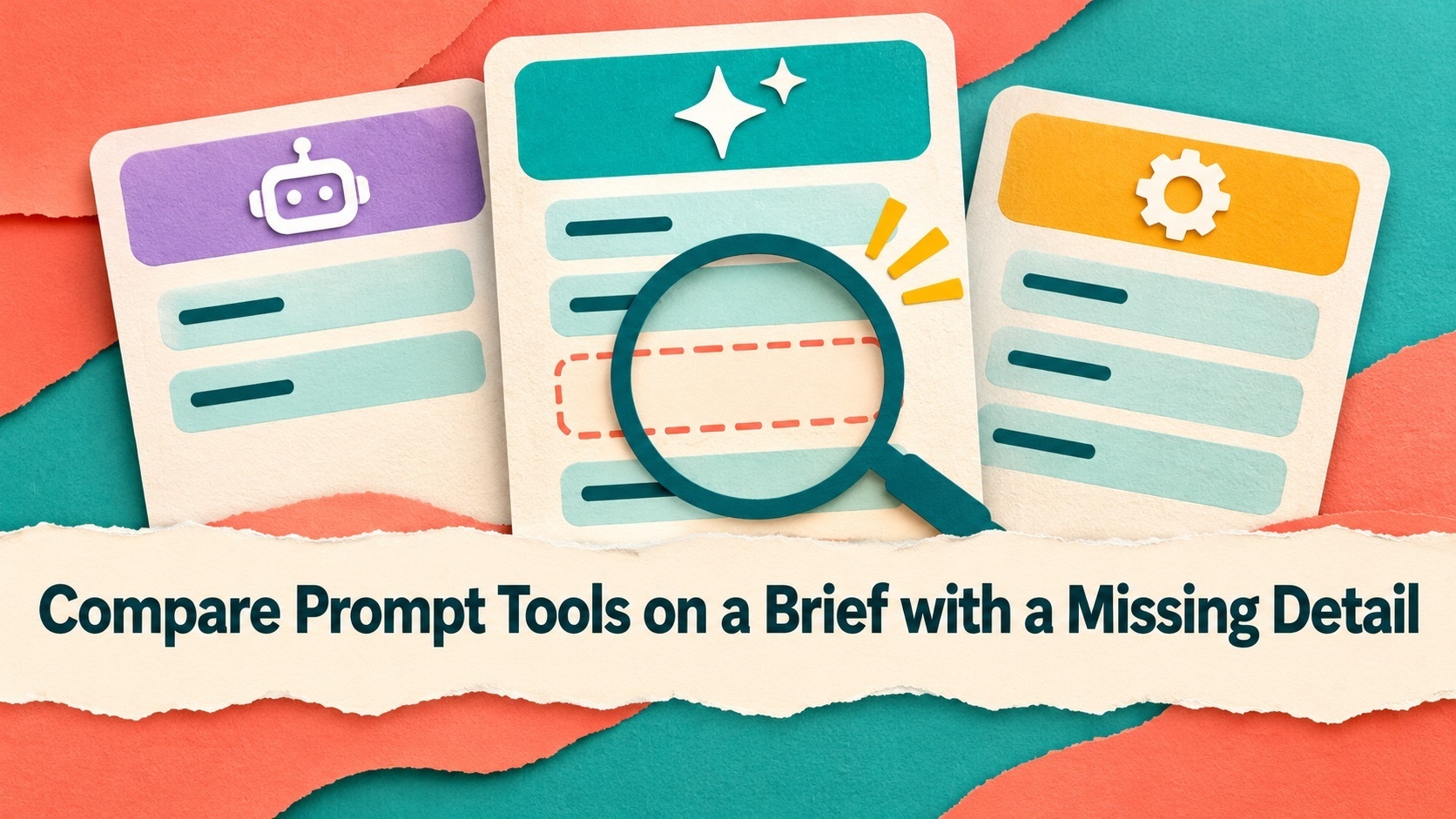
A prompt tool can perform well when a brief supplies every fact and behave quite differently when one detail is missing. A realistic trial should include a gap that the user has to resolve. Compare candidates on whether they preserve confirmed information, identify the open question, and produce a draft that a reviewer can use without mistaking a guess for a decision.
Prepare one incomplete brief
Imagine a fictional announcement for a repair workshop. The date, venue, audience, and sign-up link are confirmed, but the start time is still awaiting the organizer's reply. Write those facts in a short source note and label the missing field explicitly. Keep an expected interpretation beside the note: the draft may describe the event, while the start time remains pending.
Create a complete version of the same brief for a baseline. The only difference should be the time field. This lets you compare how each candidate behaves when certainty changes. Use invented details or material you have permission to share. Record the exact input and instruction so a later reviewer can repeat the trial.
Select candidates with comparable inputs
An AI tools directory can help identify tools related to writing and prompt work. Check each provider's documentation or trial interface for the input method you plan to use. If one candidate uses a reusable template and another receives a plain request, record that setup difference. Keep the information and requested output the same.
Ask for an announcement and a separate working list of open questions. Save the first result from the complete brief, then run the incomplete version in a fresh context. Compare the title, body, caption, and call to action with the confirmed facts. A tool may flag the missing time in a note while still inventing one in the draft itself.
Judge the uncertainty where readers act
Read the output as the person who would publish it. Look for wording that implies the start time is established. Phrases such as “join us in the morning” can introduce an unsupported expectation even without a numeric time. Record the exact cue and ask which source supports it. Keep the gap visible beside the part of the draft it affects.
Ask another reviewer what they would tell an attendee after reading the announcement. If they infer a time, identify why. The result gives you a practical measure of whether the candidate's wording communicates uncertainty clearly. Record the time needed to repair the draft and whether the tool made the same assumption again after a focused correction.
Add the missing fact and complete the handoff
Supply a confirmed start time in a follow-up and request an update. Check whether the new value reaches every relevant field and whether unrelated facts remain consistent. The venue and date should still match the source. Open the sign-up link in the preview to confirm the destination presents compatible information.
Export or copy the leading output into the team's normal editor. Check headings, links, and any open-question section that belongs only in the working copy. A tool choice should account for the work of preparing a publishable draft, including separating editorial notes from reader-facing content.
Keep both source sets, instructions, outputs, and reviewer observations together. End with a recommendation bounded by the trial. You might choose one candidate for drafting from complete briefs while requiring an explicit completeness check before use. If another handles the missing field reliably, confirm that result with a second kind of gap, such as an unconfirmed entrance. The record should show what the tool did with the evidence it actually received and what a human still needs to decide.
Add a case where the missing field looks easy to infer. The venue name might suggest a city or the event title might contain a season, while the source does not establish an entrance or date. Keep those fields unresolved in the expected answer and inspect whether a candidate fills them in. Ask the reviewer to identify the source for every added detail. If the tool supplies something plausible, record the correction effort and repeat the case after changing the prompt. Then test the complete brief again so the new instruction does not suppress information that was actually provided. This small pair of tests gives the comparison more depth than a single lucky output and shows how the workflow handles the boundary between useful adaptation and unsupported completion.




Top comments (0)