

Introduction
Every IT system creates information. Servers record activity, applications produce logs, networks send events, and monitoring systems raise alerts. When teams manage many systems, this information can quickly become hard to understand.
AIOps helps teams make sense of this large flow of information. It combines data, machine learning, analytics, monitoring, observability, and automation. Instead of looking at every alert one by one, teams can connect related signals and focus on problems that matter most.
TheAIOps.com gives learners and technology teams a place to explore these ideas in simple language. Its resources cover learning, certification, tools, implementation, consulting, and career development. Still, the most important part of AIOps comes from understanding the problem first and choosing technology that solves it.
A Simple Look at How AIOps Works
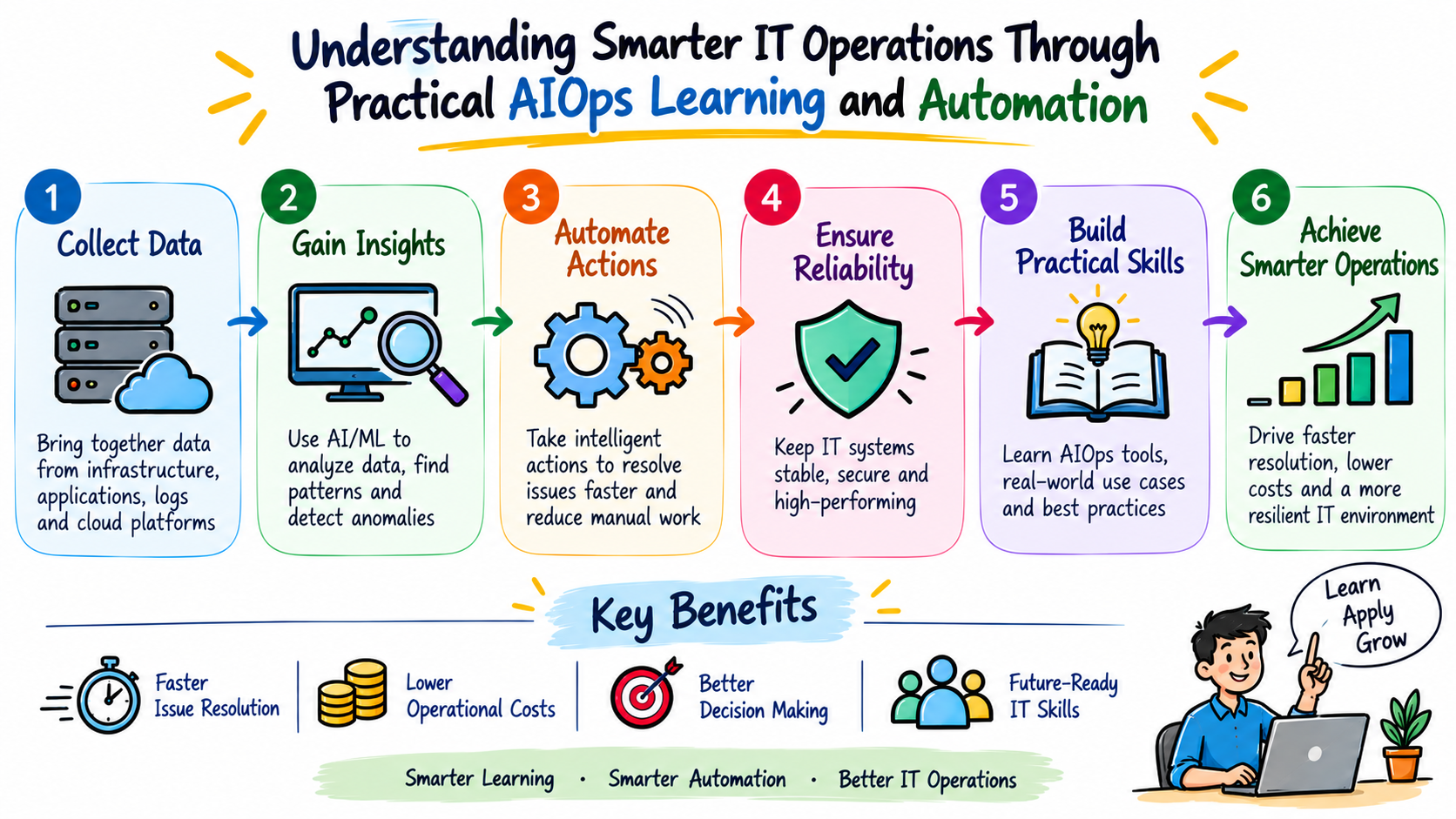
AIOps may sound like a complex subject, but its basic idea feels simple. First, teams collect information from their IT environment. Next, they bring that information together and look for useful patterns.
Then, analytics and machine learning can help identify unusual behavior or relationships between events. Finally, automation can handle selected tasks when the team creates safe rules for those actions.
Think about a website that suddenly slows down. The server may show high usage, the database may show slow queries, and the application may create several alerts. AIOps can connect these signals and help engineers investigate the larger problem.
This process helps teams move from simply seeing alerts to understanding what those alerts may mean.
Where AIOps Fits in Modern IT
Modern businesses depend on many connected systems. A cloud service can depend on a database, application, network, storage system, and security service. One failure can create problems across several areas.
AIOps can help teams study these relationships. It can support:
- Monitoring and observability
- Anomaly detection
- Event correlation
- Root-cause analysis
- Predictive analytics
- Incident management
- Automated remediation
- Infrastructure operations
However, teams should not automate every decision. Some incidents need human review, especially when an automated action could affect customers, data, security, or important business services.
Good AIOps practice combines machine assistance with human knowledge.
The Skills Behind Effective AIOps
AIOps does not depend on one skill. Professionals need knowledge from several technology areas.
Someone who understands only machine learning may struggle to understand an actual production incident. Likewise, someone who knows monitoring but does not understand data or automation may need more skills to build a complete AIOps workflow.
A strong skill base can include:
| Skill Area | What Learners Should Understand |
|---|---|
| IT Operations | Servers, applications, networks, and incidents |
| Monitoring | Alerts, metrics, and system health |
| Observability | Logs, metrics, traces, and system behavior |
| Data | Collection, quality, and analysis |
| Automation | Scripts, workflows, and safe responses |
| Machine Learning | Patterns, anomalies, and predictions |
This mix helps professionals understand both the technology and the operational problem.
Building Knowledge Through AIOps Training
Practical learning can make a difficult subject much easier. AIOps Training can guide learners through common IT situations and show how different AIOps concepts work together.
For example, learners can study a sample application that generates many alerts. They can examine logs, compare metrics, identify unusual behavior, group related events, and investigate a possible root cause.
A useful training program can include:
- AIOps fundamentals
- Monitoring and observability
- Operational data
- Anomaly detection
- Event correlation
- Root-cause analysis
- Predictive analytics
- Incident management
- Automation
- Remediation
Learners should also practice explaining their decisions. That habit helps them understand the reason behind each technical step.
Making Certification Part of the Learning Journey
An AIOps Certification can give professionals a structured target. It can encourage learners to review important concepts and test their understanding.
However, an exam cannot replace practical work. Learners should use labs, projects, troubleshooting exercises, and real examples alongside certification study.
A simple career plan can combine:
- AIOps theory
- Certification preparation
- Hands-on practice
- Automation projects
- Incident exercises
- Documentation
- Problem-solving practice
This approach helps professionals build knowledge that they can use beyond an examination.
Choosing AIOps Tools with Care
Many AIOps Tools can support different parts of IT operations. Some tools focus on observability. Others focus on monitoring, incident management, analytics, automation, or infrastructure management.
An AIOps Platform can connect several capabilities and help teams work with information from different systems.
Before selecting a solution, teams should ask practical questions:
- What problem should the tool solve?
- Which data sources can it connect?
- Does it work with current systems?
- Can it reduce unnecessary alerts?
- Does it support useful automation?
- Can engineers understand its recommendations?
- Does it provide suitable security controls?
- Can the solution support future growth?
A tool comparison should focus on actual needs. For example, a team that needs better incident correlation should not choose a product only because it has many unrelated features.
AIOps Implementation Needs a Clear Plan
Good AIOps Implementation starts with a problem, not a product. Teams should first understand where they lose time or struggle to manage incidents.
For example, a team may spend too much time investigating repeated alerts. It can choose alert correlation as an initial use case.
A practical implementation process can follow these steps:
- Identify one important operational problem.
- Study the current process.
- Find the data needed for analysis.
- Connect relevant systems.
- Create and test correlation rules.
- Review results with engineers.
- Introduce controlled automation.
- Measure the outcome.
- Improve the workflow.
- Expand to another use case.
This approach gives teams time to learn and fix problems before they expand the project.
Real Examples Make AIOps Easier to Understand
A good example can explain AIOps better than a long definition. Consider an online service that suddenly receives many customer complaints about slow performance.
The operations team checks several signals. Application response time rises, database queries take longer, and server resources increase. Each system produces different alerts.
AIOps can help connect these signals. The team can then investigate whether they share a common cause.
Other useful use cases include:
- Detecting unusual application behavior
- Finding infrastructure performance changes
- Grouping related alerts
- Supporting incident investigation
- Predicting possible failures
- Automating routine responses
- Improving capacity planning
These examples show how teams can apply AIOps to real operational work.
Consulting and Services Can Support Larger Projects
Organizations sometimes need help when they move from learning to implementation. AIOps Consulting can help teams review their current systems, identify useful use cases, and create a practical adoption plan.
AIOps Services can also support implementation, integration, automation planning, operational analysis, and improvement activities.
Teams should define clear goals before starting this work. They can measure alert volume, investigation time, incident response, automation coverage, or other results that match their needs.
TheAIOps.com provides educational material around these subjects, which can help readers understand the ideas before they make larger operational decisions.
DevOps, DataOps, and MLOps Create a Wider Skill Set
AIOps connects with several other technology practices. DevOps Training helps professionals understand software delivery, automation, infrastructure, collaboration, and continuous improvement.
At the same time, DataOps Training helps teams manage reliable data workflows. This matters because AIOps needs useful operational data to produce useful analysis.
MLOps Training teaches professionals how teams manage machine learning systems, including data, models, deployment, monitoring, and maintenance.
Together, these practices create a wider view of modern technology operations.
| Practice | Main Purpose |
|---|---|
| DevOps | Improve delivery and automation |
| DataOps | Improve data flow and quality |
| MLOps | Manage machine learning workflows |
| AIOps | Improve intelligent IT operations |
Professionals can choose the skills that match their current role and future goals.
Creating Strong AIOps Content for Search and Learning
Technical readers want quick, clear answers. Therefore, AIOps content should explain difficult ideas without unnecessary jargon.
AEO, or Answer Engine Optimization, helps writers provide direct answers to common questions. GEO, or Generative Engine Optimization, helps content provide useful context for generative search systems.
LLMO, or Large Language Model Optimization, encourages clear structure, accurate information, and useful explanations. AISEO, or AI Search Optimization, supports content discovery across modern search experiences.
Writers should also apply E-E-A-T: Experience, Expertise, Authoritativeness, and Trustworthiness.
Strong content can include:
- Real experience and personal stories
- Case studies and success stories
- Original insights and opinions
- Industry statistics and research data
- Step-by-step guides and tutorials
- Expert interviews and quotes
- Detailed comparisons
- Unique frameworks and methodologies
- Real examples and use cases
Writers should verify statistics and research before publishing them. They should also identify experts and explain the context behind their statements.
Growing Toward an AIOps Engineer Career
An AIOps Engineer combines several technical skills. The role can involve monitoring, observability, automation, cloud systems, data analysis, machine learning, incident management, and troubleshooting.
Beginners can build these skills one step at a time.
A practical checklist includes:
- Learn Linux basics.
- Understand networking.
- Practice monitoring.
- Study observability.
- Work with logs and metrics.
- Learn scripting.
- Practice automation.
- Explore cloud systems.
- Understand basic machine learning.
- Learn incident management.
- Build troubleshooting projects.
Small projects can provide valuable practice. A learner might create a monitoring workflow, study system data, detect an unusual pattern, and design a safe response.
This type of practice can build confidence and create useful examples for future interviews.
A Practical Framework for Learning AIOps
Learners can remember AIOps through a simple five-step method:
Observe → Collect → Understand → Act → Improve
First, observe what happens in the system. Next, collect useful data. Then, understand patterns and relationships. After that, take an appropriate action. Finally, review the result and improve the process.
This framework can support tutorials, training exercises, case studies, and workplace projects.
It also reminds learners that automation should not become the first step. Teams should understand the situation before they automate a response.
Frequently Asked Questions About AIOps
What does AIOps mean?
AIOps means Artificial Intelligence for IT Operations. It combines operational data, analytics, machine learning, and automation to help teams manage IT systems.
Why do teams need AIOps?
Teams can use AIOps to handle large amounts of operational information, reduce alert noise, identify unusual behavior, and support incident investigation.
Can someone with basic IT knowledge learn AIOps?
Yes. Beginners can start with IT operations, monitoring, and troubleshooting before they move into observability, automation, data, and machine learning.
What can AIOps Training teach?
AIOps Training can teach monitoring, anomaly detection, event correlation, root-cause analysis, predictive analytics, incident management, and automation.
Does AIOps Certification help a technology career?
Certification can help professionals organize their learning and demonstrate knowledge. Hands-on projects should support certification because practical experience adds important value.
What should people look for in an AIOps Course?
Learners should look for clear explanations, practical exercises, architecture concepts, tools, use cases, implementation methods, and troubleshooting examples.
What do AIOps Tools actually do?
AIOps Tools can collect operational information, analyze events, identify unusual patterns, reduce alert noise, support incidents, and automate selected tasks.
How can an organization begin AIOps Implementation?
An organization can start with one clear problem, identify useful data, test a focused use case, involve engineers, measure results, and expand gradually.
When should a company consider AIOps Consulting?
A company can consider AIOps Consulting when it needs help with assessment, use-case selection, planning, integration, implementation, or operational improvement.
What does an AIOps Engineer work with?
An AIOps Engineer can work with monitoring, observability, automation, cloud systems, operational data, machine learning, incident management, and troubleshooting.
Final Thoughts
Better IT operations come from better understanding. AIOps helps teams connect information from different systems and turn that information into useful operational insights.
Still, technology alone cannot solve every operations problem. Teams need reliable data, clear processes, skilled people, careful testing, and human judgment.
Learning through AIOps Training, AIOps Certification, an AIOps Course, and hands-on projects can build a strong foundation. Teams can then explore AIOps Tools, an AIOps Platform, AIOps Consulting, AIOps Services, and practical AIOps Implementation methods according to their needs.






Top comments (0)