
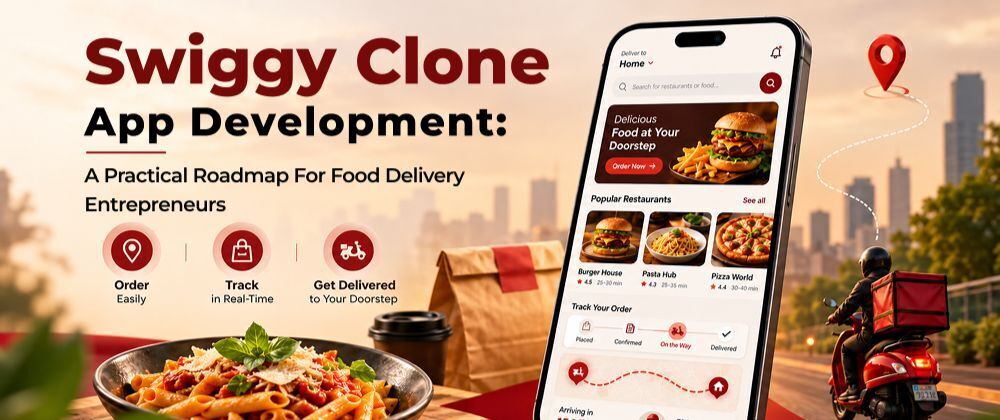

The rise of online food ordering systems among users has created new opportunities for startups. Also, the rise in the usage of smartphones has made customers increasingly prefer digital platforms to discover restaurants, compare menus, place orders, and receive at their doorsteps. This shift has boosted businesses to invest in tech-driven food delivery solutions.
However, launching a food delivery platform is not just launching the app and delivering food to customers. It is something more than connecting restaurants with customers. Businesses need a reliable system to manage the overall restaurant operations, delivery assignments, customer interactions, and payments.
Swiggy clone app development offers startups a practical way to establish their own branded food delivery platform using established business workflows and customizable software. This guide explores the features and development process for launching a food delivery business with a Swiggy clone app.
Understand the Swiggy Business Model Before Development
To make it to the top of the list, startups need to grasp how a multi-service food delivery marketplace functions before investing in its development. In this model, there are three main stakeholders: the user, the restaurant, and admins, and they are linked together by a central platform.
Customers can view restaurants' menus, order food, pay, and track deliveries.
Restaurant Partners list food, accept orders, change food in preparation, and process customer requests.
Delivery partners take delivery orders, pick up prepared orders from restaurant partners, and deliver to customers.
The platform operator will manage these activities using an administration system. This enables companies to control participating restaurants, track transactions, configure zones, and track service performance.
Choose the Right Food Delivery Business Approach
Every food delivery business does not require the same organizational set-up. The way your business operates will dictate the order processing system you use, who will do deliveries, and what software you need.
Here are three ways to do it:
Restaurant Ordering Platform: Restaurant staff prepare food and deliver the orders. The platform offers restaurants access to more customers and digital ordering capabilities.
Restaurant Aggregator Platform: Several restaurants operate under a single name on the market. Customers can browse around the different restaurants, and the platform can take care of order coordination and delivery arrangements.
Centralized Food Delivery System: The company runs a restaurant alliance and delivery system on one platform. Assignments, pickups, and customer deliveries are processed by dedicated delivery partners.
Consider your restaurant network, delivery options, and target market before choosing an approach. This means that your Swiggy clone app will be based on your business operations and not add any extra features.
Identify the Essential Features for Your Swiggy Clone App
A food delivery platform requires connected interfaces for customers, restaurant partners, delivery personnel, and administrators. Each interface should support specific operational activities. Here are some essential features of a food delivery platform like Swiggy.
Account registration
Menu discovery
Live tracking
Profile management
Availability management
Real-time updates
Operational analytics
Reviews and feedbacks
Select the Right Technology for Development
Choosing the right technology plays an important role in enhancing the performance, scalability, and security of a Swiggy clone app development. Startups should choose the right tech stacks based on their requirements, traffic, integration needs, and budget.
Some common technology options are listed below:
Frontend: React Native or Flutter for cross-platform mobile applications.
Backend: Node.js, Laravel, or Django for application logic and server-side operations.
Database: MySQL or PostgreSQL for structured business information, with MongoDB for suitable flexible data requirements.
Maps and Tracking: Google Maps APIs for location services, navigation, and delivery tracking.
Payment Integration: Stripe, Razorpay, or other payment providers supported in the target market.
Cloud Infrastructure: AWS or Google Cloud for hosting and infrastructure management.
Decide Between Custom Development and a Ready-Made Clone Solution
There are mainly two major approaches to developing a Swiggy clone app. They are custom app development and a ready-made Swiggy clone solution. Let’s discuss these in detail.
Custom App Development
Custom development involves building the food delivery app from scratch around the specific business requirements. The solution offers greater flexibility in designing workflows, integrating third-party systems, and developing specialized functionality. However, the development process requires detailed planning, engineering resources, testing, and post-launch support and maintenance.
Ready-Made Swiggy Clone Solution
A ready-made clone solution provides pre-designed application modules that businesses can customize with their branding, preferred features, and operational requirements. This process reduces the need to develop every component from scratch. Also, it helps with quick launch. While considering a ready-made solution, examine its source code and customization options, application performance, security practices, third-party integrations, and ongoing technical support.
The choice between a custom or ready-made solution depends on available resources, launch priorities, and the level of customization your business needs.
Establish Revenue Streams for Your Food Delivery Platform
Having a sustainable revenue model is crucial for the operation of the platform and returns on business. Multiple revenue streams can be added for startups based on their market structure.
Restaurant commissions: Pay restaurant partners a percentage on eligible orders made via the platform.
Delivery charges: Distance, area, or order conditions determine delivery charges, which are collected from the customer.
Featured listings: Enable restaurant partners to pay for more visibility in the app.
In-App advertising: Earning revenue through selling promotional advertisements to the participating restaurants and appropriate brands.
Surge pricing: Implement demand-based pricing as needed to control delivery capacity during periods of high demand.
Membership plans: Provide customers with the advantage of recurring benefits, for example, eligible delivery reductions or exceptional offers.
Plan Your Launch and Business Expansion
Developing the application is only one part of establishing a successful food delivery business. There is also a business plan for startups that includes restaurant acquisition, availability for delivery, customer support, and market entry. Start with a well-defined service area, rather than taking on many locations at once. Collaborate with restaurants that are able to handle incoming orders and maintain food quality. Set up delivery coverage depending on the number of staff and order acceptance. Test end-to-end for key scenarios before launch, such as successful orders, payment failures, restaurant rejections, order cancellations, unavailable menu items, and delivery delays. After the platform goes live, track customer reviews, restaurant results, order completion, and delivery speed. This information can be used to inform improvements and to decide when to add other sites or services.
Why Invest in Swiggy Clone App Development with SpotnEats?
Building a food delivery business requires a technology partner who understands both the application development and marketplace operations. SpotnEats helps startups and entrepreneurs establish their own branded food delivery platforms with a ready-made clone solution. With dedicated applications for customers and delivery partners, restaurant management facilities, and a centralized admin dashboard, businesses can coordinate essential food ordering and delivery activities via one connected platform.
The solution can be customized to reflect your business identity, operational requirements, and preferred features. This gives entrepreneurs a foundation to introduce their food delivery services without developing every application component from scratch. Whether you are entering a local food delivery market or planning a multi-location business, choosing the right software foundation can simplify your launch and support future expansion.
Conclusion
Entering the food delivery industry requires a clear business strategy, dependable restaurant partnerships, and technology that supports everyday operations. Swiggy clone app development provides startups with an opportunity to establish their own food delivery brand using customizable software and established marketplace workflows.
By selecting the right business approach, prioritizing essential features, and planning for operational growth, entrepreneurs can build a platform that meets market requirements and supports long-term business development.
Ready to launch your own food delivery platform? Explore SpotnEats and take the next step toward building your branded food delivery business.





Top comments (0)