

I wanted a simple shot of a sparkling-water bottle on a café table. Someone would pick it up, open it, take a drink, and put it back down.
By the time I finished the prompt, I'd somehow added a slow camera move, condensation close-ups, people walking behind the table, a lighting change, and another product shot at the end.
Watching it back, I wasn't wondering what else the scene needed.
I was wondering why I'd put so much in it.
I Tried the Same Scene With Less Going On
For the next version, I kept the bottle on the table and let the opening sit for a moment.
A hand came into frame, picked up the bottle, and opened it. The camera moved slightly closer during the action, then stopped.
That was about it.
The second version wasn't as flashy, but it was much easier to watch. I knew where to look, and the main action didn't have to compete with something happening in the background.
It also made me notice how often I was adding instructions simply because I could.
Now I Decide Where the Scene Ends First
This has become a small habit.
Before thinking about camera movement, lighting, or visual style, I decide what I want to see at the end.
For the café scene, I wanted the final moment to come after the drink, with the bottle still visible on the table.
Once I knew that, the rest became easier.
If the last frame is the bottle back on the table, I don't need to invent a second location halfway through the clip.
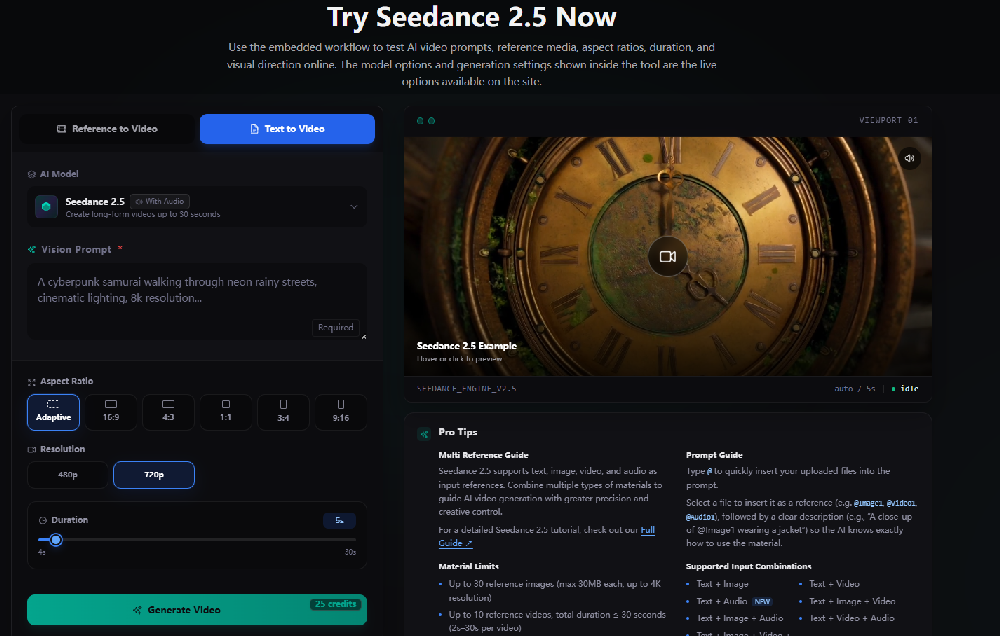
I started doing this during a few longer Seedance 2.5 generations. Instead of thinking about how much I could fit into the available time, I worked backward from the last moment I actually wanted.
That kept the prompts much more focused.
The Camera Doesn't Have to Be Busy Either
I ran into the same problem with a coffee machine scene.
All I needed was a mug under the machine, someone pressing the button, and coffee pouring into the cup.
My first version also asked the camera to move around the machine.
It wasn't completely wrong. It just made an ordinary action feel more dramatic than it needed to be.
On the next try, I kept the framing fairly steady and used a small move toward the mug when the coffee started pouring.
That suited the scene better.
Now, when I'm tempted to add another camera instruction, I ask whether it helps me see the action more clearly.
If removing it changes nothing important, I usually leave it out.
I Don't Rush Through Every Pause Anymore
Quiet moments used to bother me.
If nothing happened for a second or two, I'd assume the scene needed another action.
But think about something as ordinary as picking up a package from the front door.
You pick it up.
You look at the label.
Then you open it or carry it inside.
That moment spent looking at the label isn't wasted. It's just part of the action.
The same applies at the end of a shot. Sometimes holding on the product for a moment feels more natural than squeezing in another camera move before the clip stops.
I have taken this too far.
In one test, I left a long pause at the beginning because I thought the scene needed more breathing room.
It didn't.
It just felt slow.
I shortened the opening on the next version.
So I'm not trying to make everything slower. I just don't assume that every quiet second needs fixing.
I Stopped Trying to Fill the Full Duration
This was another easy habit to fall into.
If I had room for a longer clip, I'd start looking for more things to put in it.
Now I let the action decide.
Say the idea is a pair of sunglasses in a case.
The case opens.
Someone picks up the glasses.
The shot ends on the side profile.
If that already feels finished, I don't need another location or another action just to make the clip longer.
A different scene might naturally take more time. Someone could enter a room, notice something on a table, walk over, and interact with it.
That's fine too.
I just don't choose the length first and then try to invent enough material to fill it.
One Check Before I Generate
Before generating, I sometimes read the idea again without words like "cinematic," "dynamic," or "beautiful."
If I can still tell what's supposed to happen, the scene is usually clear enough.
If all that's left is a location and a mood, I probably need to think about the action a little more.
There's also one boundary I keep in mind when these clips are meant for public use.
I treat generated scenes as visual drafts, not product evidence. If a scene shows how something works, how food is prepared, or how a tool is used, I check the real instructions and source material separately rather than trusting generated motion.
A convincing-looking clip can still show something that isn't accurate.
When a scene feels crowded now, I usually remove something before adding another instruction.
Sometimes it's a camera move.
Sometimes it's background action.
Sometimes it's an ending I added because the original ending seemed too plain.
And sometimes I cut too much and have to put a little movement back.
But I've stopped treating every quiet second as unfinished.
If I can clearly see one small thing happen from start to finish, I usually leave it there.



Top comments (0)