
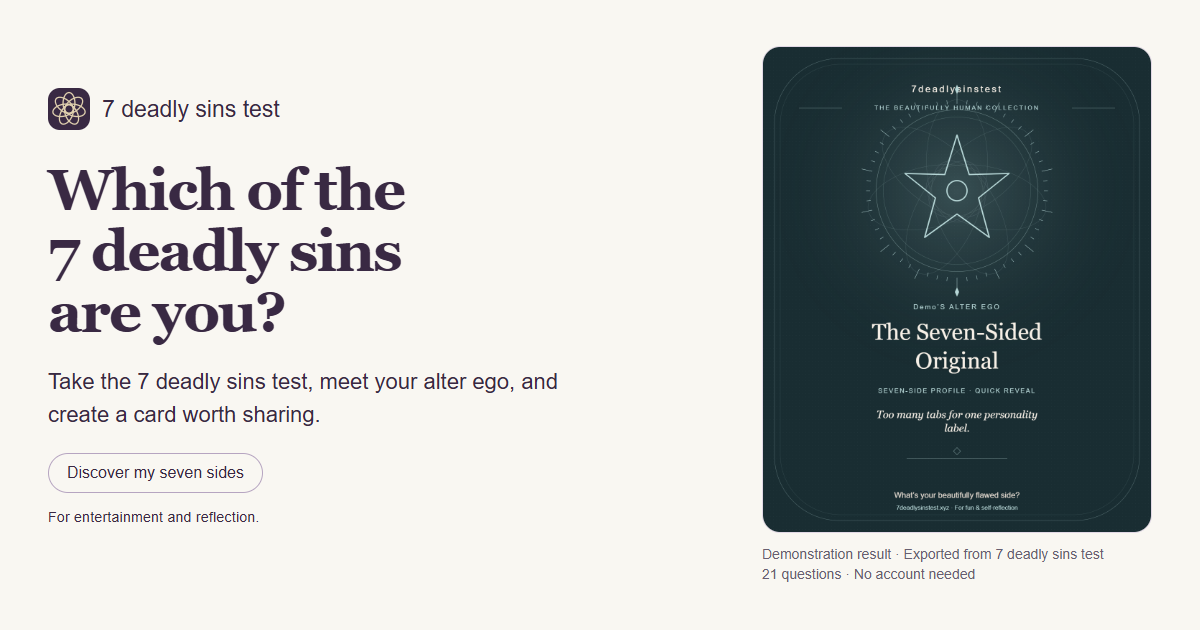

You finish a 7 deadly sins test and get “Pride.” What should you do with that word? Start with a moment you can describe: “A teammate corrected a slide, and I defended it before checking the source.” That gives you something to examine. “I'm a proud person” invites a much bigger story than one quiz can support.
If you want a profile to work with, start with the 7 deadly sins test. If you already have a result, pick one category and jump to the prompts below. You can use them with a chatbot or answer them in a notebook. The quiz itself uses fixed scoring; the prompts are a separate activity.
What the seven categories mean here
A 7 deadly sins quiz borrows names from Christian moral tradition. The Catechism of the Catholic Church, §1866 gives the traditional list, using avarice for greed. Here are the narrower, everyday behaviors Seven Sides asks about. This is a habit quiz, rather than a religious knowledge test or an anime character match.
- Pride: Defending a view before hearing a correction, or feeling bothered when work goes unnoticed. Enjoying an achievement is a different thing.
- Envy: Reading someone else's progress as evidence that you're falling behind. You can feel that sting and still be happy for them.
- Wrath: Sending a sharp reply or replaying a disagreement after it ends. Anger may be justified; the question is what you do next.
- Sloth: Avoiding an uncomfortable task when you have the time and energy to start. Needing rest doesn't fit that example.
- Greed: Wanting another option or opportunity after your original needs are met, even when you can't use what you already have.
- Gluttony: Scrolling or watching after the enjoyment fades or past the stopping point you chose. This example is about a habit, not food or body size.
- Lust: Letting attraction rush a decision you intended to take slowly. The point is whether you keep the pace you chose.
How the 7 deadly sins test scores your answers
The 7 deadly sins quiz on Seven Sides offers a 21-question quick version (three per category) and a 70-question full version (ten per category). Choose quick for a first look or use the site's Full Test link to answer about more situations. A longer version gives you more examples; it doesn't establish scientific validity.
The five regular options count from 0 to 4 internally. A statement phrased in the opposite direction is scored as 4 minus the answer. Non-applicable answers are left out. The completed profile requires at least two usable answers per category in the quick version, or eight in the full version.
Suppose three adjusted answers in one category are 4, 3, and 2. Their average is 3. Multiply by 25 and the category scores 75 out of 100. That doesn't mean you act that way 75% of the time or that you scored higher than 75% of other people. Each bar stands on its own; the seven bars don't have to add up to 100.
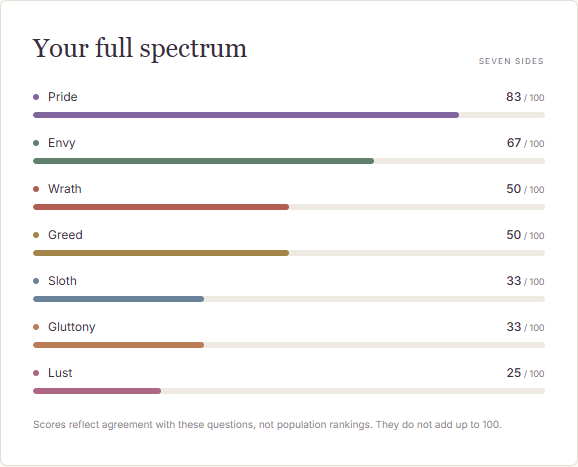
Example profile from Seven Sides. The bars show answers to a set of statements, not a population ranking.
What should you do with a high or close score?
For a clear leader, name a situation where the label fits. Then name one where it doesn't. Maybe you get defensive when corrected in front of a group but readily ask a friend to point out mistakes. The contrast is more useful than the label alone.
For close scores, read both descriptions before deciding what matters. Envy and pride could both come up when you compare yourself with coworkers; they could also describe entirely different situations. If the profile is flat, you can still pick an interesting question. There is no need to invent a winner.
A chatbot can't validate your 7 deadly sins test result. It can help you generate alternatives, ask a sharper question, or plan something you can observe. Try the following prompts with fictional or non-identifying examples. Leave out names, private messages, and result links.
Prompt 1: Separate what happened from the story about it
Paste this into a fresh conversation and replace the brackets. The result gives the model a topic; the incident gives it something to work with.
Help me reflect on one everyday event.
Quiz category: [category]
What happened: [one brief, non-identifying incident]
What I did: [observable action]
Counterexample: [a time I acted differently, or "unknown"]

List only the facts I supplied. Then give two possible
interpretations, including one unrelated to the quiz label.
Mark them as hypotheses. Ask one question that would help
distinguish them. Do not invent motives or diagnose me.
~~~

**Fictional worked example.** A teammate corrected a slide in a meeting. You defended it, checked the source later, and updated the slide. You had accepted a private correction on another day.

A useful question might be: “Did you defend the slide because the feedback was public, or because you believed the original source supported you?” Compare that with “You care too much about looking smart.” The first gives you two explanations to check. The second invents a motive. These are illustrative responses, not recorded model outputs.

## Prompt 2: Compare two categories without forcing a winner

A 7 deadly sins quiz may give you two labels that both sound familiar. Compare the events behind them instead of asking which label is your “true” personality.

~~~text
Category A: [label]
Event A: [what happened and what I did]
Category B: [label]
Event B: [what happened and what I did]

Describe one observable difference between the events.
Ask one question about each and one about a possible
shared circumstance. If an example is missing, ask for it
instead of guessing. Do not choose a winning label.
~~~

For instance, a friend's promotion may have set off a comparison, while a rushed team meeting led to a sharp reply. Both incidents happened on a difficult day, but there isn't enough information to say they had the same cause. If the response treats two nearby scores as proof of that connection, ask it to point to the specific detail it relied on.

## Prompt 3: Plan one small change you can actually observe

You don't have to retake a 7 deadly sins test to see whether a new response worked. Look for a small action you could take the next time the situation comes up.

~~~text
Situation: [a recurring, low-stakes situation]
What I usually do: [observable action]
What I would prefer to do: [observable action]
Constraint: [time, energy, or resources]

Suggest one if-then plan for next time and one thing I can
record afterward. If it assumes information I did not give
you, ask me first. Do not promise a change in a quiz score.
~~~

For the slide example: “If I'm corrected in a meeting, I'll ask which part needs changing before explaining my choice.” Afterward, you can record whether you asked. That is a clearer check than trying to decide whether you were “less prideful.”

## How to tell whether the prompt helped

Read the answer beside your original input. Check whether it kept observations separate from guesses, acknowledged the counterexample, and proposed something you could actually notice. If it failed one check, change one instruction and rerun the same fictional input. That makes it easier to see whether the change helped.

The Seven Sides questionnaire is for entertainment and reflection. A 7 deadly sins test score can't diagnose a condition, establish your character, or tell you who's “better” when you compare with friends. The useful takeaway is a specific situation you understand a little better.

What instruction would you add to stop a reflection prompt from reading too much into a label? If you try one of these templates, share a fictional input and the line you would change.




Top comments (0)