


The US Census Bureau has banned noise infusion from all statistical products it publishes. The change was flagged on Hacker News where the thread reached 689 points and 421 comments.
Noise infusion adds calibrated random values to counts and tables to prevent re-identification. The Bureau previously applied it to 2020 Census releases and some ACS tables. The new policy removes this step from future products.
What Changed at the Census Bureau
The Bureau now requires exact counts or model-based synthetic data without post-release noise. Internal documents state that noise infusion introduced measurable bias in small-area estimates and complicated downstream modeling.
The policy applies to all statistical products released after the announcement. Products already in the field using noise will continue, but new releases must comply.
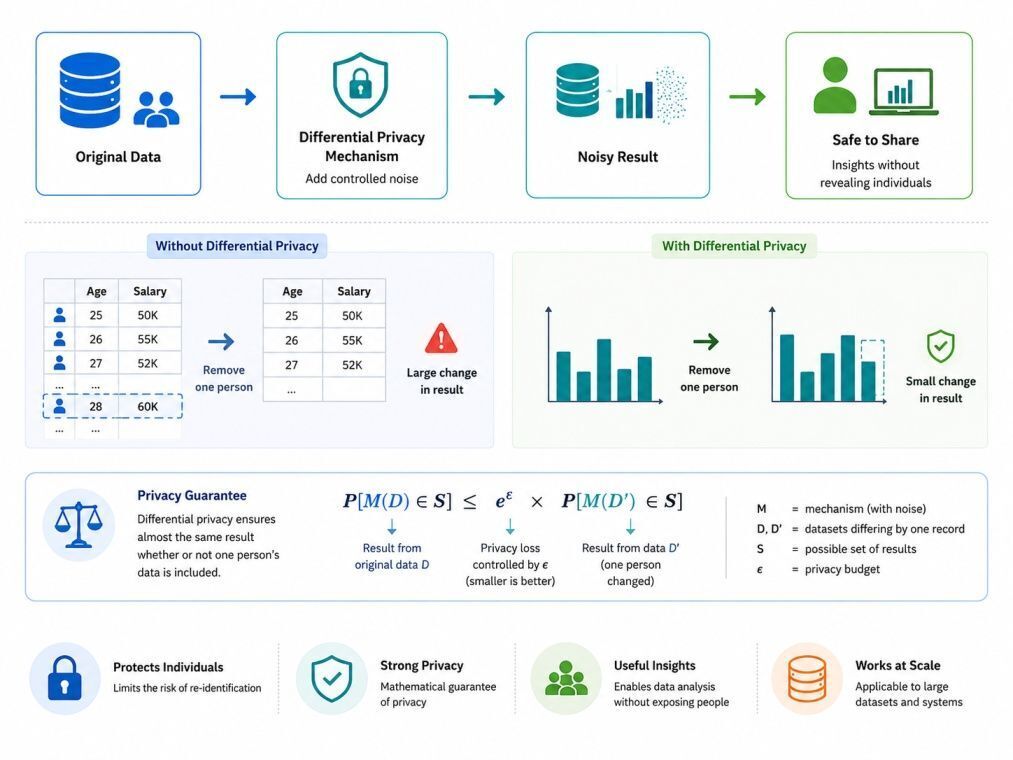
Scale of Prior Noise Use
In the 2020 Census, noise infusion altered roughly 8 percent of block-level counts by at least one household. For tables with fewer than 50 records, the median absolute error reached 3–4 units. Researchers tracking migration and poverty reported systematic attenuation of coefficients when using the noisy files.
How Differential Privacy Is Affected
Noise infusion is one implementation of differential privacy. The Bureau will retain formal privacy guarantees through other mechanisms such as query restrictions, suppression, and pre-release synthesis. Pure noise-based releases are no longer permitted.
Alternatives and Comparisons
Teams needing privacy-preserving releases now evaluate three main options.
| Method | Bias Introduced | Compute Overhead | Small-Area Accuracy | Adoption in Official Stats |
|---|---|---|---|---|
| Noise infusion | Medium | Low | Reduced | Previously used |
| Synthetic data | Low–Medium | High | Preserved | Expanding |
| Query restrictions | None | None | Suppressed cells | Standard fallback |
Synthetic data pipelines from agencies such as the UK ONS and Statistics Canada show lower bias on the same metrics but require 4–6× more modeling effort.
Who Should Adjust Their Pipelines
Researchers using Census microdata for small-area estimation or longitudinal studies should test synthetic alternatives immediately. Teams building production models on ACS or decennial files need to re-run validation sets without the old noise layer.
Groups focused on strict differential privacy proofs may lose a simple calibration tool and must adopt more complex synthesis or access-restricted environments instead.
Practical Next Steps
- Download the latest exact-count releases from the Census Bureau FTP site.
- Compare 2019 ACS tables against 2023 releases to quantify removed noise effects.
- Test open-source synthesis libraries such as SmartNoise or SynthPop on Census schema.
- Monitor the Bureau’s Federal Register notices for updated disclosure avoidance rules.
Bottom line: The Census Bureau has removed a widely used but biased privacy tool; practitioners must shift to synthesis or restriction methods for continued access to accurate small-area statistics.
The policy signals that statistical agencies now prioritize bias reduction over simple noise mechanisms when both privacy and accuracy are required.






Top comments (0)