

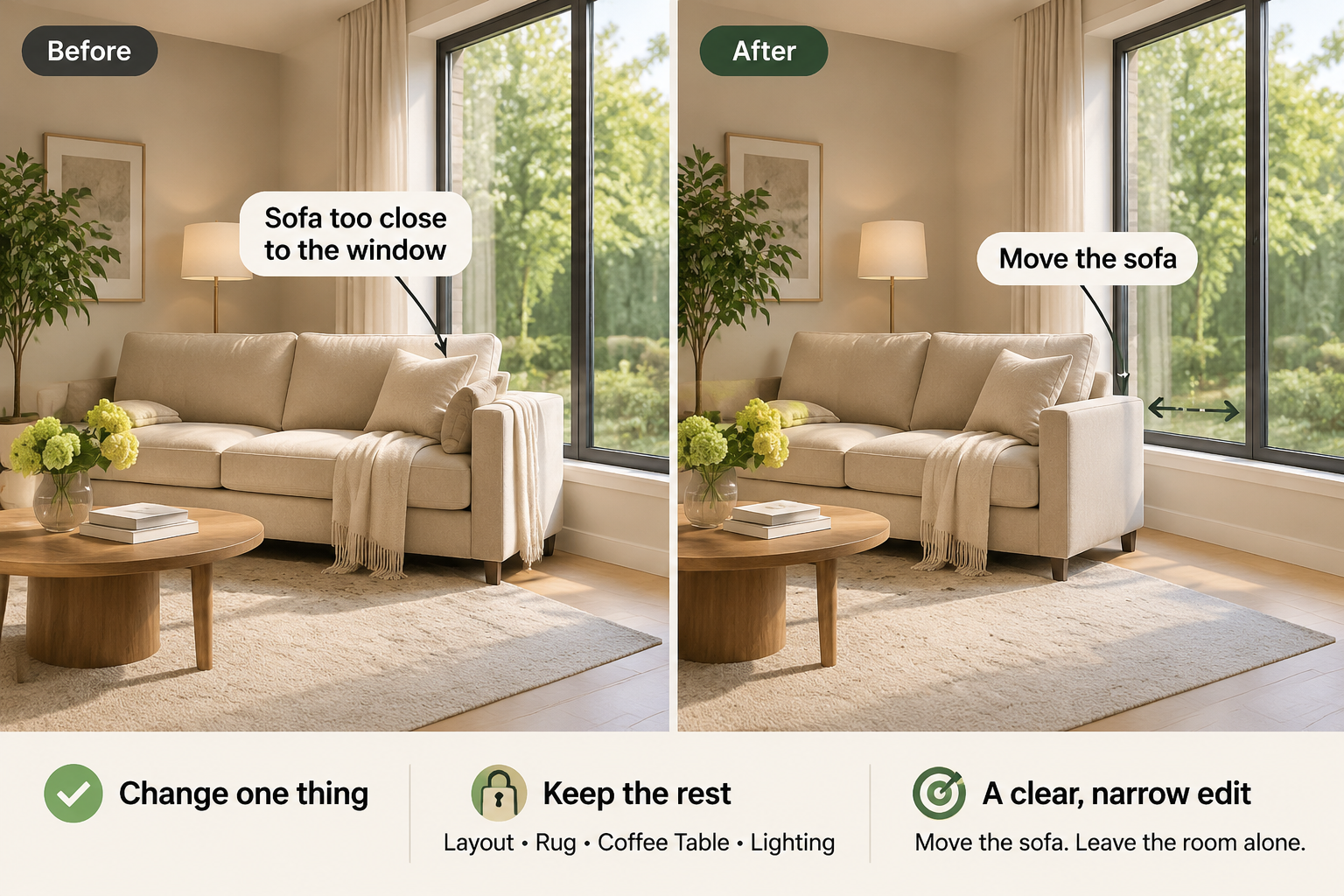
The living room looked good. The sofa was just in the wrong place.
It was blocking too much of the window and making the room feel smaller. The rug worked. The coffee table worked. The lighting was fine.
I didn't need a new room. I needed the sofa moved.
That's the kind of small change I'd rather handle through image editing than start over. The goal is simple: change the sofa without redesigning the room.
Don't Rebuild What Already Works
A new generation might fix the sofa, but it could also change the rug, lighting, furniture, or room proportions.
Then the original problem is gone, but the image has several new ones.
So I'd first decide what should stay.
For this room, that's the window, rug, coffee table, lighting, and general layout.
Everything else could stay. The sofa was the part I wanted to move.
Give the Edit One Job
Instead of asking for a better-looking living room, I'd make the request much narrower.
For that kind of edit, I'd use MiniMax H3 Image rather than starting the whole image again.
Move the sofa slightly away from the window. Keep the room layout, rug, coffee table, lighting, and sofa style unchanged.
What matters is keeping the request small.
There's a simple test I like:
If you can't describe the change in one sentence, the edit may be too broad.
“Move the sofa away from the window” is clear.
“Make the whole room feel more spacious” leaves too much open to interpretation.
A small, specific change is easier to make and easier to judge.
Look at the Whole Room Again
Furniture doesn't exist by itself.
Move the sofa and you also change its relationship with the window, coffee table, rug, and walking space.
So after the edit, I'd simply look at the room again. If the furniture still feels balanced, the window still has enough space, and the walking area makes sense, the change probably did its job.
If moving the sofa creates another problem, I'd fix that separately rather than changing five things at once.
One Problem at a Time
The same idea works beyond living rooms.
A dining table might be too close to a kitchen island. A bed might cover too much of a window. A bookshelf might need to shift without changing the rest of the room.
In each case, I'd start with one question:
What is actually wrong with this image?
I'd change that part first, then decide whether anything else actually needs fixing.
A good edit doesn't need to change more. It needs to change the right thing.
Move the sofa. Leave the room alone.






Top comments (0)