

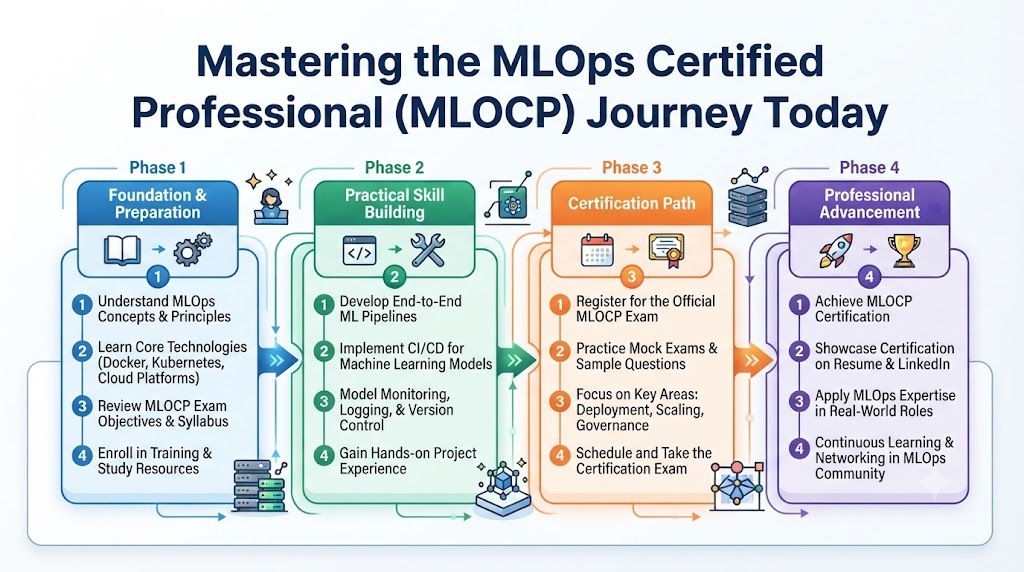
Introduction
The MLOps Certified Professional (MLOCP) is an advanced accreditation designed to bridge the gap between data science and traditional software delivery. As organizations increasingly adopt artificial intelligence, engineering teams face the challenge of moving machine learning models out of isolated notebooks and into scalable production environments. This guide is built for software engineers, site reliability engineers, cloud platform specialists, and engineering managers aiming to validate their expertise in modern AI infrastructure. By exploring this framework on Devosschool.com, technical professionals can make informed career decisions, optimize their learning paths, and master production-grade automation workflows.
What is the MLOps Certified Professional (MLOCP)?
The MLOps Certified Professional (MLOCP) represents a rigorous standard for designing, deploying, and maintaining machine learning systems at scale. It exists because building an accurate model is only half the battle; ensuring that model runs reliably, securely, and efficiently in production requires specialized operations practices. This program emphasizes hands-on, production-focused engineering over abstract academic theory, ensuring participants learn real-world architecture. It aligns directly with modern cloud-native workflows, container orchestration platforms, and automated continuous integration frameworks used by high-performing engineering enterprises.
Who Should Pursue MLOps Certified Professional (MLOCP)?
This credential targets software engineers, DevOps practitioners, infrastructure architects, and data platform specialists who handle complex deployment pipelines. Engineering managers and technical leaders also benefit by gaining the structural insight needed to oversee cross-functional AI initiatives effectively. Beginners with a solid background in cloud computing or software development find a clear roadmap into artificial intelligence operations. Experienced professionals across global technology sectors, including a rapidly expanding market in India, leverage this credential to validate specialized infrastructure competencies.
Why MLOps Certified Professional (MLOCP) is Valuable
Enterprise adoption of machine learning has accelerated dramatically, creating an unprecedented demand for engineers who understand infrastructure automation. This certification ensures longevity in a fast-changing technical landscape by focusing on core engineering principles rather than transient software tools. Professionals who earn this credential demonstrate a high return on investment of time by commanding higher responsibilities and leadership roles in cloud platform teams. Mastering these competencies helps organizations reduce model deployment failures, eliminate operational bottlenecks, and streamline collaboration between data scientists and operations personnel.
MLOps Certified Professional (MLOCP) Certification Overview
The program is delivered via specialized official training platforms and hosted on Devosschool.com. The certification framework includes tiered progression levels that accommodate both newcomers and seasoned system architects. Its assessment approach relies heavily on practical problem-solving scenarios, architectural evaluations, and real-world lab tasks rather than rote memorization. Ownership of the standard rests with seasoned engineering bodies focused on bridging the divide between software delivery and data workloads.
MLOps Certified Professional (MLOCP) Certification Tracks & Levels
The curriculum features foundation, professional, and advanced tiers designed to match progressive career milestones. Specialization tracks branch into specialized domains such as continuous integration for data, infrastructure reliability, and security compliance. Foundation levels establish basic terminology, workflow concepts, and lifecycle understanding for junior practitioners. Professional and advanced tiers target implementation automation, cluster orchestration, multi-tenant governance, and enterprise-grade cost optimization.
Detailed Guide for Each MLOps Certified Professional (MLOCP) Certification
MLOps Certified Professional (MLOCP) – Foundation Level
What it is
This entry-level validation confirms a candidate's grasp of foundational machine learning lifecycle concepts and operational terminology.
Who should take it
Junior software engineers, transitioning support staff, and technical project managers looking to understand AI infrastructure basics.
Skills you’ll gain
- Understanding the differences between traditional software lifecycles and machine learning pipelines
- Core data versioning and model tracking fundamentals
- Familiarity with standard industry terminology and tool categories
- Basic comprehension of reproducibility challenges in data science
Real-world projects you should be able to do
- Map out a complete model-to-market workflow for an enterprise application
- Document data lineage and artifact tracking requirements for a pilot project
Preparation plan
- 7 to 14 days: Review fundamental documentation, glossaries, and core workflow definitions.
- 30 days: Complete introductory guided labs and pass baseline practice assessments.
- 60 days: Extended self-paced study for candidates transitioning from non-technical backgrounds.
Common mistakes
- Treating machine learning models like static web application binaries.
- Neglecting the importance of data quality and version control.
Best next certification after this
- Same-track option: MLOps Professional Tier
- Cross-track option: DataOps Foundation
- Leadership option: Technical Project Management Essentials
MLOps Certified Professional (MLOCP) – Professional Level
What it is
This credential validates an engineer's capability to build, automate, and monitor production-grade machine learning pipelines.
Who should take it
Practicing DevOps engineers, cloud administrators, and machine learning practitioners with hands-on scripting experience.
Skills you’ll gain
- Building automated continuous integration and deployment pipelines for models
- Implementing drift detection, logging, and performance monitoring alerts
- Managing feature stores and data ingestion workflows at scale
- Configuring containerized environments using Docker and orchestration tools
Real-world projects you should be able to do
- Deploy a trained classification model using an automated container pipeline
- Configure automated performance tracking and model retraining triggers using MLflow
Preparation plan
- 7 to 14 days: Intensive pipeline automation lab sprints and tool configuration practice.
- 30 days: Deep dives into container packaging, registry management, and tracking servers.
- 60 days: End-to-end portfolio project construction covering continuous integration and deployment.
Common mistakes
- Hardcoding paths and configurations inside model deployment scripts.
- Failing to establish automated testing for data payloads entering the model.
Best next certification after this
- Same-track option: MLOps Advanced Architect
- Cross-track option: DevSecOps Professional
- Leadership option: Certified DevOps Manager
Choose Your Learning Path
DevOps Path
The DevOps path focuses heavily on rapid software delivery speed and system automation. Learners master source control, continuous integration servers, and infrastructure as code tools. It ensures that deployment pipelines remain resilient, testable, and completely repeatable across environments. Engineers use this track to eliminate manual friction from code commit to production release.
DevSecOps Path
The DevSecOps path embeds security controls into every phase of the software delivery lifecycle. Participants learn vulnerability scanning, automated compliance auditing, and secure secret management practices. This approach ensures that security is never treated as a late-stage bottleneck. Organizations rely on this track to protect sensitive data and safeguard complex infrastructure against cyber threats.
SRE Path
The Site Reliability Engineering path prioritizes production uptime, system scalability, and incident response. Engineers study service level objectives, error budgets, and automated root-cause analysis techniques. This track provides the methods required to keep large-scale distributed systems running reliably. Practitioners learn how to transform operational friction into automated, self-healing architecture.
AIOps / MLOps Path
The AIOps and MLOps path targets the intersection of artificial intelligence and operational infrastructure. Professionals learn how to scale machine learning models and apply intelligent analytics to system logs. This track bridges data science innovation with rigorous production engineering standards. It equips teams to build high-performance data factories that power modern enterprise applications.
DataOps Path
The DataOps path emphasizes streamlining information flow across analytical and operational databases. Learners focus on data pipeline orchestration, quality testing, and efficient cataloging. This track ensures that analytics teams receive clean, reliable data without unnecessary latency. Mastering these principles prevents downstream machine learning failures caused by corrupted training inputs.
FinOps Path
The FinOps path centers on cloud financial management and cost optimization strategies. Practitioners learn how to attribute cloud spending, eliminate resource waste, and right-size infrastructure. This track helps organizations prevent unexpected cloud bills during heavy machine learning training cycles. It aligns technical architecture decisions closely with enterprise budget governance.
Next Certifications to Take After MLOps Certified Professional (MLOCP)
Same Track Progression
Deepening specialization within the operations ecosystem involves pursuing advanced architecture credentials or niche infrastructure domains. Engineers transition from building pipelines to designing multi-tenant enterprise AI platforms that serve hundreds of internal teams. This path establishes technical authority and prepares professionals for principal engineering roles.
Cross-Track Expansion
Broadening technical capabilities requires exploring complementary disciplines like security automation or large-scale data engineering. Combining machine learning operations with rigorous security frameworks creates multi-disciplinary experts who protect sensitive model assets. This versatility makes engineers exceptionally valuable across dynamic, cross-functional organizational structures.
Leadership & Management Track
Transitioning into executive leadership involves shifting focus toward strategy, team culture, governance, and budget accountability. Managers learn how to measure delivery metrics, maximize return on technology investments, and scale engineering organizations effectively. This progression allows senior professionals to guide corporate technology direction rather than executing individual scripts.
Training & Certification Support Providers for MLOps Certified Professional (MLOCP)
The Core Platform Authority
The core platform authority driving technical excellence across modern infrastructure programs is deeply anchored in specialized ecosystem education. DevOpsSchool stands out globally by delivering rigorous, instructor-led training tailored for real-world engineering challenges rather than surface-level theory. Complementing this, Cotocus offers boutique, highly practical sessions customized for working technical professionals. Meanwhile, Scmgalaxy acts as an extensive community resource hub supplying technical guides, peer discussions, and continuous learning material. BestDevOps emphasizes industry-standard methodologies, updating its curricula constantly to reflect emerging paradigms like large language model operations. Additionally, specialized portals like devsecopsschool.com, sreschool.com, aiopsschool.com, dataopsschool.com, and Devosschool.com form a comprehensive network dedicated to advancing specialized operational engineering disciplines worldwide.
Frequently Asked Questions
How difficult is the certification exam for working engineers?
The assessment is designed to test practical execution rather than rote memory, making it moderately challenging for those without hands-on lab experience.
What are the formal prerequisites before enrolling?
Candidates should possess a working knowledge of Python, Git version control, and basic cloud infrastructure principles.
How much study time should I allocate weekly?
Allocating 5 to 8 hours per week typically allows working professionals to complete the preparation track comfortably within a month.
What is the typical return on investment for career growth?
Certified professionals frequently report smoother transitions into high-demand AI platform roles and improved earning potential.
Is there a specific learning sequence to follow?
Starting with foundational workflow concepts before moving into automated pipeline tools ensures steady, frustration-free progress.
Can beginners without prior data science experience join?
Yes, because the focus remains on infrastructure, automation, and pipeline plumbing rather than advanced mathematical modeling.
How are the practical labs structured?
Labs emulate live enterprise environments, focusing on container deployment, metric tracking, and automated testing scripts.
Are these credentials recognized globally?
Yes, enterprise teams across North America, Europe, and Asia actively look for these production-validated engineering credentials.
Does the curriculum cover modern container orchestration?
Comprehensive modules integrate Kubernetes and Docker specifically tailored for handling heavy machine learning workloads.
How often is the course content updated?
Curricula are updated continuously to reflect rapid changes in cloud-native tool ecosystems and operational best practices.
What kind of post-training support is available?
Learners gain access to community forums, code repositories, and technical reference libraries hosted across the provider network.
How do employers verify certificate authenticity?
Each credential issues a secure, verifiable digital badge linked directly to the official platform registry.
FAQs on MLOps Certified Professional (MLOCP)
Do I need a PhD in mathematics to succeed in this program?
No, the curriculum focuses on pipeline engineering, containerization, and automation rather than inventing neural network algorithms.
What are the primary software tools taught during the sessions?
Common tools include MLflow for experiment tracking, Docker and Kubernetes for packaging, and standard CI/CD engines for automation.
How does this differ from standard software DevOps certifications?
While standard DevOps handles web applications, this program addresses data versioning, model drift detection, and heavy inference scaling.
Is experience with cloud providers like AWS or Azure mandatory?
Familiarity with cloud environments helps, but core automation principles can be practiced on local virtualization tools as well.
How do teams handle model retraining automation in the labs?
Labs teach how to configure event-driven pipelines that trigger retraining scripts when input data characteristics change significantly.
What role does security play within the curriculum?
Security modules address artifact scanning, access governance, and protecting sensitive model weights from unauthorized extraction.
How can engineering managers utilize this certification?
Managers use the structural frameworks learned to establish standardized review gates and deployment policies across data teams.
What is the best way to showcase this credential to recruiters?
Highlighting practical lab projects, container repositories, and automated pipeline implementations on professional profiles yields the best results.
Final Thoughts
Embarking on the MLOps Certified Professional (MLOCP) journey provides a structured pathway to mastering the operational side of artificial intelligence. Success in modern engineering relies less on writing isolated code and more on building robust, self-sustaining systems that scale seamlessly. By committing to hands-on lab practice and focusing on real-world production challenges, engineers position themselves at the forefront of cloud-native infrastructure innovation. Choosing this path equips technical professionals with the enduring skills needed to build reliable AI factories for the modern enterprise.






Top comments (0)