

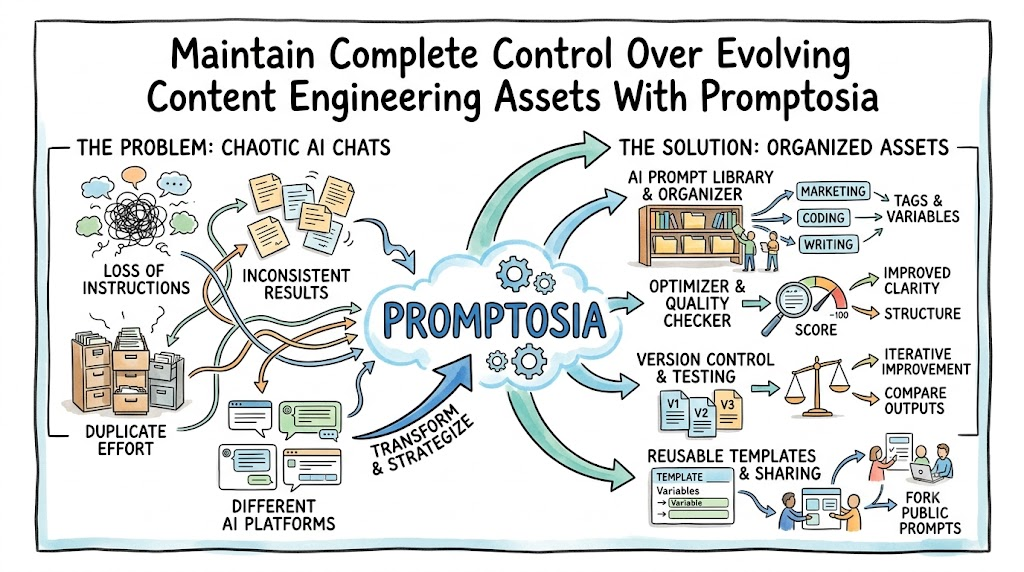
Introduction
Working with modern artificial intelligence models often feels like a double-edged sword for digital creators, writers, and technical professionals. On one hand, generative software delivers incredible assistance across writing, coding, analysis, and creative strategy tasks. On the other hand, finding that exact phrasing that produced a brilliant result yesterday usually turns into a frustrating treasure hunt. Most people scatter their best instructions across forgotten chat logs, temporary text files, crowded browser tabs, personal email drafts, and sticky notes.
This chaotic habit forces users to constantly rewrite instructions from scratch, wasting valuable creative energy and yielding wildly unpredictable outputs. When you reconstruct a complex query from memory, you inevitably miss crucial context, specific formatting rules, or stylistic nuances that made the original output successful. Recognizing this universal inefficiency, platforms like Promptosia have emerged to help users transform scattered instructions into structured, reusable, and easily accessible digital assets. By providing a dedicated space to organize, optimize, and test instructions, this platform bridges the gap between chaotic AI interactions and reliable, repeatable productivity.
Why AI Prompt Management Matters
Treating AI instructions as valuable digital assets is a fundamental shift that separates casual experimentation from professional productivity. When you craft an instruction that perfectly guides an engine to format complex code, write in your brand voice, or analyze financial datasets, that instruction becomes intellectual property. Leaving such valuable assets buried in disappearing chat histories wastes time and undermines the consistency required for high-quality professional output.
Establishing a disciplined approach to managing these assets ensures that every interaction builds upon past successes rather than starting from zero. Organized collections allow individuals and collaborative teams to standardize their workflows, eliminate redundant effort, and maintain strict quality standards across all projects. Furthermore, systematic organization transforms individual discoveries into shared organizational knowledge, enabling everyone on a team to achieve the same high-standard results effortlessly.
What is Promptosia?
Promptosia is a comprehensive prompt engineering platform designed to streamline how individuals, creators, technical experts, and collaborative organizations handle their AI instructions. Instead of letting powerful queries disappear into endless chat scrolls, the platform offers a centralized hub to store, refine, analyze, version, and share high-performing instructions. It was created to solve the widespread frustration of lost context and inconsistent outputs, helping users build structured collections that serve diverse tasks ranging from academic research to software development.
By framing queries as living resources rather than disposable text snippets, the system supports the complete lifecycle of an instruction from initial brainstorm to fully tested, production-ready asset. The platform caters to anyone seeking consistency in their AI workflows, offering tools to fine-tune phrasing, evaluate performance through detailed quality metrics, and track modifications over time without overwriting previous successes.
Understanding an AI Prompt Library
An AI prompt library acts as a centralized repository where instructions are systematically classified, documented, and stored for immediate retrieval. Rather than sifting through hundreds of past conversations, users can leverage structured categories, custom tags, and dynamic variables to organize their growing collection. Categories establish broad domains such as marketing, software engineering, or creative writing, while targeted tags offer granular filtering for specific sub-tasks or target models.
Incorporating dynamic variables allows a single instruction to adapt to multiple situations without manual retyping, preserving the core structure while swapping out specific input details. Robust search capabilities ensure that high-performing assets are always seconds away, dramatically accelerating daily output and eliminating repetitive guesswork across various generative platforms.
AI Prompt Organizer
Using an AI prompt organizer prevents digital clutter and stops teams from duplicating work that has already been perfected. By categorizing instructions into intuitive folders, tag systems, and customized collections, users maintain complete clarity over their growing repository of assets. This structural clarity ensures that whether you are drafting a quick email or executing a complex multi-step data analysis, the ideal phrasing is immediately accessible.
Organizers also preserve context, allowing you to attach notes, intended use cases, and specific model settings directly to each saved entry. This level of order transforms a chaotic list of notes into an efficient operational hub, giving users full confidence that their generative software will yield predictable, high-caliber results every time.
AI Prompt Optimizer
An AI prompt optimizer refines raw, vague, or hastily typed ideas into clear, highly structured, and effective instructions. Most initial ideas suffer from ambiguous language, missing context, or poorly defined output expectations, which inevitably confuse generative models. The optimization process analyzes the core intent of a rough concept and automatically enhances its structural clarity, adding necessary constraints, persona parameters, and output formatting guidelines.
This automated enhancement transforms basic requests into sophisticated assets without requiring users to spend hours studying manual engineering techniques. By converting simple thoughts into precise instructions, optimization guarantees that artificial intelligence engines receive the exact guidance needed to produce top-tier responses on the very first attempt.
AI Prompt Analyzer
An AI prompt analyzer evaluates the underlying components of an instruction to ensure it contains all necessary elements for optimal performance. This analytical process dissects a query to inspect its overall objective, variable placement, target persona, tone of voice, safety considerations, and structural constraints. By examining these structural dimensions, the analyzer highlights missing context or potential ambiguities before you ever run the query through a generative model.
Understanding these foundational dynamics empowers users to construct well-rounded instructions that consistently communicate intent. Furthermore, deep structural analysis helps identify potential safety risks or biased language, ensuring that generated content remains professional, compliant, and perfectly aligned with project specifications across all applications.
Prompt Quality Checker
A dedicated prompt quality checker provides objective feedback on how well an instruction is constructed before it is deployed in real workflows. By scrutinizing factors such as linguistic clarity, contextual depth, output definition, and reusability, the checker assigns an actionable quality score to guide immediate improvements. This systematic evaluation removes the guesswork from crafting instructions, showing users exactly where a query lacks specificity or structural strength.
Identifying weak points early prevents wasted API credits, reduces back-and-forth conversational corrections, and guarantees higher reliability. Utilizing a reliable quality evaluation tool ensures that only thoroughly vetted, high-performing instructions make their way into your permanent personal or team collections.
Prompt Version Control
A robust prompt version control tool allows users to track edits, preserve historical iterations, and refine instructions over time without losing past working configurations. As artificial intelligence models evolve, an instruction that worked perfectly yesterday might require minor tweaks to maintain its effectiveness today. Version tracking ensures that every modification is safely recorded, enabling creators to compare older outputs against newer revisions side by side.
If a fresh edit yields unsatisfactory results, users can effortlessly roll back to a previous baseline version with complete peace of mind. This structured iteration history encourages continuous experimentation, empowering users to continuously fine-tune their assets while maintaining a permanent record of what works best.
AI Prompt Testing
Comprehensive AI prompt testing involves running different instruction variations against identical queries to evaluate output quality, tone, and accuracy. Testing allows creators to observe how minor shifts in vocabulary, formatting constraints, or persona assignments dramatically alter the generated response. By comparing outputs side by side, users can make data-driven decisions about which phrasing delivers the most consistent and accurate outcome.
This experimental phase is critical before rolling out instructions across automated pipelines, customer service bots, or client-facing content workflows. Systematic testing eliminates trial-and-error during live tasks, giving professionals absolute confidence that their final selected instruction will perform flawlessly under varying operational conditions.
Reusable AI Prompt Templates
Reusable AI prompt templates provide standardized frameworks that eliminate the need to rebuild complex instructions from scratch for recurring tasks. These templates utilize flexible placeholders for variables, enabling users to swap out target subjects, audience demographics, or data inputs while maintaining a proven structural foundation. Standardization ensures that content generation remains consistent across an entire organization, regardless of who executes the request.
Whether generating weekly status reports, drafting code documentation, or crafting marketing copy, templates save immense amounts of time and preserve brand voice. Relying on verified templates transforms daily operational routines, allowing professionals to execute complex generative tasks in a fraction of the usual time.
Step-by-Step Guide to Managing AI Prompts
- Identify Repetitive Tasks: Map out daily operational routines, writing assignments, or coding workflows that frequently require generative assistance to uncover opportunities for standardization.
- Draft Initial Instruction: Compose a basic query outlining the core task, primary goal, and essential details required to generate an acceptable initial response.
- Refine Structural Clarity: Enhance the raw text by incorporating precise personas, explicit context, defined output formats, and necessary negative constraints.
- Categorize and Tag: Assign the polished query to a relevant functional category and attach targeted descriptive tags to make future search and retrieval effortless.
- Integrate Dynamic Variables: Replace static words with customizable placeholders, allowing the instruction to adapt quickly to varying inputs without altering its core structure.
- Test Across Models: Run the instruction through multiple scenarios and models to evaluate consistency, formatting compliance, and overall response accuracy.
- Track Version Iterations: Save new revisions as distinct historical entries whenever modifications are made, preserving past functional baseline configurations for easy rollback.
- Review and Improve: Periodically re-evaluate stored assets against updated project requirements and new model releases to maintain continuous optimization across your collection.
Who Can Benefit?
- Writers: Overcome creative blocks, structure complex book outlines, and maintain consistent character voices without manually re-entering style guides for every new chapter.
- Bloggers: Streamline keyword research, draft engaging post headlines, generate article outlines, and convert lengthy research summaries into structured long-form content efficiently.
- Developers: Standardize code refactoring requests, generate accurate documentation, automate bug hunting, and build repeatable unit test queries across various programming languages.
- Students: Summarize dense academic papers, create targeted study flashcards, generate practice quiz questions, and outline research papers while preserving proper academic formatting.
- Researchers: Synthesize complex literature, organize cross-disciplinary data, extract key statistical findings, and format extensive research bibliographies rapidly with high structural precision.
- Educators: Design interactive lesson plans, generate diverse student assignment rubrics, build customized reading comprehension exercises, and craft personalized feedback templates effortlessly.
- Digital Marketers: Produce compelling ad copy variations, draft email newsletter sequences, build target persona profiles, and optimize promotional campaign strategies with perfect brand alignment.
- Businesses: Standardize internal communication templates, automate customer support response drafts, streamline policy documentation, and maintain brand voice across all department outputs.
- Content Creators: Generate video script outlines, craft eye-catching social media captions, summarize podcast transcripts, and brainstorm fresh audience engagement ideas quickly.
- Teams: Centralize organizational knowledge, share top-performing operational instructions, eliminate duplicate workflow efforts, and guarantee consistent operational quality across all active projects.
Real-Life Scenarios
Scenario 1: Scaling Content Marketing Campaigns
- Problem: A digital marketing team spends hours rewriting background context and tone rules every time they generate new social media copy, leading to inconsistent brand representation across channels.
- Practical Approach: The team stores a master campaign query in an organized repository with variable fields for product names, target audiences, and specific call-to-action details.
- Outcome: Team members instantly generate perfectly aligned campaign copy in seconds, reducing content creation time by half while maintaining strict brand consistency.
Scenario 2: Standardizing Code Documentation
- Problem: Software developers in a growing startup document their code inconsistently, creating confusion during peer reviews and onboarding new engineering hires.
- Practical Approach: The lead architect designs a reusable documentation template containing explicit formatting constraints and saves it in a shared technical library.
- Outcome: All developers generate standardized inline comments and comprehensive structural summaries effortlessly, accelerating code reviews and improving overall codebase maintainability.
Scenario 3: Streamlining Academic Research Synthesis
- Problem: A university researcher struggles to maintain consistent formatting when extracting methodology details and key statistical findings from dozens of long journal articles.
- Practical Approach: The researcher builds an optimized extraction instruction featuring dynamic fields for article text and specific analytical parameters.
- Outcome: The researcher rapidly processes dense academic papers into structured summary tables, saving countless hours during literature review preparation.
Scenario 4: Managing Customer Support Escalations
- Problem: Support agents craft manual responses to complex technical inquiries, resulting in varying response quality, incorrect details, and long resolution times for customers.
- Practical Approach: Operations leadership creates a collection of verified, quality-checked support instructions featuring dynamic placeholders for customer names and ticket details.
- Outcome: Support representatives quickly draft accurate, empathetic, and professionally aligned responses, significantly lowering ticket resolution times and boosting customer satisfaction scores.
Scenario 5: Refining Product Description Generation
- Problem: An e-commerce seller needs to generate hundreds of product descriptions but finds that basic queries yield generic, repetitive, and uninspiring web content.
- Practical Approach: The seller uses an analytical optimizer tool to refine their query, adding tone parameters, sensory language guidelines, and SEO keyword placeholders.
- Outcome: The seller generates unique, persuasive product descriptions at scale, improving search engine visibility and driving higher conversion rates on their storefront.
Common Mistakes to Avoid
- Saving Prompts Randomly: Storing instructions without logical folder structures or consistent tagging turns your repository into a cluttered digital graveyard, making search impossible.
- Rewriting Prompts Repeatedly: Wastefully drafting fresh queries from scratch for routine daily tasks leads to inconsistent outputs and severe loss of operational time.
- Ignoring Version History: Overwriting proven queries during minor experiments prevents you from restoring successful baseline configurations when new edits fail to perform.
- Using Vague Instructions: Leaving out context, explicit personas, target audience definitions, or structural output constraints guarantees erratic and low-quality responses.
- Not Testing Prompts: Deploying unverified queries directly into critical workflows risks generating inaccurate information, awkward phrasing, or severe formatting errors in production.
- Mixing Unrelated Prompts: Combining multiple distinct, unrelated tasks into a single giant instruction confuses the language model and degrades overall response quality.
- Ignoring Quality Metrics: Assuming every written query is immediately optimal without checking its structural clarity leads to unpredictable results and wasted model processing.
- Forgetting Context: Omitting vital background details or target constraints forces the generative engine to make assumptions, often yielding irrelevant or off-target results.
- Keeping Assets Disorganized: Failing to review, prune, and reorganize your prompt library periodically causes outdated, inefficient instructions to linger alongside active, optimized assets.
AI Prompt Management Features and Their Purpose
| Feature | Why It Matters | Practical Benefit |
|---|---|---|
| Centralized Library | Eliminates scattered notes by gathering every instruction into a single accessible repository. | Saves time by making top-performing queries instantly searchable and accessible from anywhere. |
| Dynamic Variables | Allows a single structural framework to adapt to changing inputs without manual retyping. | Increases versatility and prevents users from creating dozens of nearly identical duplicate entries. |
| Version Tracking | Preserves historical iterations so users can experiment freely without destroying working setups. | Enables instant rollbacks to baseline configurations whenever new query edits fail to perform. |
| Quality Evaluation | Analyzes structural clarity and completeness to score query effectiveness before deployment. | Reduces wasted API credits and conversation cycles by fixing instruction weaknesses upfront. |
Characteristics of a High-Quality AI Prompt
| Factor | Why It Is Important | Practical Tip |
|---|---|---|
| Role Persona | Establishes the specific perspective, expertise level, and professional voice the model should adopt. | Assign an explicit role at the beginning, such as expert copywriter or senior developer. |
| Explicit Context | Provides necessary background information so the model does not make inaccurate assumptions. | Supply relevant project details, target audience nuances, and specific underlying objectives clearly. |
| Defined Output Format | Dictates the exact layout, structure, and visual presentation required for the generated content. | Specify desired outputs explicitly, such as bulleted lists, Markdown tables, or short paragraphs. |
| Negative Constraints | Restricts unwanted topics, phrases, or stylistic choices to keep responses focused and accurate. | State clearly what the model must avoid, such as jargon, overly complex words, or fluff. |
Benefits of Managing AI Prompts
- Saves Time: Eliminates the frustrating need to reconstruct complex instructions from memory every time you start a new conversational session.
- Improves Consistency: Ensures that outputs maintain uniform tone, style, and formatting across multiple projects, tasks, and team members.
- Reduces Repeated Work: Prevents individuals and team colleagues from spending hours solving operational phrasing challenges that were already solved in past projects.
- Makes Collaboration Easier: Enables seamless sharing of proven, high-performing instructions across teams, establishing standardized operational knowledge across departments.
- Encourages Prompt Reuse: Transforms disposable text snippets into permanent digital assets that deliver compounding productivity value over long time horizons.
- Improves Organization: Replaces chaotic text documents, browser tabs, and sticky notes with a clean, structured, and fully searchable operational system.
- Supports Continuous Improvement: Fosters an experimental environment where queries are systematically tested, rated, versioned, and refined to achieve higher output performance over time.
FAQ Section
1. What is an AI prompt management tool?
An AI prompt management tool is a specialized software application designed to help users store, organize, refine, version, and share the text instructions they feed into artificial intelligence models. Instead of keeping queries scattered across personal notes or lost in chat logs, these platforms offer a structured environment to build an accessible library of reusable assets.
2. How does organizing AI prompts save time in daily workflows?
Organizing queries into categorized folders with descriptive tags allows users to locate proven, high-performing instructions within seconds. This eliminates the need to constantly draft requests from scratch, guess effective phrasing, or spend time correcting vague outputs, drastically accelerating overall daily productivity.
3. Why should I use dynamic variables in my saved prompts?
Dynamic variables act as flexible placeholders within a standardized instruction framework. By using variables for changing details like product names, target demographics, or word counts, you can reuse a single master query for diverse tasks without needing to rewrite the surrounding structure every time.
4. What is the benefit of a prompt version control tool?
A version control system records every modification made to an instruction over time. This historical tracking allows you to experiment with new phrasing or constraints without losing past working configurations, making it effortless to compare output differences or revert to a previous baseline whenever necessary.
5. How does a prompt quality checker improve generated results?
A quality checker evaluates your instruction's structural clarity, context depth, and formatting guidelines before you run it. By identifying missing details or ambiguous wording upfront, the tool helps you refine the query to ensure the artificial intelligence engine delivers accurate, high-quality responses on the first try.
6. Can teams collaborate using an AI prompt engineering platform?
Yes, modern management platforms allow teams to build shared repositories where members can publish verified templates, copy effective queries, and fork existing assets into personal collections. This shared access standardizes operational output and ensures everyone adheres to identical quality standards across projects.
7. What makes a prompt template reusable?
A template becomes reusable when it is stripped of project-specific static data and built with clear parameters, explicit context constraints, and flexible variable placeholders. This clean structural design allows anyone to plug in fresh parameters while consistently achieving predictable, high-standard results.
8. How does an AI prompt optimizer work?
An optimizer analyzes rough, unformatted, or vague text instructions and enhances their structural composition. It automatically incorporates useful persona parameters, contextual depth, output constraints, and clear formatting rules, transforming a simple request into a sophisticated, highly effective asset.
9. What is the difference between a prompt organizer and a chat history log?
A chat history log is simply a chronological scroll of past interactions that is hard to search and easily buried. A prompt organizer is a dedicated, structured database where instructions are actively classified, tagged, versioned, optimized, and prepared for repeatable future use across different sessions.
10. Why is prompt engineering considered an ongoing process?
Artificial intelligence models constantly evolve, requiring queries to be periodically adapted, tested, and fine-tuned to maintain optimal performance. Treating instructions as living assets that undergo continuous testing and versioning ensures your generative workflows remain effective, efficient, and aligned with updated goals.
Conclusion
Managing artificial intelligence instructions efficiently is no longer just a clever trick for tech enthusiasts; it is a vital operational necessity for modern professionals, creators, and technical teams. Treating instructions as disposable text snippets leads to wasted time, constant frustration, and erratic output quality. By adopting a systematic approach to organizing, optimizing, analyzing, testing, and versioning your assets, you turn everyday queries into powerful, repeatable resources that consistently deliver high-value results. Platforms like Promptosia provide the modern infrastructure needed to transform scattered ideas into a structured, shared library, enabling individuals and organizations to stop starting from scratch and begin building long-term digital value. Take a moment today to review your current generative habits, gather your scattered text notes, and start organizing your prompts into a streamlined operational hub.






Top comments (0)