

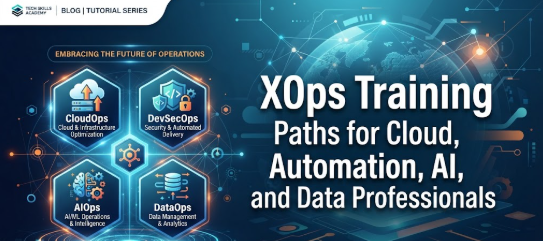
Modern technology teams work across a wide array of specialized domains. Software development, cloud infrastructure, data pipelines, machine learning models, security, and reliability all require dedicated attention.
However, as systems grow more complex, treating these domains as isolated silos creates operational friction. When development teams push code without considering infrastructure limits, or data engineers build pipelines without visibility into underlying cloud costs, organizations experience delays, reliability issues, and inefficient resource usage.
To solve these challenges, the technology industry has moved toward an umbrella approach known as XOps.
Platforms like XOpsSchool serve as centralized learning hubs designed to help engineers, developers, and IT professionals understand how these diverse operational disciplines connect into a unified, efficient workflow.
What is XOps?
At its core, What is XOps comes down to an overarching strategy for modern IT operations. The "X" acts as a variable representing various operational practices—such as DevOps, DataOps, MLOps, AIOps, SecOps, and FinOps.
Instead of treating each discipline as a completely separate island, XOps connects them through shared automation, standardized processes, and continuous feedback loops.
Rather than viewing operations as a single monolithic tool, XOps is a cultural and technical framework. It encourages organizations to apply proven automation and continuous delivery principles across applications, infrastructure, data workflows, and artificial intelligence initiatives.
By unifying these practices, teams can reduce bottlenecks, improve system observability, and respond faster to operational challenges.
Why XOps Matters in Modern IT
Organizations increasingly rely on distributed cloud environments where software, data, and machine learning models interact constantly. Disconnected operational processes often lead to severe challenges:
- Siloed teams struggle to troubleshoot complex production incidents.
- Inconsistent deployment practices increase security vulnerabilities.
- Unmonitored cloud spending spirals out of control.
- Data quality issues break downstream machine learning applications.
XOps thinking addresses these issues by promoting collaboration, automation, observability, and continuous improvement.
When infrastructure, security, data pipelines, and application delivery share a common operational mindset, teams can standardize their workflows, maintain higher reliability, and govern resources effectively.
Major XOps Disciplines
XOps encompasses several critical operational branches. Understanding how they function individually and collectively is essential for modern technical professionals.
DevOps
DevOps focuses on software delivery, CI/CD pipelines, containerization, and infrastructure automation. It bridges the traditional gap between software developers and IT operations teams, enabling faster and safer code releases.
DataOps
DataOps applies agile and automation principles to data engineering. It ensures reliable data pipelines, rigorous data quality checks, seamless orchestration, and continuous data delivery for analytics and machine learning.
MLOps
MLOps manages the machine learning model lifecycle. It covers model deployment, version control, automated testing, performance monitoring, and model maintenance in production environments.
AIOps
AIOps leverages artificial intelligence and machine learning to enhance IT operations. It supports automated monitoring, anomaly detection, event correlation, and intelligent incident analysis.
SecOps
SecOps integrates security practices directly into operational workflows, ensuring that security is a continuous part of development, deployment, and infrastructure management rather than an afterthought.
FinOps
FinOps brings financial accountability to cloud computing. It helps teams track, analyze, and optimize cloud and technology costs as part of daily operational decision-making.
Platform Engineering
Platform engineering builds internal developer platforms and self-service capabilities, providing reusable infrastructure and standardized workflows that empower development teams.
XOps Training
Structured XOps Training programs are essential for professionals looking to master these connected operational fields. A well-designed learning path typically covers:
- XOps fundamentals and core operational philosophy
- DevOps foundations, including CI/CD and container orchestration
- Cloud infrastructure management and automation
- Data operations and pipeline reliability
- Machine-learning and AI-driven operations
- Observability, monitoring, and incident management
- Security, governance, and cost optimization
Understanding the relationships between these areas helps engineers transition from specialized practitioners to versatile technical leaders.
XOps Certification
Technical certifications help professionals validate their knowledge and structure their learning journey. Preparing for an XOps Certification allows learners to organize complex concepts, follow a structured syllabus, test their understanding, and identify knowledge gaps.
It is important to remember that certification alone does not equal practical expertise. Certifications serve best as benchmarks for theoretical understanding and foundational knowledge, which must be reinforced through hands-on practice and real-world implementation.
XOps Course
Choosing the right XOps Course depends on starting with a logical curriculum progression. A comprehensive learning program typically moves through these stages:
- Introduction to XOps principles and the "X" umbrella concept
- Core DevOps concepts and version control
- Cloud infrastructure and automation fundamentals
- Containerization and orchestration with Kubernetes
- Data operations and pipeline management
- Machine learning and AI operations workflows
- Observability, metrics, logs, and reliability engineering
- Security governance and FinOps basics
- Integration strategies for multiple operational areas
Learners should choose course depth according to their existing technical background and career goals.
XOps Tutorial
An effective XOps Tutorial bridges the gap between theoretical knowledge and practical execution. Practical tutorials help learners understand configuration, automation, container management, data pipelines, and monitoring setups.
While reading a tutorial provides valuable direction, true technical proficiency comes from experimenting with the concepts in a sandbox environment and troubleshooting configuration challenges firsthand.
XOps Tools
XOps is not a single tool, but rather a methodology enabled by a diverse ecosystem of technologies.
| Operational Focus | Common Tool Categories | Example Technologies |
|---|---|---|
| Source Control | Collaboration & Versioning | Git, GitHub, GitLab |
| CI/CD | Pipeline Automation | Jenkins, GitHub Actions, GitLab CI/CD |
| Containers & Orchestration | Deployment & Scaling | Docker, Kubernetes, Helm |
| Infrastructure Automation | Infrastructure as Code | Terraform, Ansible |
| Observability | Monitoring & Metrics | Prometheus, Grafana, OpenTelemetry |
| GitOps | Declarative Delivery | Argo CD, Flux |
| Data Operations | Pipeline Orchestration | Airflow, dbt |
| MLOps | Model Lifecycle Management | MLflow, Kubeflow |
Tool selection should always depend on specific technical architecture, team skills, security requirements, and organizational scale rather than industry popularity alone.
DevOps Training
Because DevOps forms the foundational bedrock of modern software delivery, comprehensive DevOps Training is a mandatory stepping stone for any XOps journey.
It teaches core competencies like version control, continuous integration, continuous delivery, containerization, infrastructure as code, and automated testing. Mastering these fundamentals makes it much easier to expand into specialized areas like DataOps, MLOps, and platform engineering.
AIOps Training
Effective AIOps Training helps operations teams manage the overwhelming volume of alerts generated by modern cloud-native environments.
By focusing on machine learning-driven monitoring, automated anomaly detection, event correlation, and intelligent incident analysis, AIOps training teaches engineers how to filter noise and focus on resolving genuine system issues.
MLOps Training
Specialized MLOps Training connects the worlds of data science and software engineering. It focuses on the machine learning lifecycle, covering model versioning, automated testing, continuous training pipelines, model deployment, and production monitoring to ensure machine learning models remain accurate and reliable over time.
DataOps Training
Through focused DataOps Training, data engineers and analysts learn how to apply agile principles to data management.
This training covers reliable data pipeline creation, automated quality testing, data orchestration, continuous data delivery, and data observability to ensure downstream analytics and applications receive clean, trustworthy data.
| XOps Discipline | Main Focus | Common Learning Areas |
|---|---|---|
| DevOps | Application delivery & infrastructure | CI/CD, Docker, Kubernetes, Terraform |
| DataOps | Reliable data pipelines & quality | Orchestration, data testing, observability |
| MLOps | Machine learning lifecycle management | Model deployment, versioning, monitoring |
| AIOps | AI-assisted IT operations | Anomaly detection, alert correlation |
| SecOps | Security integration in operations | Compliance, vulnerability management |
| FinOps | Cloud cost management | Cost tracking, optimization, budgeting |
| Platform Engineering | Internal developer platforms | Self-service workflows, reusable infrastructure |
How XOps Connects DevOps, DataOps, MLOps, and AIOps
While each operational discipline has its own unique focus, they share a common DNA rooted in automation, continuous feedback, and reliability.
- DevOps ensures applications are delivered reliably and infrastructure scales smoothly.
- DataOps ensures the data feeding those applications is clean, structured, and delivered on schedule.
- MLOps ensures machine learning models are deployed, tested, and maintained with the same rigor as standard software.
- AIOps applies intelligence back into the operational layer to monitor and automate the entire ecosystem.
By connecting these areas, organizations break down traditional operational silos and create a unified environment where applications, data, and intelligence work together seamlessly.
Who Can Benefit from XOpsSchool?
1. DevOps and Cloud Engineers
They can broaden their technical scope beyond traditional application delivery and infrastructure management into data, machine learning, and platform engineering.
2. Data Engineers
They can apply DataOps principles to improve pipeline reliability, data quality testing, monitoring, and delivery workflows.
3. Machine Learning Professionals
They can utilize MLOps concepts to connect experimental models with reliable deployment and ongoing production monitoring.
4. IT Operations and SRE Professionals
They can complement their existing reliability and monitoring skills with AIOps, automation, and platform engineering concepts.
5. Developers and Technical Learners
They can gain a comprehensive understanding of the operational lifecycle, helping them write more reliable, scalable applications.
6. Technology Teams and Organizations
They can align development, infrastructure, data, AI, security, and cost management under a unified operational strategy.
Common Mistakes When Learning XOps
- Treating XOps as a single tool: Assuming there is a magical software package called "XOps" rather than understanding it as an operational philosophy.
- Learning tools without concepts: Memorizing commands for a specific tool without understanding the underlying architectural principles.
- Trying to learn everything simultaneously: Attempting to master DevOps, DataOps, MLOps, and FinOps all on day one.
- Ignoring DevOps foundations: Skipping core concepts like version control and CI/CD before jumping into advanced AI operations.
- Focusing only on certificates: Collecting certifications without building practical, hands-on projects.
- Ignoring observability: Failing to implement proper logging, metrics, and tracing across operational workflows.
- Neglecting security and cost: Designing automated pipelines without accounting for security vulnerabilities or cloud resource expenses.
Best Practices for Learning XOps
- Start with solid fundamentals in version control and Linux environments.
- Build strong DevOps competencies before exploring specialized branches.
- Learn cloud infrastructure basics and infrastructure as code principles.
- Prioritize observability and monitoring early in your learning path.
- Explore data workflows and machine learning operations step by step.
- Practice integrating different tools in small, manageable projects.
- Document your learning journey and review real-world operational scenarios.
| Learning Goal | Recommended XOps Area | Skills to Develop |
|---|---|---|
| Application delivery | DevOps | CI/CD, Git, Containers, Kubernetes |
| Cloud infrastructure | Platform Engineering | Terraform, Ansible, Cloud Networking |
| Data pipelines | DataOps | Orchestration, Data Quality, Airflow |
| Machine-learning deployment | MLOps | Model Versioning, Monitoring, MLflow |
| Intelligent operations | AIOps | Anomaly Detection, Alert Correlation |
| System reliability | SRE / Observability | Prometheus, Grafana, SLOs, Incident Response |
| Cost optimization | FinOps | Cloud Cost Allocation, Budgeting |
8-Step XOps Learning Guide
Step 1: Understand What XOps Means
Learn the foundational philosophy of connected operational disciplines and why siloed operations limit modern organizations.
Step 2: Build DevOps Foundations
Master version control with Git, basic containerization with Docker, and fundamental CI/CD pipeline concepts.
Step 3: Learn Cloud and Infrastructure
Study cloud platform basics, networking fundamentals, and infrastructure as code using tools like Terraform.
Step 4: Learn Observability and Reliability
Understand metrics, logs, traces, alerting, Service Level Objectives (SLOs), and structured incident management practices.
Step 5: Explore DataOps
Learn how reliable data pipelines, data quality checks, and continuous data delivery operate in modern architectures.
Step 6: Explore MLOps and AIOps
Study machine learning model lifecycles, deployment automation, and AI-driven IT operations monitoring.
Step 7: Learn Security, Governance, and Cost Awareness
Incorporate SecOps principles, compliance concepts, and FinOps cost-management strategies into your operational mindset.
Step 8: Build an Integrated Practical Project
Combine several relevant operational disciplines into a single practical project to see how components interact in a real-world scenario.
Practical XOps Learning Approach
Moving from theory to practical capability requires hands-on experimentation. Learners should set up local lab environments, build simple CI/CD pipelines, provision infrastructure using code, configure monitoring dashboards, and test data pipelines. Simulating minor operational incidents and practicing troubleshooting builds the practical muscle memory required for professional environments.
How to Choose XOps Tools
Selecting the right technologies requires evaluating several practical factors:
- Business and technical requirements
- Existing team skills and learning curves
- Current technology stack and cloud architecture
- Security, compliance, and governance standards
- Scalability and long-term maintenance costs
- Community support and active documentation
Avoiding tool-hopping and focusing on mastering tools that solve specific architectural problems yields much better long-term results.
XOps Career and Skill Development
XOps knowledge broadens technical capability across multiple domains. Professionals who understand automation, cloud infrastructure, CI/CD, data engineering, machine learning operations, and observability become versatile contributors who can bridge gaps between specialized teams.
Career growth in modern technology is driven by practical problem-solving ability, continuous learning, and effective cross-functional collaboration.
Using XOpsSchool as a Learning Resource
Approaching a comprehensive knowledge platform like XOpsSchool effectively involves structured exploration:
- Begin with fundamental definitions to understand the XOps umbrella.
- Identify the specific discipline closest to your current daily role.
- Master the core tools associated with that discipline through step-by-step tutorials.
- Practice concepts using hands-on labs or personal projects.
- Gradually explore neighboring XOps disciplines to expand your technical breadth.
- Use certification resources for structured revision when validating your knowledge.
Frequently Asked Questions
1. What is XOps in simple terms?
XOps is an umbrella approach that connects various IT operational disciplines—such as DevOps, DataOps, MLOps, and FinOps—through shared automation, standardization, and collaborative workflows.
2. How is XOps different from DevOps?
While DevOps focuses primarily on software delivery and infrastructure automation, XOps expands that operational mindset to cover data pipelines, machine learning models, security, and cost management.
3. What disciplines are included in XOps?
Major disciplines include DevOps, DataOps, MLOps, AIOps, SecOps, FinOps, and Platform Engineering.
4. Is XOps suitable for beginners?
Yes, provided learners start with fundamental concepts like version control and basic cloud operations before tackling advanced specialized branches.
5. What should an XOps training path include?
A robust training path should cover DevOps foundations, cloud infrastructure, automation, observability, data operations, machine learning operations, and security governance.
6. What is the purpose of XOps certification?
Certifications help learners organize study material, establish learning milestones, and validate their theoretical understanding of operational frameworks.
7. What should learners look for in an XOps course?
Look for structured curriculums that clearly explain both the theoretical concepts and practical applications of connected operational disciplines.
8. Which tools are commonly associated with XOps?
Common tools include Git, Docker, Kubernetes, Terraform, Ansible, Prometheus, Grafana, Argo CD, and various pipeline orchestration tools.
9. How are DevOps, DataOps, MLOps, and AIOps connected?
They share foundational principles of automation, CI/CD, monitoring, and continuous improvement, applying them across applications, data, machine learning, and operational monitoring.
10. How can someone start learning XOps?
Begin by understanding core operational challenges, mastering basic DevOps skills, exploring cloud automation, and gradually studying specialized areas like data or machine learning operations.
Conclusion
Modern technology operations require more than isolated technical skills. As systems incorporate complex software, cloud infrastructure, large-scale data, and artificial intelligence, organizations need a unified operational strategy.
XOps provides the conceptual framework to connect DevOps, DataOps, MLOps, AIOps, and other operational practices into a cohesive workflow. By focusing on practical learning, mastering essential tools, and understanding how different operational domains interact, professionals can build resilient, efficient, and scalable technology systems.






Top comments (0)