

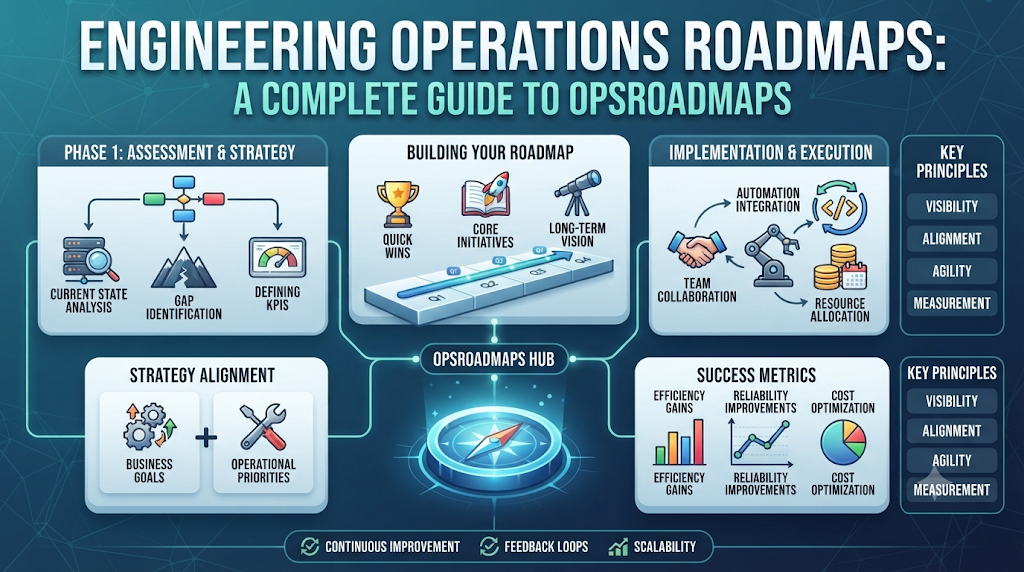
Modern software teams face constant pressure to ship features fast while keeping systems reliable and secure. However, without a clear plan, engineering efforts often become reactive and chaotic. An engineering operations assessment and improvement framework, such as OpsRoadmaps, helps organizations measure their current maturity, find hidden technical gaps, and build step-by-step plans for growth.
Understanding Engineering Operations Roadmaps
Engineering operations cover all the systems, tools, and habits needed to build, run, and maintain software in production. Many teams struggle because they adopt new cloud tools without updating their daily workflows.
An engineering roadmap solves this problem by turning vague goals into concrete milestones. Instead of guessing what to fix next, teams use structured evaluations to see where they stand today. This approach connects high-level business goals with daily technical tasks across DevOps, reliability, security, and cloud infrastructure.
Why Structured Operational Improvement Matters
When systems grow quickly, small technical shortcuts turn into major outages. Teams often spend more time fighting fires than building new products.
Common challenges include:
- Unreliable deployments: Code releases frequently break production features.
- Alert fatigue: Engineers receive hundreds of noisy alerts without clear instructions on how to fix issues.
- Security bottlenecks: Security checks happen too late in the development cycle, delaying launches.
- Rising cloud bills: Teams provision servers and databases without tracking usage or waste.
Structured assessments bring order to this chaos. By measuring current practices against proven industry standards, engineering leaders can prioritize the highest-impact fixes first.
Core Concepts and Components
A complete engineering operations strategy spans several connected disciplines. Because the topic covers the full lifecycle of modern software delivery, all ten core operational areas play an important role in building a resilient organization.
- DevOps Maturity Assessment: Evaluates how smoothly developers and operations teams collaborate, automate builds, and deploy code.
- Production Readiness Assessment: Checks whether a new service meets strict reliability, monitoring, and capacity rules before real users access it.
- Kubernetes Production Readiness Checklist: Verifies specific container settings, such as resource limits, health probes, and auto-scaling rules.
- Kubernetes CrashLoopBackOff Troubleshooting: Provides repeatable runbooks to diagnose and fix containers that repeatedly crash and restart.
- SRE Adoption Roadmap: Guides teams in adopting Site Reliability Engineering habits, including Service Level Objectives (SLOs) and error budgets.
- Incident Management Maturity Model: Defines clear roles, communication steps, and blameless post-incident reviews to resolve outages faster.
- Observability Maturity Model: Tracks how well teams collect and connect logs, metrics, and traces to understand system behavior.
- Platform Engineering Adoption Roadmap: Outlines how to build internal self-service tools that make developers faster and safer.
- DevSecOps Implementation Roadmap: Integrates automated security scanning and access controls directly into daily coding workflows.
- Cloud Cost Optimization Roadmap: Establishes budgets, tagging rules, and resource right-sizing to eliminate wasted cloud spending.
Step-by-Step Guide to Building an Operations Roadmap
Follow these numbered steps to evaluate your engineering systems and create an actionable improvement plan.
- Define your scope and goals. Choose which teams, applications, or cloud environments you want to evaluate first. Decide whether your main goal is better uptime, faster releases, or lower costs.
- Run a baseline maturity assessment. Score your current practices across key areas like deployment automation, monitoring, and security. Be honest about where manual work still dominates.
- Identify critical technical gaps. Compare your current scores against your target goals. Look for high-risk weaknesses, such as missing backups or unmonitored services.
- Prioritize improvements by impact and effort. Group your fixes into short-term quick wins (30 days), medium-term upgrades (90 days), and long-term structural shifts (6 to 12 months).
- Create standardized checklists and runbooks. Turn your standards into simple documents that engineers can use every day. For example, require a standard health check configuration in every Kubernetes deployment:
livenessProbe:
httpGet:
path: /healthz
port: 8080
initialDelaySeconds: 15
periodSeconds: 20
Assign owners and track progress. Give each roadmap item a clear owner and a target completion date. Review progress every two weeks during regular engineering planning meetings.
Re-assess and adjust quarterly. Technology and team needs change over time. Repeat your maturity check every few months to measure gains and set new targets.
Benefits and Challenges
Adopting a structured roadmap delivers clear advantages, though teams must prepare for common obstacles.
Realistic Benefits
- Fewer production outages: Catching configuration errors before launch prevents downtime.
- Faster onboarding: New engineers learn best practices quickly through clear checklists and runbooks.
- Better budget alignment: Leaders see exactly why infrastructure upgrades are needed and how they reduce risk.
- Reduced burnout: Clear incident processes and better monitoring stop late-night guesswork.
Common Challenges
- Cultural resistance: Teams used to informal habits may view checklists as extra bureaucracy.
- Competing priorities: Product deadlines often push operational improvements to the bottom of the backlog.
- Tool overload: Buying new monitoring or security software without changing team habits rarely solves underlying issues.
Best Practices for Engineering Teams
To keep your operational roadmap practical and effective, apply these proven habits:
- Start small with pilot teams. Test new checklists and maturity models with one cooperative team before rolling them out company-wide.
- Automate verification wherever possible. Instead of relying on manual reviews, build checks directly into your continuous integration (CI) pipelines.
- Keep runbooks short and actionable. During a live outage, engineers need exact commands and clear decision trees, not long essays.
- Tie reliability to product work. Dedicate a fixed percentage of every sprint, such as 15% to 20%, to paying down operational debt.
- Focus on outcomes over tools. Measure success by faster recovery times and fewer failed deployments rather than how many dashboards you build.
Common Mistakes to Avoid
Many organizations stall on their operational journey because they fall into predictable traps.
- Trying to fix everything at once: Launching ten different initiatives simultaneously overwhelms engineers and leads to abandoned projects. Focus on two or three top priorities per quarter.
- Treating maturity models as rigid pass-or-fail tests: Assessments exist to guide growth, not to punish teams. Use scores to start helpful conversations rather than judging individual performance.
- Ignoring developer experience: If security gates or deployment rules are too slow, developers will find ways to bypass them. Always design guardrails that make the right path the easiest path.
- Skipping post-incident learning: Fixing an outage without updating your runbooks or checklists guarantees the same failure will happen again.
Realistic Example: Scaling a Growing SaaS Platform
The Situation: A mid-sized software company experiences frequent downtime after migrating its applications to Kubernetes. Deployments often fail, cloud bills are rising rapidly, and engineers spend hours debugging crashing containers without clear logs.
The Approach: The engineering leadership team runs a structured baseline assessment across DevOps, Kubernetes, and observability. They discover three major gaps: services lack resource limits, teams have no standard launch checks, and alerts lack clear ownership. Instead of buying new tools, they create a 90-day roadmap. In month one, they roll out a Kubernetes checklist requiring memory limits and health probes. In month two, they standardize logging and write troubleshooting runbooks for common container crashes. In month three, they introduce basic cloud cost tagging and incident response roles.
The Outcome: Within one quarter, deployment failures drop significantly because misconfigurations are caught before release. When issues do occur, on-call engineers resolve them faster using the new runbooks, freeing up time to focus on new customer features.
Frequently Asked Questions (FAQs)
1. What is an engineering operations roadmap?
An engineering operations roadmap is a structured, step-by-step plan that helps software teams improve how they build, deploy, monitor, and maintain systems over time.
2. How is OpsRoadmaps used by engineering teams?
Teams use platforms like OpsRoadmaps to evaluate their current operational maturity, identify technical weak spots, and access ready-to-use checklists, runbooks, and improvement plans.
3. When should a company run a production readiness assessment?
Organizations should run a production readiness assessment before launching any major new service, migrating to a new cloud environment, or scaling up for high-traffic events.
4. What is the difference between a DevOps maturity assessment and an SRE adoption roadmap?
A DevOps maturity assessment measures current automation and collaboration habits, while an SRE adoption roadmap provides a phased plan for implementing reliability practices like error budgets and service level objectives.
5. Why do teams need a Kubernetes production readiness checklist?
Kubernetes offers many configuration options, and missing basic settings like resource limits or health checks can easily cause application crashes or cluster instability.
6. How does a platform engineering adoption roadmap help developers?
It guides infrastructure teams in building self-service internal tools so developers can deploy and manage applications safely without waiting on manual IT tickets.
7. What is included in an incident management maturity model?
It outlines progressive stages for handling outages, covering on-call schedules, clear communication channels, automated alerting, and blameless post-incident reviews.
8. How does an observability maturity model improve troubleshooting?
It helps teams move from basic server monitoring to connected logs, metrics, and traces, making it much faster to find the root cause of complex software bugs.
9. Why is a DevSecOps implementation roadmap important for fast-moving teams?
It embeds automated security checks early in the coding process, catching vulnerabilities before launch without slowing down release schedules.
10. How often should engineering teams update their cloud cost optimization roadmap?
Teams should review cloud spending monthly and update their optimization roadmap every quarter to account for new services, traffic changes, and updated pricing models.
Conclusion
Building reliable, secure, and cost-effective software systems requires more than just modern cloud tools. It demands clear visibility into your current practices and a disciplined plan for steady improvement. By combining baseline maturity assessments with practical checklists, runbooks, and phased roadmaps, engineering teams can move away from constant firefighting and build resilient operations that scale smoothly with the business.






Top comments (0)