

A latest survey from BCG Research of boardroom and CXO-level leaders shows that 60% of companies report minimal gains from AI despite heavy investment, and only 5% achieve material value at scale. Executive teams buy software licenses and announce digital transformation during quarterly town halls. But one quarter down the line, the initiative stalls in middle management.
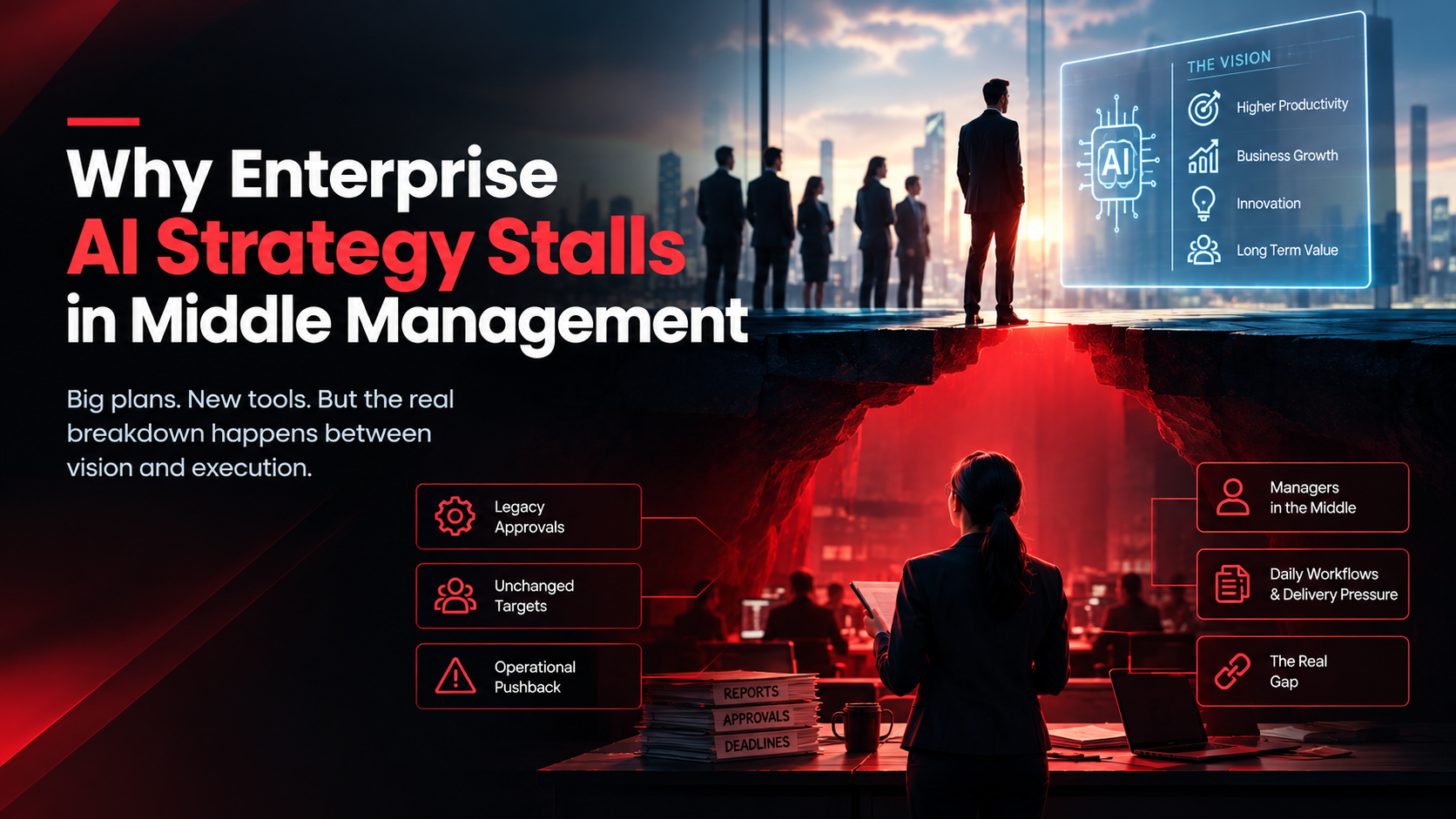
This breakdown is not an attitude problem. Effective adoption of AI by middle-level management requires recognizing that executives are unintentionally creating a structural gap between the AI vision and reality, while managers have to absorb the operational pushback and adoption tensions.
From an associate or a middle manager’s point of view, it may seem that the leadership is rolling out new tools without any consideration for updating daily workflows. This results in software turning into expensive shelfware. The gap between executive ambition and execution gets wider every week.
What AI for leadership actually means
AI for leadership is how executives decide where automation is applied, who owns the final outcome, and how daily work changes to make technology stick. It goes far beyond purchasing software licenses or issuing directives.
True leadership requires redesigning approval chains, performance metrics, and accountability structures. When leaders align those elements, managers can adopt new technology without taking on unmanaged operational risk.
The silent wall between executive slides and platform rollouts
Top executives buy tools expecting immediate productivity gains across engineering and product teams. Middle managers get handed responsibility for team adoption without any reduction in daily delivery goals. They are expected to figure out implementation on the fly while hitting every quarterly milestone. Sometimes, the quarterly targets are even raised in advance, assuming AI-led productivity gains.
When evaluated purely on immediate output and uptime, forcing staff to adopt unfamiliar workflows feels like a direct threat. RAND research found that the leading cause of AI project failure was miscommunication about project goals between leaders and technical teams. Middle managers recognize this risk and protect their teams from operational chaos.
These managers are not anti-technology. They are actively shielding daily engineering and data pipelines from broken processes that leadership never sees up close.
Why executive optimism blinds leadership
Gartner analysts noted in a report title Workforce Insights that was based on a survey of over 12,000 employees and managers that "Managers are best positioned to integrate AI into daily workflows, provide context on how to work alongside AI tools, and encourage experimentation and creativity."
Yet executive perception remains disconnected from frontline reality. BCG found in its People Change Study that 76% of executives believed employees were excited about AI adoption, while only 31% of employees shared that optimism.
Executives write quick prompts for high-level summaries and assume technical teams can automate complex platform workflows just as easily. An engineering manager dealing with strict compliance standards and system stability cannot fix a broken deployment pipeline with a single prompt.
What a double-system rollout looks like on a platform team
Most corporate commentary pretends that failed adoption is a simple training deficit. The reality is a structural governance problem created by executive teams who isolate strategy from technical operations.
Consider a software platform team adopting an automated code review tool. If leadership mandates the new tool but retains the legacy sign-off board, the manager must run both systems. The team writes automated checks, then manually verifies the output to satisfy compliance rules.
Instead of accelerating delivery, the tool adds an extra review step to every release cycle. Managers spend hours verifying AI outputs while performance targets stay unchanged. Eventually, the extra workload forces them to abandon the tool and return to legacy workflows.
Five signals your rollout is stuck below executive leadership
- Managers still run legacy manual approvals alongside the new automated AI workflow.
- Department performance targets remain unchanged despite new software adoption targets.
- Adoption is measured strictly by software license logins rather than completed business workflows.
- No named operational owner exists between the executive sponsor and the delivery team.
- Teams receive generic tool overviews instead of workflow-specific role enablement.
How to fix the breakdown with TrustedAI™ Adoption
If you want your strategy to survive past the announcement deck, stop treating middle managers as passive conduits for policy. Give them explicit authority to redesign workflows and adjust performance targets during transition.
BCG research shows that only 36% of employees feel adequately trained to use AI tools effectively. Leaders must invest in structured AI workforce enablement programs that focus on role-specific workflows rather than technical theories.
Ground your strategy in the three stages of TrustedAI™ Adoption:
- AI Literacy: Build a shared understanding of AI capabilities and risks across management levels.
- AI Learnability: Develop practical skills tailored directly to daily engineering and operational workflows.
- AI Adoption: Embed automated tools into core delivery pipelines while updating legacy approval chains.
Pick two or three core business processes to update first, demonstrating clear time savings without adding operational risk.
Frequently asked questions
What does AI for leadership mean?
AI for leadership is how executive teams structure accountability, approval chains, and workflow changes so managers can adopt automation safely.
Why do enterprise AI rollouts stall after launch?
Rollouts stall when new tools are added without removing legacy approval steps. Managers end up running two systems at once, which increases workload.
What role do middle managers play in AI adoption?
Middle managers integrate tools into daily operations, manage delivery risks, and contextualize technology for their teams.
How can leaders tell if AI adoption is working below the executive level?
Leaders should measure completed workflows rather than logins. If managers still rely on legacy approvals and performance targets remain unadjusted, adoption is likely stalled.
Is your organization building a capable digital workforce, or are you just buying software licenses that nobody uses? Until executives back their managers with real authority and psychological cover, enterprise strategy will remain stuck.





Top comments (0)