

AI agents are evolving quickly.
They are no longer limited to answering questions. Modern agents can use tools, access external data, execute workflows, and interact with different services.
However, as agent capabilities grow, a new challenge appears:
How do developers discover and manage the growing number of extensions available for AI agents?
The Rise of AI Agent Plugins
Plugins are becoming an important part of the AI ecosystem.
They allow agents to extend their capabilities without rebuilding the entire system.
Common examples include:
- External API integrations
- Data retrieval tools
- Automation workflows
- Memory systems
- Developer utilities
- Multimodal capabilities
A powerful agent is not only defined by the model behind it, but also by the ecosystem around it.
The Challenge of Finding Useful Plugins
As more AI agent plugins are created, developers face several problems:
- Plugins are distributed across different repositories
- Installation methods are inconsistent
- Maintenance status is unclear
- Security and permissions are difficult to evaluate
Finding the right extension often requires manually searching through many sources.
Exploring the DeepSeek Harness Ecosystem
DeepSeek Harness is an emerging AI agent ecosystem that supports plugin-based extensions.
To make plugin discovery easier, I built DSH Marketplace, a searchable platform for exploring DeepSeek Harness plugins.
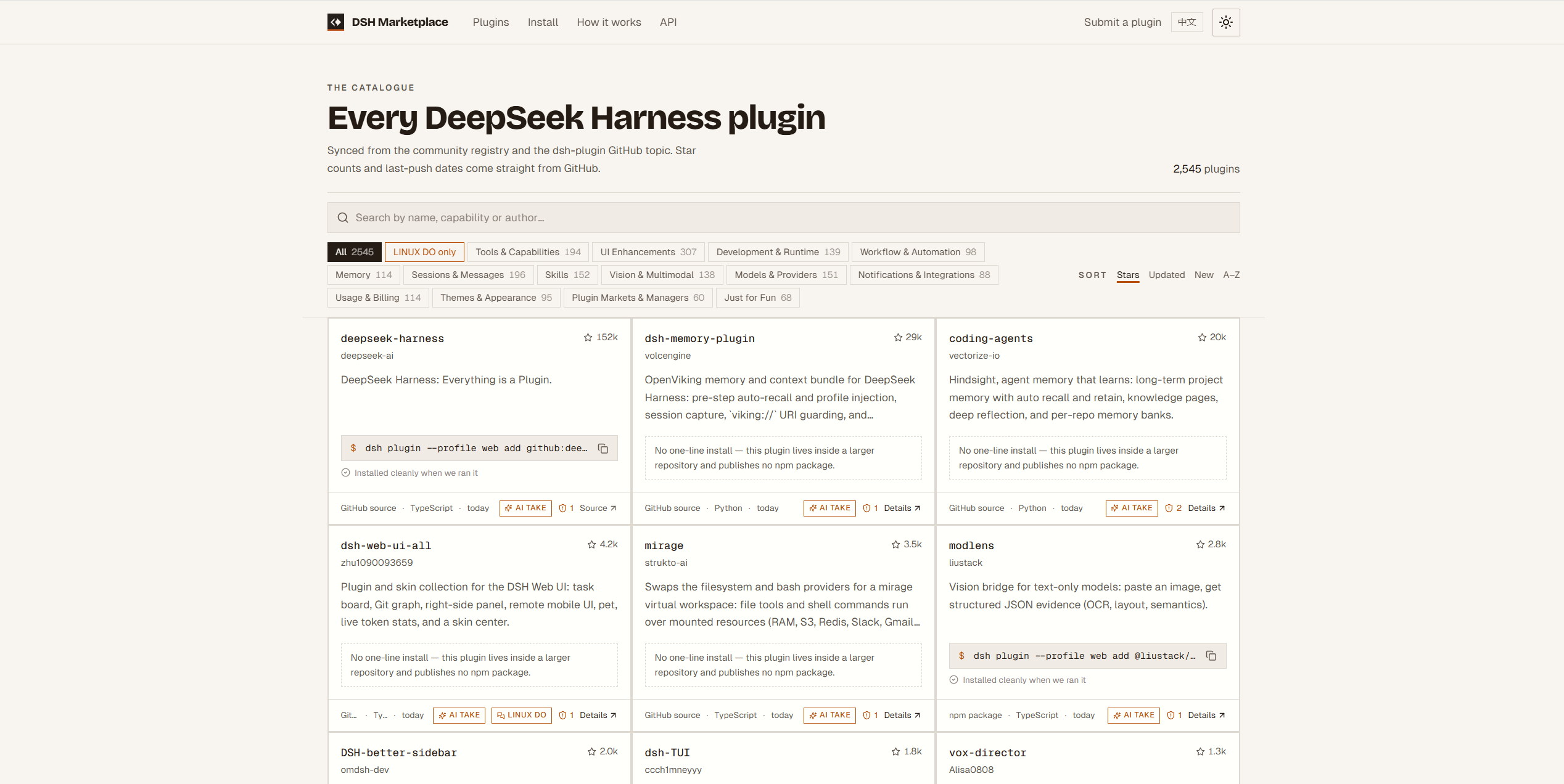
The platform organizes plugin information including:
- Categories
- GitHub repositories
- Installation methods
- License information
- Maintenance signals
- Related metadata
Currently, it indexes more than 2,500 DeepSeek Harness plugins.
Why Plugin Discovery Infrastructure Matters
Many software ecosystems eventually need discovery platforms.
Examples include:
- App stores for mobile applications
- Package managers for programming languages
- Extension marketplaces for browsers
AI agents will likely need similar infrastructure.
Developers need a reliable way to discover, evaluate, and use extensions.
The Future of AI Agent Ecosystems
In the future, AI agent ecosystems may require:
- Standardized plugin metadata
- Security verification
- Compatibility checks
- Better installation workflows
- Quality signals from usage data
The next stage of AI development may not only depend on better models, but also better ecosystems around those models.
Project:


Top comments (0)