
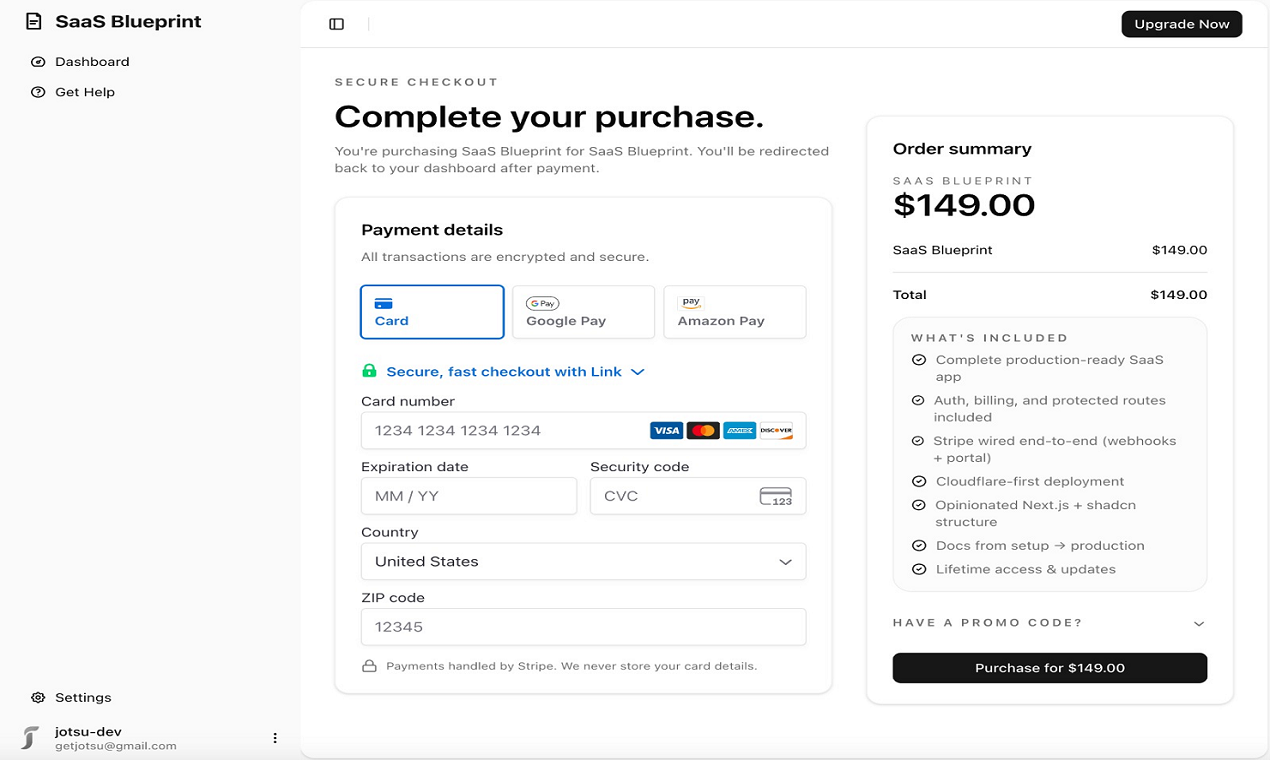

SaaS Blueprint is a production-ready foundation that serves as the perfect starting point for AI-assisted development. It gives AI tools a clear structure, conventions, and boundaries, so they can generate accurate code, make safe changes, and extend your product without guessing. Instead of prompting against a blank repo, you start from a real, working SaaS with intentional architecture.
Everything you see on this site is included in the blueprint. The Next.js application, authentication system, Stripe billing, protected app areas, documentation, and deployment setup all ship together as a cohesive product. This is not a demo app or sample project — it’s a real SaaS baseline meant to be cloned, customized, and launched.
The blueprint removes ambiguity for both humans and AI. Core patterns are already established, making it easier for AI tools to understand how routing, data access, authentication, and billing are meant to work. This dramatically reduces rework, hallucinated code paths, and fragile integrations when using AI to build features.
Authentication is fully implemented with email and password support, GitHub OAuth, reliable session handling, protected routes, and user profile and organization settings. Access control behaves correctly out of the box, paid features stay gated, and users experience a polished, predictable app flow.
Monetization is ready from day one. The blueprint includes a launch-ready Stripe integration with pricing and checkout flows, support for subscriptions or one-time purchases, promo codes, pricing previews, webhook-driven billing state sync, and billing management screens. Upgrade and downgrade paths are flexible and developer-controlled, without forcing rigid product decisions.
Documentation is treated as a first-class part of the system. Built-in Velite support lets you write Markdown or MDX-based documentation that lives alongside your code and ships with your app. This creates a shared source of truth for both developers and AI tools, keeping product knowledge versioned and easy to evolve.
The UI is intentionally minimal and unopinionated, making it easy to swap templates, apply a custom design system, or layer on branding without fighting opinionated styles. You start with clarity, not visual noise.





Top comments (0)