

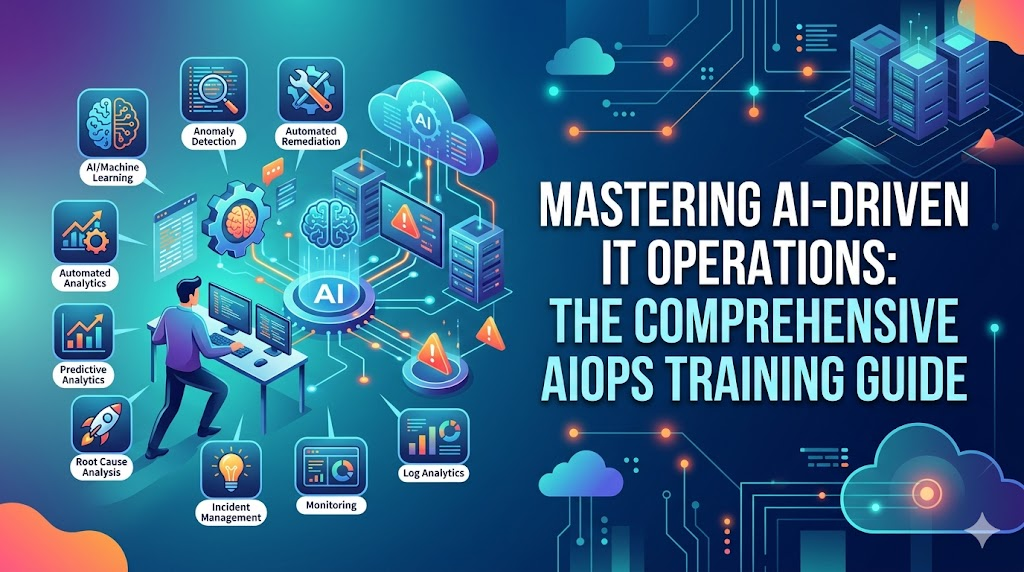
The digital landscape is shifting. As infrastructure scales into the realm of microservices and multi-cloud architectures, the traditional "dashboard-monitoring" approach is failing. IT teams are currently facing a "data deluge"—an overwhelming influx of telemetry data that leads to alert fatigue, missed outages, and inefficient manual troubleshooting.
The future of IT isn't just about managing systems; it’s about deploying intelligence to manage them for you. This is the era of Artificial Intelligence for IT Operations (AIOps), and structured AIOps training is the key to staying relevant in an increasingly automated world.
The Paradigm Shift: What is AIOps?
AIOps is the integration of machine learning and big data analytics into the IT operational stack. It moves beyond static monitoring, where teams rely on manual threshold-based alerts, to a dynamic model that understands the "normal" behavior of a system.
By leveraging AIOps, engineers can:
- Correlate Events: Collapse thousands of noisy alerts into a single, high-fidelity incident.
- Detect Anomalies: Use ML models to catch subtle performance degradation before it impacts the end-user.
- Automate Responses: Implement auto-remediation scripts that resolve routine issues instantly.
Why Professionals are Choosing AIOps Training
The demand for AIOps skills is surging. DevOps engineers, SREs, and IT managers are realizing that manual management is a bottleneck. An AIOps course provides the technical roadmap needed to transform from a reactive responder into a proactive architect.
Whether you are a developer looking to move into Site Reliability Engineering (SRE) or an IT manager tasked with reducing operational costs, learning AIOps provides the skills to build self-healing, scalable infrastructure.
The Core AIOps Curriculum
To succeed, you need training that focuses on the end-to-end operational lifecycle. A world-class AIOps curriculum covers:
- Observability Fundamentals: Mastering metrics, logs, and traces.
- Incident Intelligence: Strategies for noise reduction and event correlation.
- ML for Operations: Applying supervised and unsupervised learning to IT use cases.
- Auto-remediation & Automation: Designing systems that fix themselves.
- Enterprise Architecture: Scaling AI across global, multi-cloud environments.
The AIOps Tooling Landscape
Navigating the ecosystem of AIOps tools is part of the job. Professionals need to understand how to leverage powerhouses like Dynatrace, Splunk, Datadog, Moogsoft, and BigPanda. Each of these platforms offers unique approaches to observability, correlation, and automated incident response, and an effective training program will give you hands-on experience with these tools.
Why AIOps School is the Industry Standard
When it comes to specialized training, AIOps School stands apart. Rather than burying learners in academic theory, they emphasize a project-based approach. By utilizing hands-on labs and real-world scenarios, AIOps School ensures that you aren't just learning how to define AIOps—you are learning how to build and architect it.
Their certification pathways—from Foundation to Architect—offer the validation required by enterprise-level organizations, ensuring that your skills are recognized globally.
The Career Impact of AIOps Certification
An AIOps certification is more than a badge; it is a signal to recruiters that you possess the advanced skills required to run modern, resilient systems. As companies race to integrate AI into every aspect of their operations, certified AIOps engineers are among the most highly compensated professionals in the DevOps and SRE space.
Frequently Asked Questions (FAQ)
- What is AIOps training? It is a curriculum teaching you how to use AI and ML to automate IT operational processes.
- Is an AIOps certification worth it? Yes, it is a high-value credential that proves you can handle complex, modern infrastructure.
- What prerequisites are needed? A solid foundation in Linux, networking, and basic monitoring concepts.
- Can DevOps engineers pivot into AIOps? Absolutely; it is a natural career evolution for those already familiar with cloud-native stacks.
- How long does it take to complete a course? Most foundational tracks are designed for completion within 30–60 days.
- Are hands-on labs important? Critical. You cannot master AIOps without practice in configuring correlation models.
- Which industries need AIOps? Finance, healthcare, retail, and tech—any sector with high-scale digital infrastructure.
- What is the future of AIOps? The industry is moving toward fully autonomous IT management.
- Is AIOps hard to learn? With the right structured program, it is highly accessible to any IT professional.
- Where can I begin? You can explore detailed pathways at AIOps School.
Conclusion
The complexity of modern IT is not going away; it is accelerating. Instead of trying to keep pace manually, the best path forward is to build intelligence into your systems. By pursuing structured AIOps training and earning an industry-recognized certification, you are future-proofing your career and positioning yourself as a leader in the next generation of IT Operations.





Top comments (0)