

Introduction
Building an advanced machine learning model or fine-tuning complex prompts is an exciting milestone, but moving that experiment out of a local testing environment and into everyday production is an entirely different challenge. Many organizations find that their models and prompt-driven applications work wonderfully on isolated computers, yet struggle severely when exposed to live production traffic. This friction occurs because real-world information changes constantly, and maintaining software stability requires specialized care.
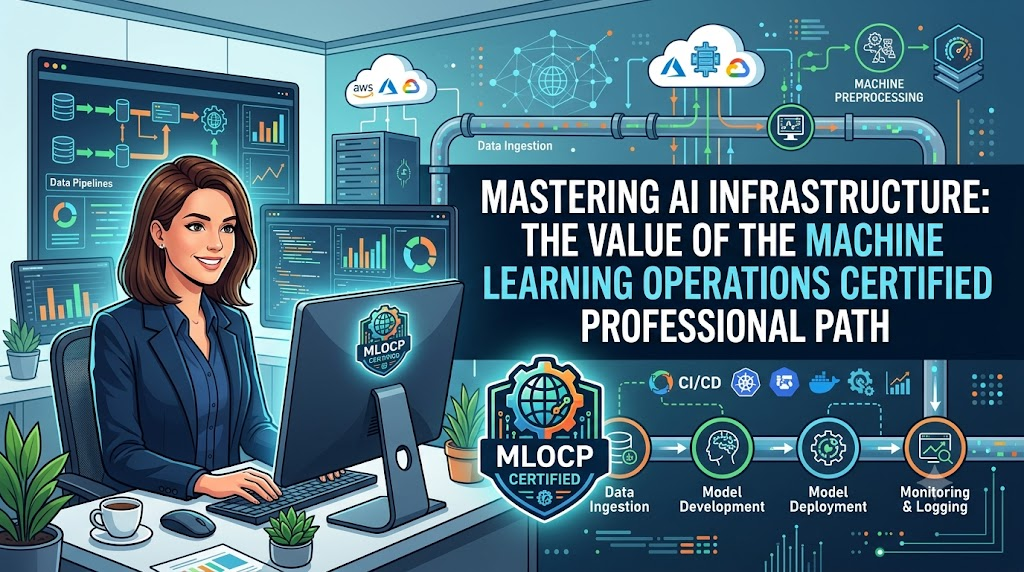
To resolve these operational bottlenecks, the tech industry relies heavily on structured machine learning operations. If you want to become the expert who successfully connects experimental data science with reliable software infrastructure, earning an MLOps Certified Professional (MLOCP) credential is a powerful step forward. In this guide, we will explore the core concepts of this discipline, practical use cases, essential best practices, and the actionable steps you can take to build a resilient career in this field.
Moving Beyond Experimental Development
In the early phases of artificial intelligence adoption, companies focused almost entirely on building models with high accuracy on static datasets. Once a model was ready, the code was typically handed off to software engineers who had to figure out how to integrate it into existing business systems. This process often resulted in miscommunication and delayed deployments because exploratory data science and production software engineering operate under very different rules.
Machine learning operations emerged to harmonize these two domains. By applying reliable automation principles to data workflows, teams can now deploy, monitor, and update models smoothly. Understanding how to manage this entire lifecycle has quickly become one of the most sought-after skill sets in modern technology.
What is an MLOps Certified Professional (MLOCP)?
An MLOps Certified Professional (MLOCP) is a technical expert who specializes in building, automating, and maintaining the infrastructure that supports machine learning applications at scale. Rather than focusing only on writing algorithms or prompt templates, these professionals focus on system architecture, pipeline reliability, and long-term maintenance.
Core Focus Areas
Professionals working in this space typically manage several vital responsibilities:
- Workflow Automation: Creating automated pipelines that transport raw data, clean it, train the model, and push updates without manual intervention.
- Rigorous Version Control: Tracking every change made to code, configuration settings, and training datasets so that past results can be easily reproduced.
- Infrastructure Consistency: Using containerization tools to ensure applications run identically regardless of whether they are tested locally or deployed on cloud servers.
Real-World Applications
To appreciate the true value of these operational practices, let us look at how they function across different business sectors.
- Retail Supply Chain Management: Large retail companies use predictive models to estimate inventory needs. Automated pipelines feed daily sales data directly into the system, ensuring predictions adjust dynamically so warehouses never run out of high-demand items.
- Digital Fraud Protection: Financial institutions rely on machine learning to spot suspicious transactions instantly. Operations professionals ensure these models remain fast, secure, and continuously updated with new security patterns.
- Automated Customer Support: Companies handling thousands of support inquiries use classification models and automated prompts to route messages to the correct department. Robust monitoring ensures these systems maintain high availability around the clock.
Best Practices for Stable Infrastructure
Succeeding in this technical domain requires strict adherence to industry-tested best practices:
- Maintain Complete Audit Trails: Keep detailed records of every dataset and code version used in production. If a model starts generating unexpected results, your logs should allow you to diagnose the issue immediately.
- Implement Gradual Deployments: Never push a completely new model directly to all users at once. Use canary releases or shadow deployments to evaluate performance safely under live conditions.
- Automate Data Validation: Just as software code requires unit tests, data pipelines need strict validation checks to catch missing values, format shifts, or extreme outliers before they reach the model.
- Keep Your Tooling Simple: Avoid the temptation to adopt every new tool on the market. Start with a lean, understandable tech stack and only add complexity when a genuine operational challenge requires it.
Common Pitfalls to Avoid
Even skilled engineering teams can stumble if they overlook basic operational rules. Watch out for these frequent mistakes:
- Ignoring Model Degradation: Assuming a deployed model will maintain its accuracy indefinitely is a major error. Without monitoring for data drift, your system's performance will silently erode over time.
- Working in Isolated Silos: Operations is a collaborative bridge between data science and software engineering. If teams do not communicate regularly, the resulting architecture will likely fail to meet practical business goals.
- Rushing Deployments: Skipping testing phases to meet tight deadlines almost always leads to emergency troubleshooting later. Patience during setup saves significant time down the road.
- Overcomplicating the Architecture: Building overly complex microservices when a straightforward structure would suffice creates unnecessary maintenance burdens.
The Benefits of Focusing on Operations
Developing deep expertise in machine learning infrastructure offers substantial rewards for both individuals and organizations.
For businesses, strong operational practices minimize downtime, lower cloud resource costs, and ensure that AI initiatives deliver a genuine return on investment. Teams spend less time firefighting broken scripts and more time innovating.
For professionals, mastering this domain establishes you as an indispensable asset. Because you understand both the analytical side of data and the structural requirements of software deployment, you become a natural leader capable of guiding cross-functional projects to success.
Challenges in the Field
While the career path is deeply rewarding, it comes with unique hurdles. The primary challenge is the breadth of knowledge required. You must feel comfortable touching multiple disciplines, including networking, basic data engineering, software testing, and cloud infrastructure.
Additionally, introducing process discipline to creative teams requires patience and clear communication. Helping data scientists appreciate the value of clean code and repeatable workflows is an ongoing part of the professional journey.
Comparison: Experimental vs. Operational Workflows
To highlight how day-to-day work changes when moving into an operational mindset, consider the following breakdown:
| Aspect | Experimental Development | Operational Production |
|---|---|---|
| Primary Goal | Maximizing metric accuracy on a static test set. | Ensuring system uptime, speed, and reliability. |
| Environment | Local machines or isolated development servers. | Scalable, multi-tier cloud environments. |
| Code Structure | Exploratory scripts and interactive notebooks. | Modular, version-controlled, and tested codebases. |
| Update Cycle | Manual, ad-hoc adjustments when needed. | Automated CI/CD pipelines triggered by new data or code. |
| Feedback Loop | Manual inspection of output charts and logs. | Automated real-time alerts and dashboard tracking. |
Actionable Steps to Build Your Expertise
If you want to strengthen your capabilities in this area, consider taking these practical steps:
- Refine Your Coding Fundamentals: Focus on writing clean, readable Python code. Learn how to structure projects logically so other engineers can easily review your work.
- Practice Containerization: Learn how to package an application and its dependencies into isolated containers. This skill is foundational for ensuring your work runs consistently across different machines.
- Build a Complete End-to-End Project: Do not stop at training a model in a notebook. Write a script to wrap it in an API, containerize it, and set up a basic automated test that runs whenever you push changes.
- Study System Logging: Learn how to collect and visualize system logs and performance metrics so you can spot errors before they impact users.
- Improve Your Documentation Skills: Practice writing clear technical guides and system architecture notes. Good documentation is essential for handoffs and team collaboration.
Frequently Asked Questions
1. Is a heavy background in mathematics required for this career?
A deep background in advanced math is not strictly required. While you should understand basic statistics to know what models are doing, your primary focus is on software automation, infrastructure, and pipeline stability.
2. How long does it take to become proficient in these operational skills?
The timeline depends on your starting point. Software engineers or data scientists with some cross-functional exposure often pick up the core concepts within a few months of focused study. Beginners should expect a longer ramp-up period.
3. What is data drift, and why does it matter?
Data drift happens when the statistical nature of the input data changes over time. For example, consumer buying habits might shift due to economic changes. If a model is not retrained on fresh data, its predictions become inaccurate.
4. Can these operational principles be applied to smaller projects?
Yes. While full-scale enterprise automation may be unnecessary for small tasks, applying basic principles like version control and modular code structure saves time on projects of any size.
5. What programming languages are most useful in this space?
Python is the dominant language for machine learning tasks, while configuration languages like YAML and container tools are essential for managing the underlying infrastructure.
6. How do automated pipelines handle unexpected errors?
Well-designed pipelines include error-handling routines, automated rollbacks to previous stable model versions, and immediate notification alerts sent to the engineering team when a failure occurs.
Conclusion
The journey from a promising data experiment to a stable, production-ready system requires patience, structure, and technical discipline. By embracing the principles of machine learning operations, professionals help organizations unlock the true potential of their AI initiatives. Earning an MLOps Certified Professional (MLOCP) credential serves as a meaningful way to validate your skills in building resilient, automated systems that stand the test of time.





Top comments (0)