

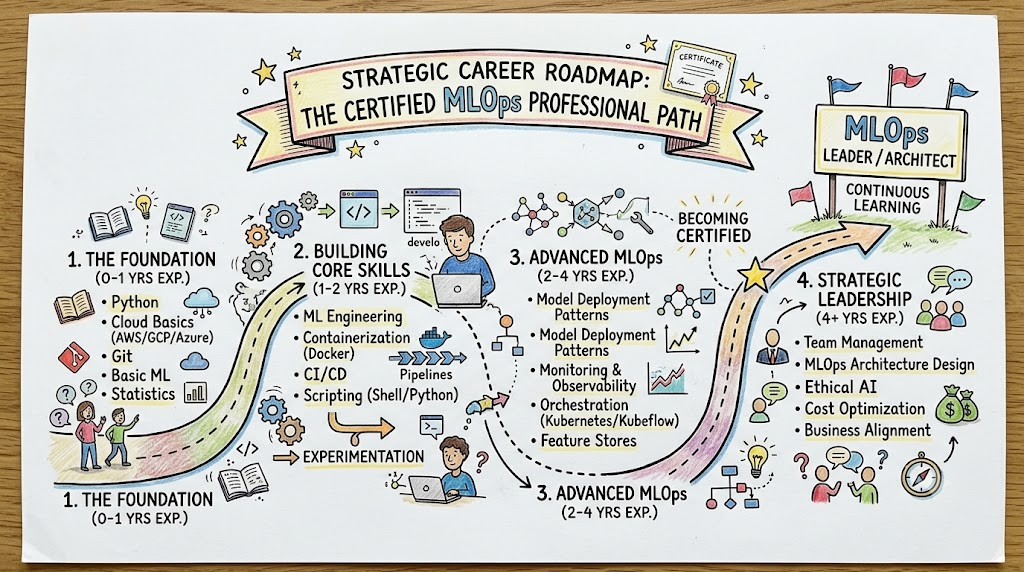
The world of machine learning has shifted from the experimentation phase to a production-grade necessity. For many years, data scientists built models in silos, leaving the operationalization of these models to guesswork. Today, that approach is unsustainable. The demand for scalable, reliable, and automated AI systems has created a critical gap in the workforce. To bridge this divide, professionals are turning to the Certified MLOps Professional designation, a curriculum hosted by AIOps School. As we navigate the complexities of modern engineering, mastering the intersection of development, operations, and machine learning is no longer optional; it is the baseline for high-impact engineering careers.
What is the Certified MLOps Professional?
The Certified MLOps Professional is a structured validation of an engineer’s ability to manage the end-to-end lifecycle of machine learning systems. It is not merely about writing algorithms or building models. Instead, it focuses on the operational challenges: continuous integration and continuous deployment (CI/CD) for ML, data versioning, model monitoring, drift detection, and automated retraining.
In a professional setting, an MLOps practitioner ensures that a model which works in a Jupyter notebook also works in a live production environment with thousands of requests per second. It bridges the gap between data science teams, who focus on accuracy and metrics, and operations teams, who focus on stability, security, and scalability. Understanding these concepts allows engineers to reduce "model decay" and ensure that AI products deliver long-term value rather than failing shortly after deployment.
Who Should Pursue Certified MLOps Professional?
This certification is designed for professionals who need to move AI from the laptop to the cloud. The target audience includes:
- DevOps Engineers: Those looking to expand their skill set into the AI domain by applying automation practices to ML pipelines.
- Data Scientists: Practitioners who want to take their models to production and understand the infrastructure required to support them.
- SREs (Site Reliability Engineers): Professionals responsible for the uptime and reliability of complex AI-driven systems.
- Software Engineers: Developers who want to specialize in the backend infrastructure that powers modern AI applications.
- Engineering Managers: Leaders who need to understand the technical requirements to build and manage high-performing AI teams.
Why Certified MLOps Professional is Valuable
The market value of this certification lies in its focus on the "Day 2" operations of AI. Most organizations can build a prototype. Very few can maintain a performant system. Certified professionals demonstrate they can manage technical debt in ML systems, implement governance, and ensure that security and compliance are built into the pipeline. As organizations standardize their AI tech stacks, they prioritize hiring engineers who have demonstrated competence in reproducible, automated workflows. This certification validates that the candidate is not just a coder, but an architect of scalable systems.
Certified MLOps Professional Certification Overview
The certification is delivered via the course link provided in the introduction and is hosted by the institution mentioned. The program is designed to be rigorous, focusing on tool-agnostic concepts alongside hands-on practice. It ensures that regardless of the specific cloud provider—be it AWS, Azure, or Google Cloud—the engineer understands the core principles of data pipelines, model registry, and infrastructure as code.
Certified MLOps Professional Certification Tracks & Levels
The learning structure is built to accommodate various levels of experience, allowing professionals to start where they are and progress systematically.
| Track | Level | Who it’s for | Prerequisites | Skills Covered | Recommended Order |
|---|---|---|---|---|---|
| Foundation | Entry | Students & Juniors | Basic Python & Linux | Concepts & Terminology | 1 |
| Professional | Intermediate | Engineers & Data Scientists | Foundation Knowledge | CI/CD, Pipelines, Monitoring | 2 |
| Advanced | Expert | Architects & Lead Engineers | Professional Level | Scalability, Security, Strategy | 3 |
Detailed Guide for Each Certified MLOps Professional Level
Foundation Level
- What it is: An introduction to the MLOps ecosystem.
- Who should take it: Beginners and those transitioning into tech.
- Skills you’ll gain: Understanding the ML lifecycle, version control basics, and containerization.
- Real-world projects: Containerizing a simple model inference script.
- Preparation plan: 7 days of intensive study.
- Common mistakes: Skipping the basics of command-line tools.
- Next certification: Professional Level.
Professional Level
- What it is: The core practitioner certification focused on implementation.
- Who should take it: Working engineers and data scientists.
- Skills you’ll gain: Automated testing, feature stores, and model registry management.
- Real-world projects: Building an automated retraining pipeline.
- Preparation plan: 30 days of hands-on practice.
- Common mistakes: Ignoring the importance of data validation.
- Next certification: Advanced Level.
Advanced Level
- What it is: Focused on enterprise-grade architecture and strategy.
- Who should take it: Tech leads and architects.
- Skills you’ll gain: Multi-cloud strategy, regulatory compliance, and cost optimization.
- Real-world projects: Architecting a high-availability production AI system.
- Preparation plan: 60 days of case study analysis.
- Common mistakes: Over-engineering simple solutions.
- Next certification: Specialized domain tracks.
Choose Your Learning Path
- DevOps Path: Focuses on infrastructure automation, Kubernetes orchestration, and pipeline management.
- DevSecOps Path: Prioritizes secure supply chains, vulnerability scanning for AI models, and policy as code.
- SRE Path: Centers on error budgets, SLOs for ML services, and incident management.
- AIOps / MLOps Path: Specializes in the operationalization of AI and machine learning models in production environments.
- DataOps Path: Focuses on data quality, ingestion pipelines, and ensuring the "data" in machine learning is reliable.
- FinOps Path: Centers on cost management, cloud resource efficiency, and ROI analysis for AI projects.
Role → Recommended Certified MLOps Professional Certifications
| Role | Recommended Certifications |
|---|---|
| Data Scientist | Professional Level MLOps |
| DevOps Engineer | Foundation & Professional MLOps |
| MLOps Engineer | Advanced MLOps |
| SRE | Professional MLOps & SRE tracks |
| Engineering Manager | Foundation MLOps & Advanced Strategy |
Next Certifications to Take After Certified MLOps Professional
After completing this certification, you can diversify based on your career trajectory:
- Same Track: Pursue advanced architecture certifications or specialized tracks in Large Language Model (LLM) operations.
- Cross Track: Move into DataOps to gain a deeper understanding of the data engineering that fuels ML models, or FinOps to manage the high costs of compute resources.
- Leadership Track: Explore management certifications that focus on leading AI teams and fostering a culture of operational excellence.
Why Certified MLOps Professional Matters for Your Career
For those operating in the AI and prompt engineering space, the value of this certification is significant. Modern AI interfaces often rely on prompts and LLMs, but these are fragile if not supported by an operational framework. As a professional, you are likely working with tools that generate content, analyze text, or build agents. MLOps provides the stability to ensure these outputs are consistent, secure, and reproducible. By obtaining this certification, you demonstrate to your organization that you can move beyond simple prompt experimentation and into building durable, production-ready AI applications that can scale to thousands of users without crumbling under the load.
Training & Certification Support Providers for Certified MLOps Professional
DevOpsSchool
DevOpsSchool provides a comprehensive ecosystem for learners, offering extensive curriculum coverage for MLOps. Their approach is heavily focused on practical implementation, ensuring that learners are not just memorizing theory but building robust pipelines. They offer support for various certification tracks and provide resources that cater to both beginners and advanced engineers looking to sharpen their operational skills in the machine learning space.
Cotocus
Cotocus specializes in consulting-led training. They bring industry-grade experience into the classroom, focusing on how companies actually deploy MLOps in real-world scenarios. Their training programs are highly interactive and often emphasize problem-solving, which is essential for certification exams that test applied knowledge rather than rote memorization.
Scmgalaxy
Scmgalaxy is a key player in the space, focusing deeply on Source Configuration Management and CI/CD tools, which are the backbone of MLOps. Their training provides a strong foundation in versioning models and data, which is critical for the reproducible AI workflows emphasized in the Certified MLOps Professional curriculum.
BestDevOps
BestDevOps focuses on standardized practices and industry benchmarks. They provide a structured learning path that aligns with global standards, making their training an excellent choice for professionals looking to align their skills with enterprise expectations for MLOps maturity.
devsecopsschool.com
This provider is essential for those who want to integrate security into their MLOps workflow. They emphasize the "Sec" in DevSecOps, teaching how to protect ML models from adversarial attacks, ensure compliance, and manage data privacy within the AI pipeline.
sreschool.com
Focusing on the SRE side of MLOps, this provider teaches engineers how to manage AI systems with the reliability of traditional software. They emphasize monitoring, alerting, and incident response, which are crucial for any system that runs on production data.
aiopsschool.com
As the primary hosting institution, this provider offers the most direct access to the course material and certification process. Their content is refined specifically to meet the standards of the Certified MLOps Professional, offering deep dives into AI-specific infrastructure and orchestration.
dataopsschool.com
This provider emphasizes the data side of the equation. Understanding data quality, lineage, and engineering is paramount to MLOps, and their curriculum ensures that professionals have the technical grounding to build efficient data pipelines for AI.
finopsschool.com
Finally, this provider focuses on the financial aspect of AI operations. As cloud costs for training and serving models can balloon, their training is critical for engineers who want to build cost-effective AI systems and demonstrate ROI to leadership.
Frequently Asked Questions
General FAQs
- Is programming experience required? Yes, basic knowledge of Python or similar scripting languages is recommended.
- Can I take this exam online? Yes, the certification is designed for remote accessibility.
- How long is the certification valid? Generally, these certifications are valid for a duration that encourages continuous learning updates.
- Are there labs involved? Yes, the learning path emphasizes hands-on practical labs.
- Is this vendor-specific? No, the concepts are designed to be cloud-agnostic.
- Can beginners enroll? Yes, the Foundation track is specifically designed for those new to the field.
- What is the passing criteria? The criteria are based on a mix of theoretical tests and practical assessments.
- Are study materials provided? Yes, official guides and practice exercises are typically included.
- Can I pause my course? The platform usually allows for self-paced learning, offering flexibility.
- Is there community support? Yes, learners often have access to forums or expert groups.
- Do I need a degree in Data Science? No, practical experience is often more relevant than a formal degree.
- Is this relevant for non-IT professionals? It is tailored primarily for technical roles and those in engineering management.
Focused FAQs
- Does MLOps certification cover GenAI pipelines? Yes, modern curricula include operationalizing LLMs and generative models.
- How does this differ from DevOps? MLOps adds the specific layer of model data and training management to standard DevOps practices.
- Will this help me pass cloud-specific ML exams? Yes, the vendor-agnostic principles make cloud-specific exams significantly easier.
- How do I handle model drift? The certification teaches specific monitoring techniques for detection and automated handling.
- Is feature engineering covered? Yes, specifically the creation and management of feature stores for consistency.
- What is the focus of the Advanced track? It focuses on multi-region scaling and complex regulatory compliance frameworks.
- Can this lead to a job promotion? Yes, it demonstrates specialized skills that are in high demand across tech enterprises.
- Does it cover cost management? Yes, the integration of FinOps principles is a key component of the professional tracks.
Final Thoughts: Is Certified MLOps Professional Worth It?
The decision to pursue a certification should be driven by the desire to solidify your knowledge and demonstrate credibility in a competitive market. The Certified MLOps Professional designation offers a structured way to master the complexities of AI production. If you are an engineer who is tired of the "it works on my machine" syndrome, this certification is worth the investment. It provides the frameworks, the vocabulary, and the technical grounding to turn chaotic AI experiments into stable, high-value production systems. It is not a shortcut, but a milestone in a career defined by continuous learning and operational discipline.






Top comments (0)