

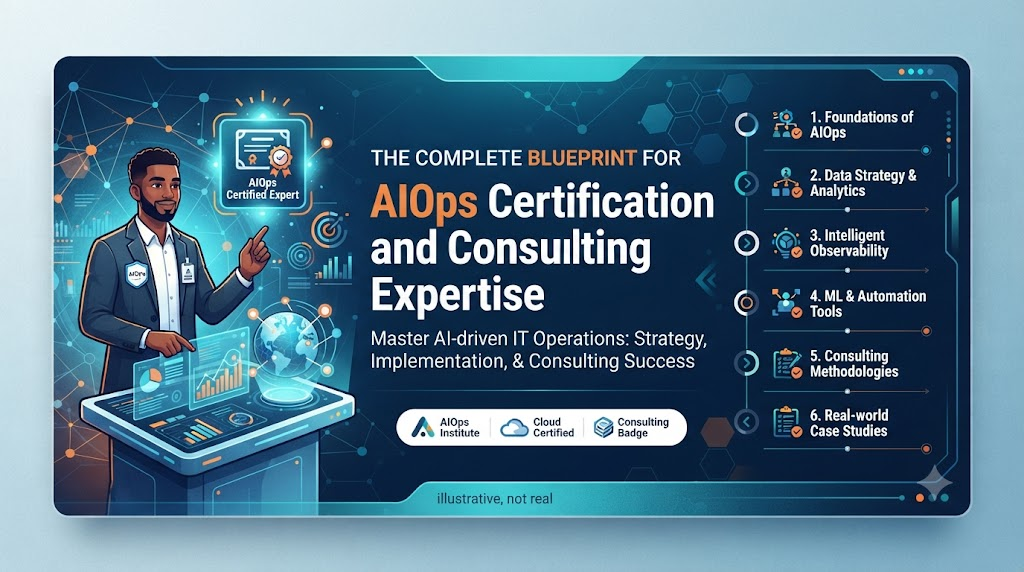
Introduction
Modern technology environments—defined by sprawling cloud-native architectures, microservices, and Kubernetes—produce data at a rate that human operators simply cannot keep up with. For many technology teams, this results in a constant state of "alert overload," where the signal is buried under a mountain of noise. Conventional manual monitoring is increasingly insufficient for today's high-velocity digital services.
AIOps (Artificial Intelligence for IT Operations) offers the solution by leveraging machine learning to automate the diagnostic cycle, turning overwhelming telemetry into clear, prioritized insights. For IT professionals, building proficiency in this domain is a strategic necessity for career longevity. At AIOpsSchool, we focus on providing the essential training, certification pathways, and consulting frameworks to help you master these technologies. This article details how you can leverage intelligent operations to improve system reliability and define your career path.
Featured Snippet: What Is AIOps?
AIOps, or Artificial Intelligence for IT Operations, combines big data, machine learning, and advanced analytics to optimize IT infrastructure. It automatically ingests, correlates, and analyzes operational signals—including logs, metrics, and traces—to detect anomalies and pinpoint root causes, allowing teams to resolve incidents faster and maintain high-performance systems.
The Fundamentals of AIOps
In Simple Terms
Think of AIOps as an intelligent layer built over your existing infrastructure. It constantly monitors your system's health, learns its unique behavior patterns, and identifies precisely when something is going wrong—often flagging the root cause before your team even knows there is an issue.
Real-World Example
During a critical service slowdown, an AIOps engine aggregates thousands of individual alerts into one high-priority incident, linking them to a recent database update. This prevents the "war room" scramble and allows the team to fix the issue immediately.
Why It Matters
It removes the "noise" from daily operations, prevents professional burnout, and dramatically reduces downtime.
Key Takeaways
- AIOps replaces manual firefighting with intelligent, automated analysis.
- It is essential for maintaining stability in complex, distributed systems.
- It enables a transition from reactive monitoring to proactive reliability.
| Manual Operations | AIOps-Enabled Operations |
|---|---|
| Primarily manual troubleshooting | Automated incident correlation |
| Reactive "alert-chasing" | Proactive anomaly detection |
| Fragmented data silos | Unified, AI-driven observability |
| Subjective root cause analysis | Evidence-based, ML-backed analysis |
Why AIOps Proficiency is a Competitive Advantage
In Simple Terms
Infrastructure is becoming far too complex for manual intervention. Leaders are actively hiring engineers who know how to embed AI into their operational workflows to ensure their services remain resilient.
Real-World Example
A firm expanding into multi-cloud architecture realizes their manual monitoring can’t track the scale of their infrastructure. They recruit AIOps-trained engineers to build automated detection that grows with their environment.
Why It Matters
Developing these skills shifts your professional value from simply "watching dashboards" to becoming a key architect of system reliability.
Key Takeaways
- Modern, distributed systems make human-only monitoring obsolete.
- AIOps is the necessary bridge to advanced SRE and DevOps practices.
- Professionals with this expertise are in high demand and command higher industry value.
The Value of AIOps Certification
In Simple Terms
An AIOps certification is an industry-recognized credential that proves you have the technical rigor and strategic knowledge to deploy and manage AI-enhanced operational platforms.
Real-World Example
A DevOps Engineer uses their certification to lead the transition of their company's legacy monitoring stack toward a modern, automated observability suite.
Why It Matters
It creates a professional benchmark, assuring employers that you can handle complex, mission-critical infrastructure with standard best practices.
Key Takeaways
- Provides verifiable validation of your technical engineering skills.
- Acts as a powerful catalyst for career growth in the tech sector.
- Ensures a unified approach to high-scale operational excellence.
Training and Skill Mastery
High-quality training should focus on real-world production challenges, teaching you how to master event correlation, predictive analytics, and automated incident response.
AIOps Engineer Certification Roadmap
| Level | Key Focus Areas | Typical Result |
|---|---|---|
| Entry | Monitoring Basics, Data Pipelines | Foundation of Observability |
| Mid | ML Logic, Python, Correlation | Incident Automation Specialist |
| Senior | Predictive Scaling, Self-Healing | AIOps Transformation Leader |
Building Your AIOps Career
- Foundations: Deepen your knowledge of Linux, networking, and cloud platforms.
- Tooling: Master observability tools like OpenTelemetry, Prometheus, and Grafana.
- Data Skills: Learn Python and basic data modeling to process system telemetry.
- Certification: Complete professional AIOps training to validate your expertise.
- Strategic Focus: Align technical reliability improvements with measurable business value.
Mastering AI Observability
In Simple Terms
While monitoring asks "is it up?", observability asks "what is happening inside?". AI Observability uses machine learning to decode the complex data produced by microservices, providing a full view of your system's internals.
Real-World Example
When an application slows down, AI observability analyzes the trace data to reveal that a specific service dependency is causing the bottleneck, not the infrastructure itself.
Why It Matters
It minimizes the time wasted on "blind" debugging, allowing engineers to release updates with higher confidence.
Key Takeaways
- Observability is the essential data foundation for all AIOps functionality.
- OpenTelemetry is the industry standard for collecting this data.
- AI helps filter the massive volume of observability telemetry into useful insights.
| Monitoring | Observability |
|---|---|
| Focused on dashboard health | Focused on system-wide internal state |
| Answers "What is happening?" | Answers "Why is it happening?" |
| Best for known performance thresholds | Critical for investigating unique, unknown bugs |
AIOps for SRE and DevOps Teams
AIOps acts as a strategic "force multiplier." By automating the manual triage process, it eliminates the alert fatigue that leads to team burnout, enabling SREs to focus on architecture and continuous delivery.
Enterprise AIOps Consulting
Deploying AIOps is an organizational shift. Consulting services assist companies in assessing their operational maturity, selecting the right technology, and building a roadmap that maximizes ROI.
The Implementation Lifecycle
- Maturity Assessment: Audit current monitoring gaps.
- Architecture: Design a scalable telemetry pipeline.
- Integration: Connect tools to your correlation engine.
- Automation: Build self-healing workflows for common incidents.
- Refinement: Continually train models for higher detection accuracy.
Strategic Industry Use Cases
- Finance: Detecting anomalous transaction patterns that signal potential infrastructure or fraud issues.
- Healthcare: Ensuring 24/7 availability for critical patient records through predictive failure detection.
- SaaS/E-Commerce: Automating resource capacity management during unpredictable traffic spikes.
Avoiding Professional Pitfalls
- Prioritizing Tools over Strategy: AIOps is a process, not just a software install.
- Dirty Data: ML is only as effective as the data you feed it; invest in clean telemetry.
- Ignoring Skill Development: Manual expertise doesn't automatically translate to AIOps; formal training is key.
Why Study at AIOpsSchool?
We offer a curriculum tailored to the demands of modern industry. By combining theory with hands-on scenarios and enterprise consulting insights, we ensure you are prepared to lead the next generation of IT operations.
FAQ Section
- What is an AIOps Certification? A credential confirming you have the expertise to build and manage AI-powered IT workflows.
- Who is this training for? SREs, DevOps engineers, platform architects, and IT leads.
- What are the key skills? Cloud infrastructure, scripting, observability, and data analysis.
- How does this support DevOps? It automates the tedious parts of incident triage.
- What is AI Observability? Using AI to interpret complex system signals (logs/metrics).
- Why prioritize OpenTelemetry? It is the vendor-neutral standard for telemetry.
- How long does training take? Professional paths typically span 3–6 months.
- What are implementation services? Expert strategy for deploying AIOps into the enterprise.
- Is this a strong career path? AIOps is becoming a standard requirement for senior roles.
- Where is the industry headed? Toward autonomous, self-healing IT infrastructure.
Final Summary
The transition toward AI-powered IT is inevitable. By pursuing AIOps certification and specialized training, you position yourself as a leader in this critical field. As systems scale, the ability to automate intelligence will define the next generation of IT leadership. We invite you to explore AIOpsSchool to start your professional development journey today.






Top comments (0)