

Introduction
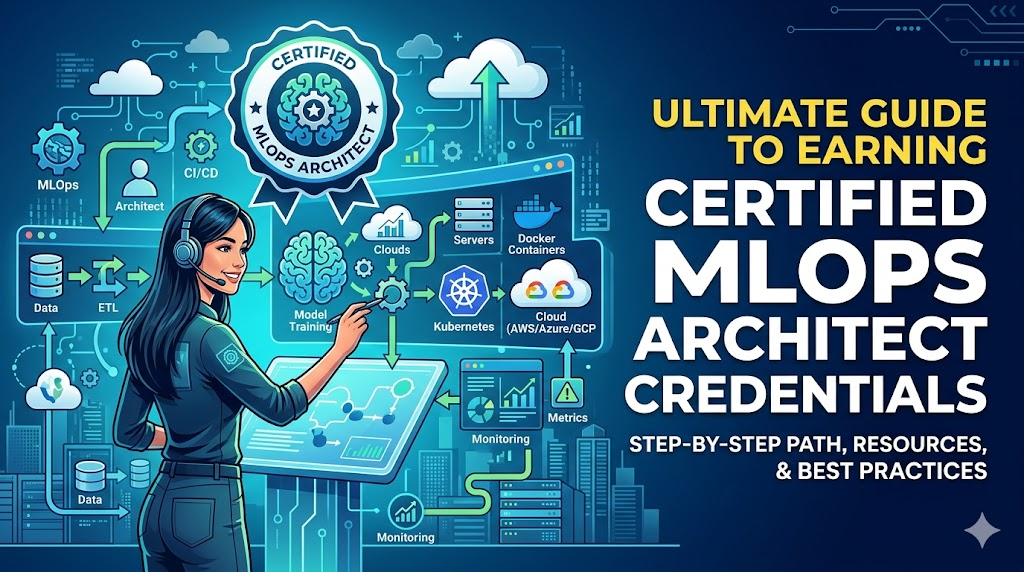
Certified MLOps Architect is an advanced certification for professionals who want to design, manage, and improve machine learning systems at enterprise scale. It is not only about building models. It is about creating the full platform, process, governance, automation, monitoring, and infrastructure that allow machine learning models to move safely from development to production.
For developers, DevOps engineers, SREs, cloud professionals, data engineers, and beginners planning a long-term AI engineering career, this certification gives a clear direction. Modern companies are not only asking whether a model works. They want to know whether it can be deployed reliably, monitored continuously, secured properly, scaled across teams, and improved without breaking business systems.
The Certified MLOps Architect certification from AIOps School helps learners understand this bigger picture. It connects machine learning, DevOps, cloud infrastructure, automation, compliance, observability, and platform engineering into one practical career path.
What is the Certified MLOps Architect?
Certified MLOps Architect is a professional credential focused on designing enterprise-ready machine learning platforms. It teaches how to plan ML infrastructure, automate ML pipelines, manage model lifecycle, build governance, design scalable architecture, and support multiple teams using a shared ML platform.
In simple words, an MLOps Architect builds the system behind machine learning success. Data scientists may create models, developers may write application code, and DevOps engineers may manage deployment pipelines. However, the MLOps Architect connects all these areas into one reliable operating model.
The certification is useful because many organizations struggle after model development. A model may perform well in a notebook, but real production environments need version control, CI/CD, feature stores, monitoring, rollback strategies, access control, cost control, and compliance. Certified MLOps Architect prepares professionals to solve these real problems.
Who Should Pursue Certified MLOps Architect?
Certified MLOps Architect is suitable for professionals who want to move beyond basic machine learning deployment and understand the full production lifecycle.
Developers can pursue it if they want to work on AI-enabled applications, model APIs, deployment automation, and production engineering. DevOps engineers can use it to expand their skills into ML pipelines, model release workflows, infrastructure automation, and monitoring. SREs can benefit because ML systems need reliability, uptime, incident response, performance tracking, and observability.
Cloud engineers can pursue this certification to understand how ML workloads run across cloud-native platforms, Kubernetes, storage, networking, security, and compute environments. Security engineers can use it to understand access control, data privacy, secure pipelines, model governance, and audit readiness.
Engineering managers and technical leaders can also pursue this certification because MLOps architecture is not only a technical issue. It affects team structure, delivery speed, risk control, cost, hiring, and long-term AI strategy.
Why Certified MLOps Architect is Valuable
Certified MLOps Architect is valuable because companies are increasingly investing in AI and machine learning, but many of them face execution challenges. They may have skilled data scientists, but they often lack a reliable process for deploying and managing models in production.
This certification helps professionals understand how to build repeatable systems. Instead of treating every ML project as a separate experiment, an MLOps Architect creates standard patterns, reusable platforms, shared pipelines, and governance practices.
It also improves career direction. A professional who understands both engineering and machine learning operations can work across many roles, including ML platform engineer, MLOps engineer, cloud architect, AI infrastructure specialist, DevOps lead, SRE lead, and technical architect.
The long-term value is strong because production AI systems require continuous maintenance. Models drift, data changes, business rules change, security policies evolve, and infrastructure costs increase. Certified MLOps Architect prepares professionals to manage these realities with practical architecture thinking.
Certified MLOps Architect Certification Overview
Certified MLOps Architect is delivered through the official course page linked in the introduction and hosted on the AIOps School website. It is designed for professionals who want to understand enterprise-grade MLOps architecture, not just basic model deployment.
The certification focuses on platform architecture, scalable ML pipelines, data and feature platform design, multi-cloud ML strategy, security, compliance, governance, and organization-wide ML enablement.
Learners should expect advanced concepts. This certification is best suited for professionals who already understand DevOps, cloud, CI/CD, containers, data pipelines, or machine learning basics. Beginners can still use it as a roadmap, but they should build foundation skills before attempting advanced architecture topics.
Certified MLOps Architect Certification Tracks & Levels
Certified MLOps Architect can be understood through three practical learning levels: foundation, professional, and advanced. These levels help learners move step by step instead of jumping directly into complex architecture.
The foundation level focuses on basic concepts such as ML lifecycle, DevOps principles, data pipelines, model deployment, and cloud basics.
The professional level focuses on production practices such as CI/CD for ML, experiment tracking, model registry, monitoring, automation, security, and collaboration between teams.
The advanced level focuses on architecture decisions such as enterprise ML platforms, multi-cloud strategy, feature platforms, governance, cost optimization, compliance, and organization-wide enablement.
Complete Certified MLOps Architect Certification Table
| Track | Level | Who it’s for | Prerequisites | Skills Covered | Recommended Order |
|---|---|---|---|---|---|
| MLOps Foundation | Foundation | Beginners, developers, junior DevOps engineers | Basic programming, Linux, cloud awareness | ML lifecycle, CI/CD basics, containers, model deployment basics | First |
| MLOps Professional | Professional | DevOps engineers, cloud engineers, data engineers, SREs | Foundation-level MLOps, CI/CD, cloud, containers | ML pipelines, model registry, monitoring, automation, collaboration | Second |
| Certified MLOps Architect | Advanced | Senior engineers, architects, managers, platform leads | Production ML experience, DevOps, cloud, platform knowledge | Enterprise ML architecture, multi-cloud, governance, security, feature platforms | Third |
Detailed Guide for Each Certified MLOps Architect Certification
Foundation Level
What it is
The foundation level introduces the basic building blocks of MLOps. It explains how machine learning models are developed, tested, packaged, deployed, monitored, and improved over time.
This level is important because many beginners think MLOps starts only after a model is created. In reality, MLOps begins much earlier with data quality, experiment tracking, versioning, reproducibility, and collaboration.
Who should take it
Developers, beginners, junior DevOps engineers, cloud learners, and students should start here. Anyone who understands basic programming but is new to production machine learning should treat this as the first step.
Skills you’ll gain
You will learn ML lifecycle basics, version control, CI/CD fundamentals, containers, cloud deployment concepts, basic monitoring, and the difference between software deployment and model deployment.
Real-world projects
Good foundation projects include deploying a simple model as an API, using version control for model code, containerizing an ML application, creating a basic deployment pipeline, and monitoring model response time.
Preparation plan
For 7 days, focus on ML lifecycle, DevOps basics, and container concepts. For 30 days, build a small model deployment project and document the process. For 60 days, add CI/CD, basic monitoring, logging, and simple rollback practices.
Common mistakes
The most common mistake is learning only theory without building anything. Another mistake is focusing too much on model accuracy and ignoring deployment, reproducibility, and monitoring.
Next certification
After completing the foundation level, learners should move to the professional level to understand production workflows and team-based MLOps practices.
Professional Level
What it is
The professional level focuses on production implementation. It teaches how ML pipelines work in real environments and how teams manage model development, testing, approval, deployment, and monitoring.
This level connects data science, DevOps, cloud infrastructure, and software engineering into a practical workflow.
Who should take it
DevOps engineers, SREs, cloud engineers, data engineers, backend developers, and ML engineers should take this level if they already understand basic MLOps concepts and want to work on real production systems.
Skills you’ll gain
You will gain skills in automated ML pipelines, model registry, experiment tracking, CI/CD for ML, feature management, testing, monitoring, observability, infrastructure automation, and team collaboration.
Real-world projects
Useful projects include building an end-to-end ML pipeline, creating a model approval workflow, setting up model monitoring, automating deployment to cloud infrastructure, and connecting a model registry with CI/CD.
Preparation plan
For 7 days, revise CI/CD, containers, orchestration, and ML lifecycle. For 30 days, build one complete ML pipeline with automation and monitoring. For 60 days, add security checks, approval gates, model versioning, rollback strategy, and documentation.
Common mistakes
Many learners ignore data pipelines and focus only on model deployment. Another mistake is not testing models properly before deployment. Some professionals also forget that ML monitoring must track both system performance and model behavior.
Next certification
After the professional level, the next step is Certified MLOps Architect. This advanced level teaches how to design platforms and systems for many teams, not just one project.
Advanced Level
What it is
The advanced level is the Certified MLOps Architect stage. It focuses on architecture, strategy, governance, scalability, security, multi-cloud design, feature platforms, and organization-wide ML enablement.
This level is about decision-making. An architect must understand trade-offs, choose suitable tools, design reusable systems, control risk, and align technology with business needs.
Who should take it
Senior DevOps engineers, senior SREs, ML platform engineers, cloud architects, technical leads, principal engineers, engineering managers, and AI infrastructure leaders should take this level.
Skills you’ll gain
You will gain skills in enterprise ML platform design, scalable pipeline architecture, multi-cloud ML strategy, feature store planning, model governance, audit readiness, privacy controls, platform adoption, cost optimization, and technical leadership.
Real-world projects
Advanced projects include designing a shared ML platform for multiple teams, creating a feature platform strategy, planning model governance workflows, building multi-cloud ML architecture, and designing an observability system for hundreds of models.
Preparation plan
For 7 days, study enterprise architecture concepts and review production ML patterns. For 30 days, design a sample ML platform architecture with pipelines, security, monitoring, and governance. For 60 days, add multi-cloud strategy, cost planning, compliance controls, team enablement, and architecture documentation.
Common mistakes
A common mistake is thinking architecture means only choosing tools. Real architecture means understanding users, scale, security, cost, maintainability, and organizational adoption. Another mistake is designing a complex platform before understanding team maturity.
Next certification
After Certified MLOps Architect, professionals can move into related advanced tracks such as AIOps Architect, DevOps Architect, SRE Architect, DataOps Architect, FinOps Architect, or leadership-oriented certifications.
Choose Your Learning Path
DevOps Path
The DevOps path is suitable for engineers who already work with CI/CD, containers, cloud infrastructure, automation, and release management. For them, MLOps is a natural next step because ML systems also need reliable deployment pipelines.
Start with MLOps foundation concepts, then move into ML CI/CD, model packaging, registry workflows, infrastructure as code, monitoring, and rollback strategies. The final step is learning how to design reusable ML platforms for different teams.
DevSecOps Path
The DevSecOps path is for professionals who care about secure engineering practices. Machine learning systems involve sensitive data, model access, pipeline permissions, dependency risks, and audit requirements.
This path should focus on secure ML pipelines, access control, data protection, model governance, privacy, compliance, and risk management. Certified MLOps Architect helps DevSecOps professionals understand how security fits into every layer of the ML platform.
SRE Path
The SRE path focuses on reliability, performance, observability, incident response, and service-level thinking. ML systems need SRE practices because models can fail in ways that normal applications do not.
SRE learners should focus on model monitoring, drift detection, latency, error budgets, incident response, rollback strategy, capacity planning, and production readiness. Certified MLOps Architect helps SREs design reliable ML platforms at scale.
AIOps Path
The AIOps path is useful for professionals working with intelligent IT operations, anomaly detection, event correlation, automated remediation, and operational intelligence.
AIOps professionals can benefit from Certified MLOps Architect because many AIOps systems depend on machine learning models running in production. Understanding MLOps helps them manage data pipelines, model behavior, monitoring, and automation quality.
MLOps Path
The MLOps path is the direct path for professionals who want to specialize in production machine learning. It includes model lifecycle management, experiment tracking, feature stores, model deployment, governance, monitoring, and scalable ML architecture.
Certified MLOps Architect is the advanced stage of this path. It prepares learners to move from project-level implementation to enterprise-level platform leadership.
DataOps Path
The DataOps path is useful for data engineers and analytics professionals. ML systems depend heavily on data quality, data pipelines, metadata, lineage, governance, and feature engineering.
DataOps professionals should focus on data reliability, pipeline automation, feature platform design, data contracts, observability, and governance. Certified MLOps Architect helps them connect data platforms with production ML requirements.
FinOps Path
The FinOps path is important because ML workloads can become expensive. Training, inference, storage, GPUs, cloud services, and data processing can create serious cost challenges.
FinOps professionals can use Certified MLOps Architect knowledge to understand workload placement, resource optimization, cost monitoring, cloud budgeting, and platform efficiency. This is valuable for organizations running large-scale AI systems.
Role → Recommended Certified MLOps Architect Certifications
| Role | Recommended Certifications |
|---|---|
| Beginner Developer | MLOps Foundation, Cloud Foundation, DevOps Foundation |
| DevOps Engineer | MLOps Foundation, MLOps Professional, Certified MLOps Architect |
| SRE Engineer | SRE Foundation, MLOps Professional, Certified MLOps Architect |
| Cloud Engineer | Cloud Professional, MLOps Professional, Certified MLOps Architect |
| Data Engineer | DataOps Foundation, MLOps Professional, Certified MLOps Architect |
| Security Engineer | DevSecOps Foundation, MLOps Professional, Certified MLOps Architect |
| ML Engineer | MLOps Professional, Certified MLOps Architect |
| Engineering Manager | MLOps Foundation, Certified MLOps Architect, Leadership Track |
| Platform Architect | MLOps Professional, Certified MLOps Architect, AIOps Architect |
| Technical Consultant | Certified MLOps Architect, DevOps Architect, DataOps Architect |
Next Certifications to Take After Certified MLOps Architect
Same Track
After Certified MLOps Architect, professionals can continue deepening their expertise in advanced MLOps, ML platform engineering, model governance, and AI infrastructure architecture. The same-track path is best for people who want to become specialists in production machine learning systems.
This path is useful for ML platform architects, principal engineers, and senior consultants who want to design large-scale AI platforms for enterprises.
Cross Track
Cross-track certifications help professionals connect MLOps with nearby disciplines. DevOps, SRE, DevSecOps, DataOps, AIOps, and FinOps all connect strongly with MLOps.
A DevOps certification can improve automation knowledge. An SRE certification can strengthen reliability thinking. A DevSecOps certification can improve secure pipeline design. A DataOps certification can improve data quality and lineage skills. A FinOps certification can help manage cloud cost.
Leadership Track
The leadership track is suitable for engineering managers, platform leaders, principal architects, and consultants. It focuses on strategy, governance, communication, team enablement, stakeholder management, and technology decision-making.
Certified MLOps Architect can support leadership roles because AI platforms affect many teams. Leaders need to understand not only tools but also adoption, cost, compliance, culture, and long-term platform maturity.
Why Certified MLOps Architect Matters for Developers and DevOps Readers
Certified MLOps Architect matters for developers and DevOps readers because AI is becoming part of normal software delivery. Applications are no longer limited to static business logic. Many modern systems now include recommendations, predictions, anomaly detection, personalization, fraud detection, automation, and intelligent decision support.
For developers, this certification helps explain how models become production services. It shows how APIs, data pipelines, model versions, testing, monitoring, and deployment workflows work together.
For DevOps engineers, it creates a bridge between traditional CI/CD and ML-specific delivery. Normal application deployment is usually code-focused. ML deployment also involves data, models, features, experiments, drift, and retraining.
For beginners, the certification gives a roadmap. Instead of learning random tools, they can understand the full structure of MLOps step by step. They can see how Linux, Git, Python, Docker, Kubernetes, cloud, CI/CD, data pipelines, and monitoring connect with machine learning.
The practical career impact is strong. A professional who understands MLOps architecture can contribute to AI projects more confidently. They can help teams reduce deployment delays, improve reliability, control cloud cost, maintain governance, and create repeatable systems.
Training & Certification Support Providers for Certified MLOps Architect
DevOpsSchool
DevOpsSchool is known for professional training and certification support across DevOps, DevSecOps, SRE, cloud, automation, and platform engineering areas. For learners preparing for Certified MLOps Architect, DevOpsSchool can be useful because MLOps depends strongly on DevOps fundamentals. Concepts such as CI/CD, infrastructure as code, containers, Kubernetes, monitoring, automation, release management, and collaboration are important before moving into advanced ML platform architecture. DevOpsSchool-style learning can help professionals build the engineering base needed for MLOps. It is especially useful for DevOps engineers who want to expand their career into machine learning operations and AI platform engineering.
Cotocus
Cotocus focuses on technology services, consulting, automation, DevOps, cloud, and digital engineering support. For Certified MLOps Architect learners, Cotocus can be relevant from a practical implementation angle. MLOps architecture is not only about passing an exam. It also requires understanding how businesses execute real technology projects. Cotocus-style expertise can help learners think about delivery models, client requirements, automation strategy, platform implementation, and scalable engineering practices. Professionals who want to work in consulting, enterprise delivery, or digital transformation can benefit from this practical mindset. It helps connect certification knowledge with real business execution.
Scmgalaxy
Scmgalaxy is strongly connected with software configuration management, DevOps, build tools, release engineering, and automation learning. These areas are important for Certified MLOps Architect preparation because production ML systems need controlled versions of code, data, models, configurations, and deployment environments. Learners who understand SCM practices can better manage reproducibility, traceability, rollback, and governance in ML projects. Scmgalaxy can support professionals who want to strengthen the foundation behind MLOps pipelines. It is especially useful for engineers who want to move from traditional release management into AI and ML platform delivery.
BestDevOps
BestDevOps is useful for learners looking at DevOps certifications, career direction, salary awareness, skill roadmaps, and professional growth in modern engineering. For Certified MLOps Architect learners, BestDevOps can help frame MLOps as part of a larger DevOps career journey. Many professionals first build DevOps skills and then move toward cloud, SRE, DevSecOps, platform engineering, and MLOps. BestDevOps-style guidance can help learners understand where this certification fits in their career path. It can also help professionals compare learning priorities and choose the right certification sequence based on their role and experience.
devsecopsschool.com
devsecopsschool.com is relevant for professionals who want to understand secure software delivery, compliance, risk management, secure pipelines, and security automation. Certified MLOps Architect includes many security-related concerns because ML systems often handle sensitive data, business-critical predictions, and production model endpoints. Learners must understand access control, data privacy, secure model deployment, pipeline security, dependency risk, and audit readiness. DevSecOps knowledge helps MLOps architects design platforms that are not only scalable but also secure. This is especially valuable for professionals working in finance, healthcare, enterprise software, government projects, or regulated industries.
sreschool.com
sreschool.com is useful for professionals who want to build reliability, observability, incident management, and production operations skills. MLOps systems need SRE thinking because models can fail due to infrastructure issues, data drift, latency problems, poor monitoring, or unexpected input patterns. Certified MLOps Architect learners can benefit from SRE concepts such as service-level objectives, error budgets, alerting, capacity planning, post-incident reviews, and reliability engineering. SRE knowledge helps architects design ML platforms that are stable and measurable. This is important when models support customer-facing products or critical business processes.
aiopsschool.com
aiopsschool.com is directly relevant to Certified MLOps Architect because it focuses on AIOps, MLOps, training, certifications, and AI-driven operations. The platform supports learners who want to understand how artificial intelligence and operational engineering connect in real environments. For this certification, aiopsschool.com provides the main learning direction around ML platform architecture, scalable pipelines, feature platforms, multi-cloud ML, security, compliance, and organization-wide enablement. It is especially useful for professionals who want a structured path from foundation-level knowledge to architect-level expertise. Learners can use it to build both conceptual understanding and practical architecture confidence.
dataopsschool.com
dataopsschool.com is useful for professionals who want to improve data pipeline, data quality, data governance, and analytics operations knowledge. Certified MLOps Architect depends heavily on strong data practices because machine learning models are only as reliable as the data behind them. DataOps knowledge helps learners understand lineage, metadata, data validation, pipeline automation, feature engineering, and governance. These skills are critical when designing enterprise ML platforms. For data engineers and analytics professionals, dataopsschool.com can help create a bridge from data operations to MLOps architecture. It supports the data foundation required for reliable production AI systems.
finopsschool.com
finopsschool.com is useful for professionals who want to understand cloud cost management, budgeting, optimization, and financial accountability in technology operations. Certified MLOps Architect learners should care about FinOps because ML workloads can be expensive. Training jobs, GPUs, storage, inference services, experiments, and multi-cloud infrastructure can increase cost quickly. FinOps knowledge helps architects design platforms that balance performance and budget. It also helps teams create cost visibility, resource policies, workload optimization, and chargeback models. For senior engineers and managers, FinOps knowledge adds strong business value to MLOps architecture decisions.
Frequently Asked Questions
- What is Certified MLOps Architect?
Certified MLOps Architect is an advanced certification focused on designing enterprise-grade machine learning platforms, pipelines, governance systems, monitoring practices, and production ML architecture.
- Is Certified MLOps Architect suitable for beginners?
It is mainly an advanced certification, but beginners can use it as a career roadmap. They should first learn programming, DevOps basics, cloud, containers, CI/CD, and ML lifecycle concepts.
- Do DevOps engineers need MLOps skills?
Yes, DevOps engineers can benefit from MLOps skills because ML systems also need automation, CI/CD, monitoring, infrastructure, rollback, security, and deployment governance.
- How is MLOps different from DevOps?
DevOps focuses mainly on software delivery, while MLOps includes software, data, models, experiments, features, monitoring, drift, retraining, and model governance.
- Is cloud knowledge required for MLOps?
Cloud knowledge is highly useful because many ML workloads run on cloud infrastructure. Learners should understand compute, storage, networking, containers, Kubernetes, and cloud security basics.
- Can SRE professionals move into MLOps?
Yes, SRE professionals can move into MLOps because production ML systems need reliability, observability, incident response, performance monitoring, and operational excellence.
- What skills should I learn before Certified MLOps Architect?
You should learn Python basics, DevOps, CI/CD, Docker, Kubernetes, cloud platforms, data pipelines, monitoring, model deployment, and basic machine learning concepts.
- Does MLOps require deep data science knowledge?
Deep data science knowledge is helpful but not always mandatory. MLOps architects mainly focus on production systems, platform design, pipelines, governance, reliability, and infrastructure.
- What jobs can Certified MLOps Architect support?
It can support roles such as MLOps engineer, ML platform architect, AI infrastructure engineer, DevOps lead, SRE lead, cloud architect, technical consultant, and engineering manager.
- Is MLOps useful for small companies?
Yes, small companies also need reliable model deployment, monitoring, cost control, and repeatable workflows. The scale may be smaller, but the principles remain useful.
- How long does it take to prepare?
Preparation time depends on experience. Professionals with DevOps and ML exposure may prepare faster, while beginners may need several months to build the required foundation.
- Is Certified MLOps Architect worth it for managers?
Yes, it can help managers understand AI platform decisions, delivery risks, team responsibilities, governance needs, cost control, and long-term technical planning.
FAQs on Certified MLOps Architect
- What makes Certified MLOps Architect different from basic MLOps certifications?
Certified MLOps Architect focuses on enterprise architecture, multi-team platforms, governance, security, scalability, and strategic design. Basic certifications usually focus on core concepts and simple implementation.
- Does Certified MLOps Architect cover multi-cloud ML?
Yes, the certification includes multi-cloud ML thinking, workload placement, cloud-agnostic architecture, cost awareness, and infrastructure strategy for large ML systems.
- Does this certification include security and compliance?
Yes, security and compliance are important parts of MLOps architecture. Learners should understand access control, data protection, audit readiness, pipeline security, and model governance.
- Is Certified MLOps Architect useful for platform engineers?
Yes, platform engineers can benefit because MLOps architecture often involves building self-service platforms, shared pipelines, developer experience, infrastructure automation, and reusable services.
- What type of projects should I build for preparation?
You should build projects involving model deployment, CI/CD, model registry, monitoring, feature management, cloud infrastructure, security controls, and platform architecture documentation.
- Can I take Certified MLOps Architect without MLOps experience?
It is better to have production ML, DevOps, cloud, or platform experience first. Without that background, the advanced architecture concepts may be difficult to apply.
- How does Certified MLOps Architect help career growth?
It helps professionals move toward senior roles that require architecture thinking, cross-team leadership, platform design, cloud strategy, governance, and AI infrastructure planning.
- Is Certified MLOps Architect only for machine learning engineers?
No. It is also useful for DevOps engineers, SREs, cloud engineers, data engineers, security engineers, platform engineers, managers, and technical consultants.
Final Thoughts: Is Certified MLOps Architect Worth It?
Certified MLOps Architect is worth it for professionals who want to work seriously with production machine learning systems. It is not a basic certification for casual learning. It is more suitable for people who want to design platforms, lead technical decisions, support multiple teams, and solve real enterprise AI challenges.
The certification is valuable because it teaches a complete view of MLOps. It covers not only model deployment but also architecture, pipelines, security, governance, monitoring, scalability, cost, and organizational enablement.
For developers and DevOps engineers, it can open a path toward AI infrastructure and ML platform roles. For SREs, it adds model reliability and observability knowledge. For cloud and data engineers, it connects infrastructure and data pipelines with production AI systems. For managers, it provides a better understanding of AI delivery risks and platform strategy.
The honest answer is simple: Certified MLOps Architect is worth it if your goal is long-term growth in AI engineering, platform engineering, DevOps, SRE, cloud, or technical leadership. It requires preparation, hands-on practice, and real understanding. But for professionals who want to stay relevant in modern engineering careers, it can be a strong and practical certification path.






Top comments (0)