


GPT is one named family inside the broader LLM category. In 2026, the practical choice comes down to task, latency, cost, and control, not the label.
That sounds obvious, but the GPT vs LLM framing still leads teams toward the wrong evaluation. GPT became the best-known productized branch of the LLM market after ChatGPT launched in November 2022, yet the broader category now includes closed APIs, open-weight models, mixture-of-experts systems, and self-hosted deployments with very different operational constraints. Recent adoption research also describes the post-ChatGPT rise in LLM use as a catalyst for the wider market, not merely a milestone for one vendor.
The useful question isn't “Which label is better?” It's “Which model family and deployment topology fit this workload?”
| Decision area | GPT-branded API | Broader LLM category |
|---|---|---|
| Model access | Usually hosted, closed-weight endpoint | Hosted APIs or downloadable open weights |
| Operating model | Token spend and provider limits | Token spend, GPU cost, or both |
| Customization | Prompting, tools, fine-tuning where offered | Self-hosting, tuning, quantization, routing |
| Privacy control | Provider-controlled processing model | Operator-controlled when self-hosted |
| Best initial fit | Variable traffic and fast integration | Predictable workloads and deployment control |
| Main failure mode | Cost, quotas, vendor dependency | VRAM, serving complexity, maintenance |
Table of Contents
- What GPT and LLM Actually Mean
- How GPT Fits the Broader LLM Timeline
- Architecture and Deployment Differences
- Cost and Capacity Tradeoffs Across Families
- Choosing Between a GPT API and an Open-Weight LLM
- Why Output Quality Is the Wrong Question
- A Practical Selection Path by Workload
What GPT and LLM Actually Mean
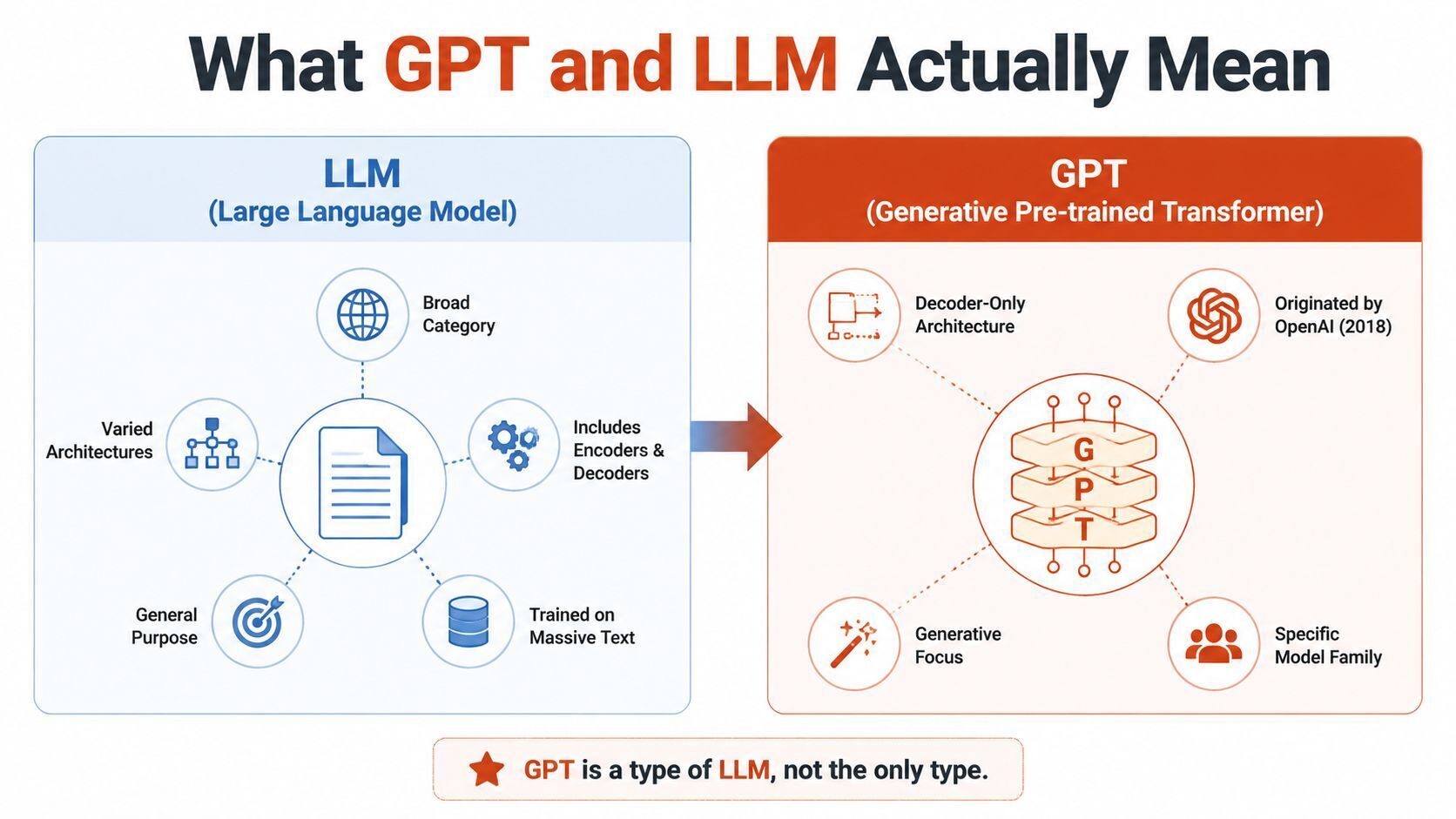
GPT, or Generative Pre-trained Transformer, is a specific family of decoder-only transformer models originated by OpenAI. LLM, or large language model, is the umbrella category covering language models trained on broad text corpora at scale. The relationship is simple: every GPT model is an LLM, but most LLMs aren't GPT models. The broader LLM definition makes that category boundary clear.
GPT models use a generative, next-token prediction design. Given tokens already in the sequence, the model predicts what should come next. The GPT name identifies OpenAI's model lineage, not every language model that generates text.
LLM is the category name. It includes GPT, BERT-derived systems, T5, Claude, Gemini, Llama, Mistral, Qwen, DeepSeek, and other families. These models can use different architectures, training mixtures, serving methods, and ownership models.
Three naming mistakes that cause bad architecture decisions
- GPT doesn't mean ChatGPT. ChatGPT is a product interface and service. GPT refers to a model family, although OpenAI has reused the name across product generations.
- GPT doesn't mean every OpenAI model. OpenAI products can include models or systems that aren't interchangeable GPT endpoints.
- LLM doesn't mean open source. Many LLMs are closed services, and “open-weight” isn't identical to “open source” because licensing, training data, and tooling can differ.
The historical line began with GPT-1 in June 2018. It established the now-familiar pattern of pre-training on large text corpora and then adapting a model for downstream tasks. GPT-1 used 117 million parameters, GPT-2 arrived in February 2019, and GPT-3 launched in June 2020 with 175 billion parameters, roughly 100 times larger than GPT-2. The GPT timeline documents that progression.
For engineers, the right mental model is a taxonomy plus an operations matrix. GPT is a brand lineage within LLMs. The production axes are vendor, weights access, serving location, data handling, latency, cost, and control. A public model claim such as “GPT parity” still needs workload-specific evidence, as shown by this model parity prompt record.
How GPT Fits the Broader LLM Timeline
GPT matters because of its timing, scale, and effect on how developers use language models. It does not represent the entire LLM field. Modern LLM history is commonly anchored around 2018, when GPT-1 appeared and BERT followed later that year. BERT's bidirectional design set benchmarks across NLP tasks and entered Google Search, while population-level research summarized in this LLM usage study examined its broader use.
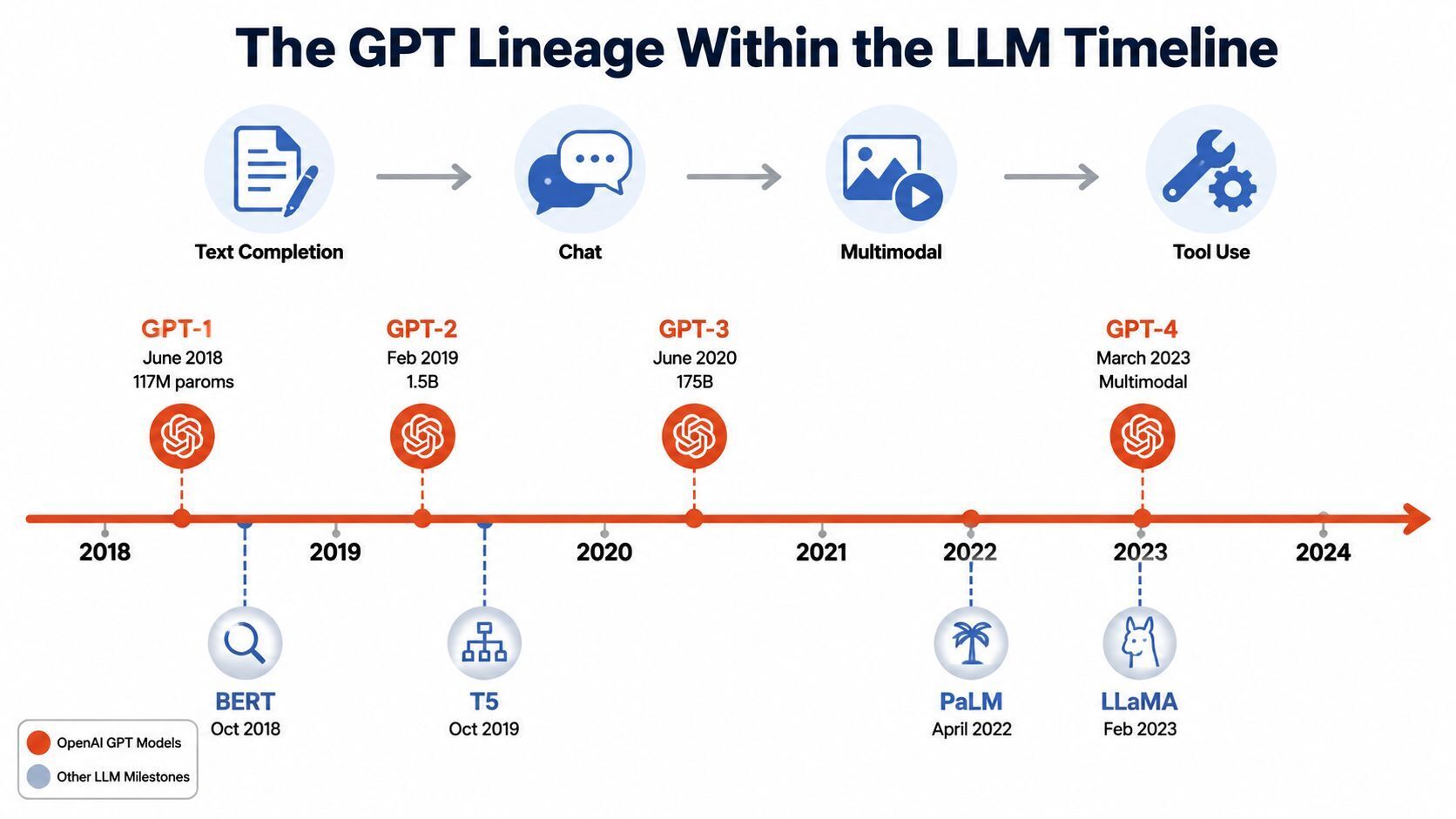
GPT-1 was a decoder-only proof of concept. GPT-2 showed how scaling could improve continuation without a separate task head for each use case. GPT-3, released in June 2020, made in-context learning practical for application developers. Its 175 billion parameters marked a major scale increase and pushed language modeling toward more general-purpose behavior.
GPT-3.5 and InstructGPT brought another shift in 2022. Reinforcement learning from human feedback improved instruction following, while ChatGPT's November 2022 launch moved the family into mainstream consumer and enterprise use. GPT-4 followed in March 2023 with multimodal input. GPT-4 Turbo and GPT-4o then targeted lower latency and more realtime multimodal interaction.
GPT was never the whole field
Other model families shaped the category:
- BERT, an encoder-only architecture, emphasized language understanding rather than open-ended generation.
- T5 used an encoder-decoder design and represented tasks as text-to-text transformations.
- PaLM and later Gemini releases extended Google's large-scale general model work.
- LLaMA, followed by LLaMA 2 and LLaMA 3, made downloadable weights central to developer decisions.
- Mistral 7B and Mixtral showed that smaller and mixture-of-experts models could compete on selected workloads.
- Claude 3, Claude 3.5, and Claude 4 became alternatives for reasoning, writing, coding, and agent workflows.
- DeepSeek-V3 and DeepSeek-R1 added competition across open-weight and reasoning-focused deployments.
Current release tracking covers families such as GPT, Claude, Gemini, Llama, Grok, Mistral, DeepSeek, and Kimi. A model name identifies lineage, not a guaranteed fit or capability ranking. Deployment constraints, governance requirements, and workload shape determine whether that lineage is useful in production.
Historical rule: Treat a model announcement as a versioned implementation, not proof that the entire family fits your workload.
Verify exact versions and dates through the maintained AI model release index. Forward-looking claims require the same discipline. A community post about GPT-5.6 being imminent is not a confirmed release, so engineers should separate roadmap speculation from models available to select, test, and bill.
Architecture and Deployment Differences
GPT-branded systems and other LLMs can produce similar text while creating very different responsibilities for the engineering team. The architecture affects inference behavior, but weights access and deployment topology usually affect the project more.
| Dimension | GPT-branded OpenAI | Broader LLM category |
|---|---|---|
| Core architecture | Primarily decoder-only transformer lineage with next-token generation | Encoder-only, encoder-decoder, decoder-only, and mixture-of-experts designs |
| Weight access | Closed weights through managed endpoints | Hosted APIs or downloadable weights such as Llama, Mistral, Qwen, and DeepSeek |
| Deployment | Provider-hosted REST or compatible API integration | Provider API, third-party endpoint, owned hardware, or cloud GPU |
| Governance | Provider policies, endpoint controls, and available moderation hooks | Operator owns policy enforcement when self-hosting |
| Scaling | Add API capacity within quotas and account limits | Add replicas, GPUs, batching, quantization, and serving infrastructure |
| Context planning | Version-specific limits such as 8K, 32K, or 128K | Version-specific limits, including Gemini-class windows reaching 1M tokens |
| Tool calling | Integrated support varies by model and endpoint | Depends on model, API wrapper, and orchestration layer |
| Primary risk | Vendor dependency, rate limits, and token spend | VRAM pressure, latency tuning, upgrades, and operational load |
Architecture is only one layer of the decision
The broader category includes encoder-only systems such as the BERT family, encoder-decoder systems such as T5 and Flan-T5, and mixture-of-experts systems such as Mixtral and DeepSeek-V3. GPT's decoder-only design is well suited to generation and tool-oriented workflows, but that doesn't make it the right choice for every embedding, classification, or retrieval component.
A hosted GPT API shifts infrastructure complexity away from your team. You still need retries, request tracing, quota handling, structured-output validation, and data classification, but you don't manage model weights, CUDA compatibility, or GPU scheduling.
Open-weight deployment reverses that trade. You can run Llama 3, Mistral, Qwen, or DeepSeek through serving stacks such as vLLM or TGI, tune the model for private data, and place the workload inside infrastructure you control. You also inherit every failure mode that the API provider would otherwise handle.
Governance changes with the topology
A provider API typically comes with usage policies and provider-side controls. A self-hosted model doesn't automatically enforce your application policy. Your team must implement input filtering, output validation, audit logging, retention rules, access controls, and incident response.
Long context also changes engineering behavior. A model with a 128K window isn't automatically cheaper or faster than one with a shorter window. Gemini-class systems can reach 1M-token context windows, but the usefulness depends on retrieval quality, attention behavior, latency, and the amount of context you send.
A distributed deployment can make those choices more complex, especially when several models share inference capacity. This mesh LLM deployment example is useful as an architecture reference, but production teams still need to measure queue time, token throughput, failure recovery, and data boundaries.
Cost and Capacity Tradeoffs Across Families
Token pricing is a workload property, not a model footnote. A short classification request and a long agent loop can use the same model while producing very different bills.
Every token in the context is input. That includes system prompts, conversation history, retrieved documents, tool definitions, and prior turns in an agent loop. Long-context pricing analysis describes the mechanical result: a filled context window can cost substantially more than a short request even when the user task is unchanged.
| Model | Provider or hosting | Context window | Input price | Output price | Notes |
|---|---|---|---|---|---|
| GPT-4o | OpenAI API | Version-specific | Check current index | Check current index | Managed multimodal workflow |
| GPT-4.1 | OpenAI API | Version-specific | Check current index | Check current index | Exact endpoint and cache terms matter |
| Claude Sonnet | Anthropic API | Version-specific | Check current index | Check current index | Common coding and agent option |
| Gemini 1.5 Pro | Google API | Long-context capable | Check current index | Check current index | Capacity must be matched to actual prompt size |
| Llama 3.1 405B | Self-hosted or hosted inference | Deployment-specific | GPU and serving cost | GPU and serving cost | Cost depends on hardware, quantization, batching |
Public comparison data illustrates the spread. One 2026 comparison lists Gemini 2.5 Flash at $0.30 per million input tokens with a 1M-token context window. Other flagship models in the same period have materially different prices and capacity limits, so a single “cheapest model” ranking doesn't survive contact with real prompts. The model pricing breakdown is a useful reference for comparing those tradeoffs.
Context length can dominate the bill
A 128K window gives you room to send more material, but it doesn't make that material free. Retrieved documents, repeated instructions, tool schemas, and accumulated history all count as input. Agent loops are particularly expensive because the same context may be serialized repeatedly.
Cached-input discounts can help where providers offer them, but caching doesn't remove the need to control prompt growth. Track input tokens, output tokens, cache hits, retry volume, and tool-loop depth separately.
For current list prices and model-specific context limits, use a regularly refreshed LLM API pricing reference. Teams comparing provider bills can also see Donely pricing when they need another published pricing reference, but validate the exact model version and billing conditions before committing.
Self-hosting replaces token billing with infrastructure accounting. GPU memory, batching, quantization, utilization, storage, monitoring, and engineering time all become part of the unit cost. The 2026 comparison of API pricing is useful for the initial spreadsheet, but your own traces should decide the final architecture.
Choosing Between a GPT API and an Open-Weight LLM
The GPT versus LLM choice is a false binary. GPT is a model family and API option, while an open-weight LLM is a deployment choice. Start with VRAM budget, latency target, and data residency, then match the workload to the operating model.
A GPT API usually fits variable traffic, teams without GPU operations, and applications that need current tool-calling or vision features without maintaining inference servers. You can ship the application layer first and postpone capacity engineering until usage patterns are clear. The tradeoff is less control over placement, model updates, provider limits, and where prompts and outputs are processed.
Open weights suit predictable, private, or heavily customized workloads. Serving Llama, Mistral, Qwen, or DeepSeek through vLLM or TGI gives direct control over quantization, routing, fine-tuning, and model placement. It also transfers responsibility for capacity planning, upgrades, monitoring, and incident response to your team. A measured open-weights deployment comparison helps separate operating control from assumptions about quality.
Use this deployment checklist
- Measure throughput per H100. Test batch size one for interactive requests, then realistic batching for background work. Do not infer user-facing latency from a throughput result measured under a different queue.
- Budget KV cache pressure. Long prompts and generations consume memory even when model weights fit. Concurrent long-context requests can fail after the initial model load succeeds.
- Set a p99 latency target. Chat, extraction, and asynchronous summarization have different tolerance for queueing and generation time.
- Define data residency. Classify prompts, retrieved documents, tool outputs, and logs. A provider API may suit one data class and be prohibited for another.
- Add observability hooks. Record model version, token counts, latency phases, finish reason, refusal behavior, validation failures, and retry causes.
- Write the rollback story. Keep a tested fallback model or provider, version prompts, and enforce response schemas tightly enough to catch silent degradation.
A predictable workload with sustained infrastructure demand may justify an owned serving layer. The break-even point depends on utilization, staffing, data requirements, and downtime cost, so a fixed monthly threshold is a poor universal rule.
Hybrid routing often fits better than a single-family commitment. A smaller open model can handle classification, extraction, routing, or routine drafting, while GPT handles difficult cases, multimodal inputs, or requests where tool support justifies API costs. Use a current top 7 LLMs for developers list to form candidates, then test them against production traces.
Why Output Quality Is the Wrong Question
Output quality matters, but a single benchmark score rarely predicts whether your service will work. MMLU, GPQA, and HumanEval can help identify capability floors and major gaps, yet production failures often come from latency spikes, malformed JSON, overconfident answers, excessive refusals, or exhausted rate limits.
A model can rank well and still fail the workflow. For example, a code assistant that produces strong implementations but violates your schema, times out during repository retrieval, or consumes too much context may be worse for production than a slightly weaker model with predictable behavior.
Score the interface around the model
Use an evaluation set that measures the contract your application depends on.
- p99 latency: Separate queue time, time to first token, and completion time.
- Structured-output adherence: Validate JSON, tool arguments, enums, and required fields automatically.
- Refusal calibration: Check whether the model refuses unsafe requests without blocking ordinary tasks.
- Rate-limit headroom: Test burst traffic, retries, and provider quota behavior.
- Groundedness: Compare citations or extracted fields against the supplied source material.
- Regression behavior: Re-run the same fixtures after model, prompt, or retrieval changes.
Frontier GPT variants have posted strong public results, including SWE-bench Verified results around the high-70s to low-80s percent range and GPQA Diamond results above 90% for some variants, as summarized in this model leaderboard reference. Those results are useful signals, not procurement decisions.
PromptZone's LLM selection guidance is more useful when treated as a starting matrix for task and constraint matching. The prompt directory shows evidence, not opinion. Public text prompts run in a locked sandbox with no tools, no network, no credentials, synthetic inputs only, and an exact model identity with no provider fallback. The complete output is shown on the prompt page.
Prompts that clear the three-model panel earn the Curated badge only when separate models from different vendors judge usefulness, accuracy, and safety unanimously. Evidence is hashed to the prompt body, so editing the prompt invalidates the badge until the pipeline runs again. That doesn't replace your production evaluation, but it gives you a reproducible baseline instead of a marketing claim.
A Practical Selection Path by Workload
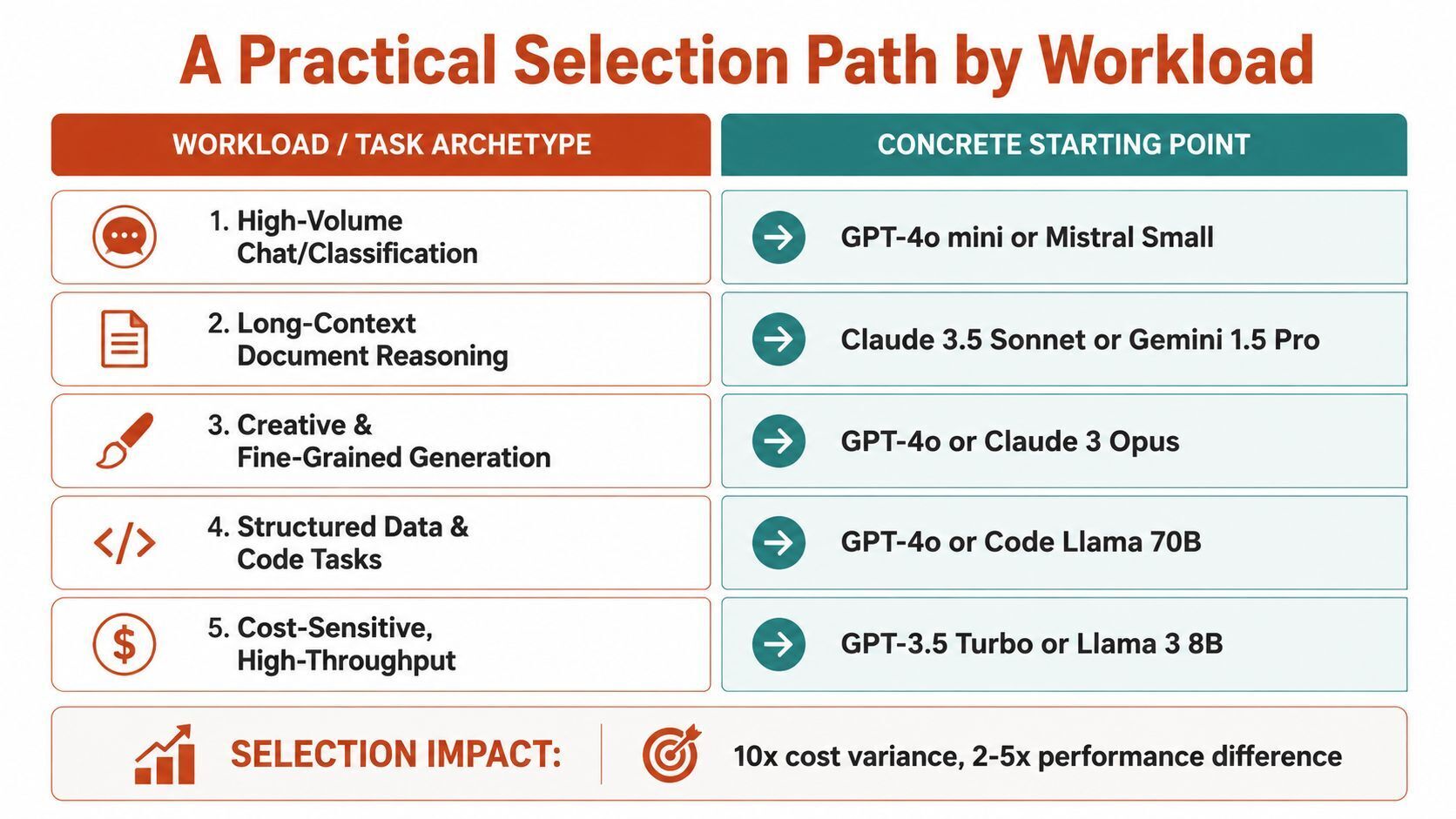
Choose the model from the workload and deployment constraints, not from the GPT or LLM label. One application may need several models. Classification, retrieval, code review, and long-form reasoning impose different requirements for latency, context, privacy, cost, and output control.
| Workload | Starting family | Deployment mode | Watch first |
|---|---|---|---|
| High-volume chat and classification | GPT-4o-class API or a small open model | API or self-hosted | Latency, quotas, and unit cost |
| Long-context document reasoning | Claude Sonnet 4 or Gemini 2.5 Pro | API | Context billing, retrieval quality, and citation accuracy |
| Code generation and review | GPT, Claude, or a coding-tuned open model | API or self-hosted | Tool use, repository context, and patch correctness |
| Private data pipelines | Llama 4 or Mistral | Self-hosted | Residency, quantization, and operational ownership |
| Edge or on-device inference | Small open-weight LLM | Local | Memory, thermal limits, and output quality |
High-volume chat and classification
Start with a fast GPT-4o-class endpoint when traffic varies and managed serving matters. A smaller open model can suit stable, repetitive classification, especially when reserved capacity and predictable unit cost matter. Test confusion cases and routing errors, not only average accuracy. A weak classifier can send too many requests to an expensive fallback.
Long-context document reasoning
Claude Sonnet 4 and Gemini 2.5 Pro fit workloads that require large context windows. Sending every document in full can raise input cost and dilute retrieval quality. Retrieve relevant sections, measure citation accuracy, and account for repeated context in multi-step workflows.
Code and private pipelines
Code evaluation should cover tool calling, patch application, test execution, and recovery after failed commands. Plausible code is insufficient if the model cannot maintain a valid tool protocol through an autonomous loop.
For private pipelines, Llama 4 or Mistral may fit when data residency and control over model weights outweigh access to the newest hosted features. Use a VRAM sizing tool such as PromptZone's LLM GPU calculator, then test the quantized model at the concurrency your service requires.
Edge inference has its own operating limits. The model must fit available memory, stay within thermal constraints, and continue working offline. A smaller model trained or prompted for a narrow, validated task can be easier to operate than a larger API model because it removes the network dependency.
For cutoff dates, exact versions, and newly released families, verify the current information in your release-tracking process. Pair those details with task-specific model selection and your own fixtures. The decision should connect workload evidence to deployment, governance, and capacity requirements, rather than create a permanent preference for GPT or another label.
PromptZone provides model-selection guidance, API and GPU pricing references, release tracking, and a prompt directory with reproducible sandbox evidence for public text prompts. Visit PromptZone to compare candidate models, inspect version-specific workflows, and build a test baseline before committing production traffic.
Made with the Outrank app






Top comments (0)