
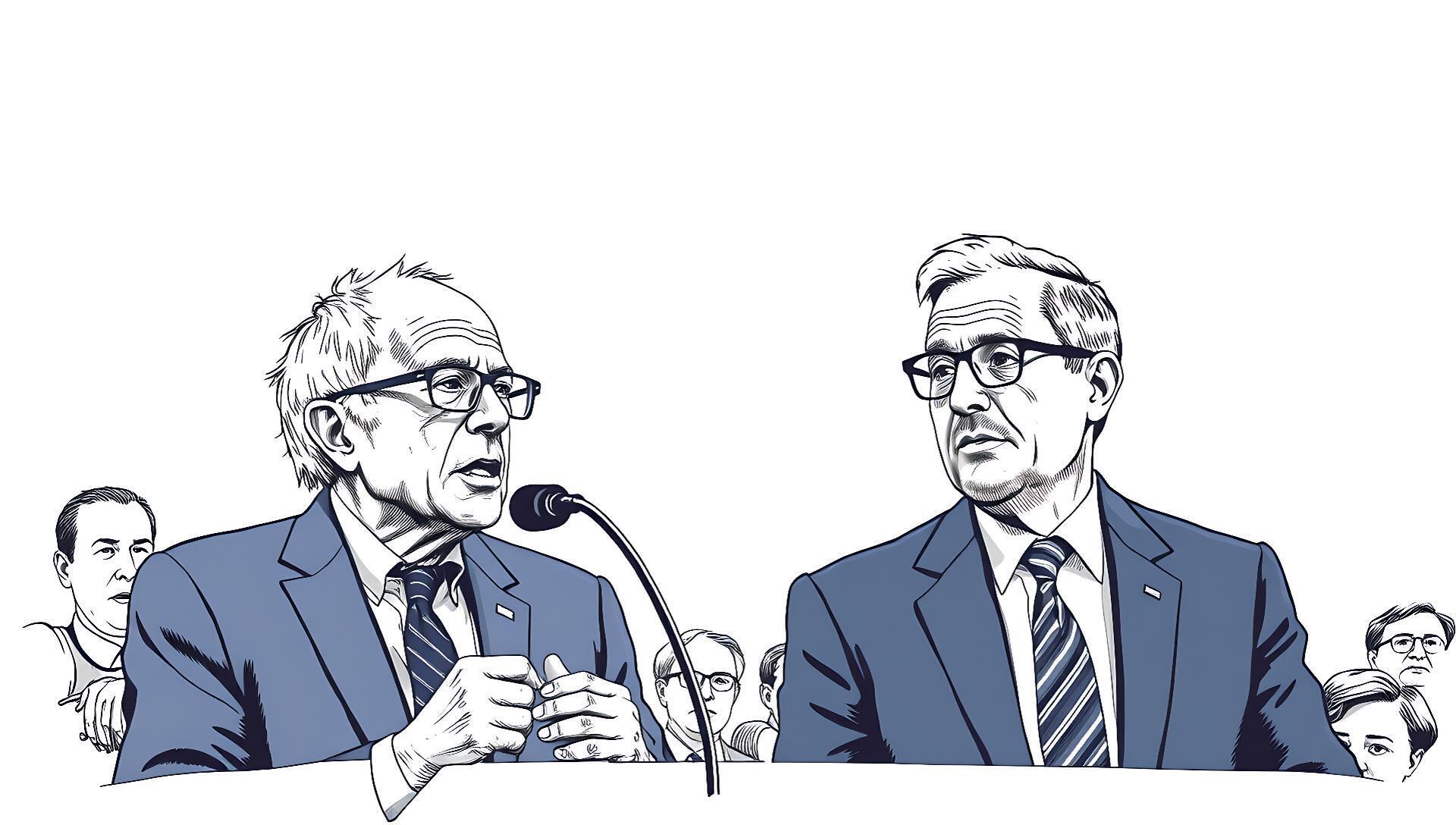

Senator Bernie Sanders and Representative Greg Casar introduced a bill on May 23, 2025, that would enact the most restrictive AI development framework proposed in the United States to date. The legislation, flagged in an AI News discussion, seeks to ban superintelligent AI systems outright and impose a mandatory pause on advanced AI development pending new federal rules.
Key Provisions: Ban on superintelligent AI | Pause on advanced AI development | New Cabinet-level AI department | Penalties: Up to 20 years imprisonment for individuals
What the Bill Actually Does
The proposed bill establishes three immediate legal barriers. First, it institutes a permanent ban on the development or deployment of superintelligent AI, defined as systems that could “outperform humans in virtually all economically and strategically relevant domains.” Second, it mandates a pause on “advanced” AI development until a newly created federal regulator completes a rulemaking process. Third, it creates a new cabinet-level Department of Artificial Intelligence to oversee all regulation and enforcement.
The enforcement mechanisms are severe. The bill proposes criminal penalties for individuals, including fines and imprisonment for up to 20 years for violations. This personal liability clause represents a significant escalation from typical corporate-focused regulations.
How It Compares to Existing Frameworks
This proposal diverges sharply from current U.S. voluntary commitments and the European Union’s risk-based approach. The EU AI Act categorizes systems by risk level (unacceptable, high, limited, minimal) and tailors rules accordingly, while the Sanders-Casar bill imposes blanket prohibitions and a developmental moratorium.
| Regulatory Approach | Sanders-Casar Bill | EU AI Act | U.S. Voluntary Commitments (White House) |
|---|---|---|---|
| Core Mechanism | Ban & Pause | Risk-Based Tiering | Voluntary Safety Standards |
| Superintelligent AI | Explicitly Banned | Not Specifically Addressed | Not Addressed |
| Development Pause | Mandatory for "Advanced AI" | No | No |
| Enforcement | Criminal Penalties (Individual) | Fines on Providers | N/A (Voluntary) |
| Governing Body | New Cabinet Department | Existing EU Agencies | NIST-led Frameworks |
The bill’s definition of “advanced AI” remains broad, potentially covering today’s leading frontier models. This creates more uncertainty than the EU’s specific thresholds based on compute power (FLOPs).
Immediate Implications for Practitioners
For AI researchers and engineers at frontier labs, the bill’s passage would trigger an immediate operational halt. Work on models exceeding certain capability benchmarks—yet to be defined by the new department—would become illegal. The personal criminal liability is the most striking element, moving beyond corporate fines to target individual engineers and executives.
For the broader developer community, the pause creates a chilling effect on open-source releases. Distributing a model that could be classified as “advanced” during the regulatory gap period could carry legal risk. This contrasts with the EU AI Act, which largely exempts open-source models released for research.
Bottom line: The bill replaces today’s compliance-focused landscape with a precriminalization model for frontier AI development.
Who Should Be Most Concerned (And Who Shouldn’t)
This bill directly targets a small group: organizations and individuals working on the frontier of AI capability, often termed “AGI” or “superintelligent” research. Labs like OpenAI, Anthropic, Google DeepMind, and Meta’s FAIR would face an immediate mandate to stop certain research lines.
Most enterprise ML teams and developers working on applied, narrow AI would likely fall outside the “advanced” definition. However, the uncertainty during the rulemaking period could slow investment and deployment across the board as legal teams assess risk.
"Practical Next Steps for Teams"
While the bill’s passage is uncertain, proactive teams can:
The Political and Industry Reality Check
The bill faces steep odds in the current Congress but frames the regulatory debate for the 2024 election cycle. Its introduction signals a growing faction within U.S. politics advocating for a precautionary principle over innovation-centric governance. Early industry reaction, as seen in the source thread, highlights deep concern over the potential for U.S. research to migrate overseas to less restrictive jurisdictions.
Proponents argue the drastic measures are justified by existential risk, citing frameworks like the AI Pause Open Letter from 2023. Critics contend it would cede U.S. technological leadership and stifle beneficial applications, aligning more with think tanks advocating for innovation, such as the Center for Data Innovation.
The proposal’s ultimate impact may be as a negotiation anchor. Even if not passed, it pushes the Overton window on AI regulation toward stricter, more centralized control, influencing the design of more moderate, future legislation.
This bill is less a likely new law and more a stark boundary marker in the evolving debate over who controls the trajectory of advanced AI. Its introduction ensures that discussions of development pauses and outright bans will be part of the U.S. policy conversation, moving beyond theoretical discourse into tangible legislative text.





Top comments (0)