

Picture this: You’ve spent hours crafting an original article, essay, or report. You poured your personal experience into it. Just to be safe, you run it through a popular "free AI detector" before submitting.
The result pops up in bright red: "80% AI Generated."
The frustration is real. False positives are the plague of the generative AI era. Writers are being falsely accused, students are facing academic probation for work they did themselves, and honest content creators are being penalized by search engines.
Why is this happening?
The Problem with "Pattern Matching"
Most first-generation AI detectors rely on simple statistical patterns trained primarily on English data. They look for predictable sentence structures.
The problem is, many human writers—especially in formal or technical contexts—also write predictably. If you follow standard grammar rules perfectly, a basic detector might flag you as a robot.
This flaw becomes glaringly obvious when you test these detectors on complex, high-context languages.
The Ultimate Challenge: Japanese
When we set out to build a better detector, we didn't start with the easy stuff. We started with one of the hardest challenges in Natural Language Processing (NLP): Japanese.
Japanese is notoriously difficult for AI analysis for several reasons:
No Spaces: Words aren't separated by spaces, making tokenization a nightmare.
High Context: Subjects (like "I" or "it") are frequently omitted because they are understood from context—something current AI models struggle to replicate naturally.
Ambiguity: The reliance on kanji and multiple character systems creates layers of nuance that baffle standard algorithms.
We found that most major Western detectors completely fail on Japanese text, either flagging everything as human because they don't understand the structure, or flagging everything as AI because it looks "alien" to their training data.
Building Content True: A Different Approach
We knew that if we could build a system sensitive enough to parse the subtleties of high-context Japanese, we would have an incredibly powerful engine for English as well.
Instead of just looking for surface-level patterns, we developed Content True to analyze the "DNA" of the text using two key metrics:
Perplexity: A measurement of how unpredictable a text is. Humans are surprising writers; AI is mathematically predictable.
Burstiness: The variation in sentence length and structure. Humans write with a rhythm—short sentences mixed with long, complex ones. AI tends to be monotonous.
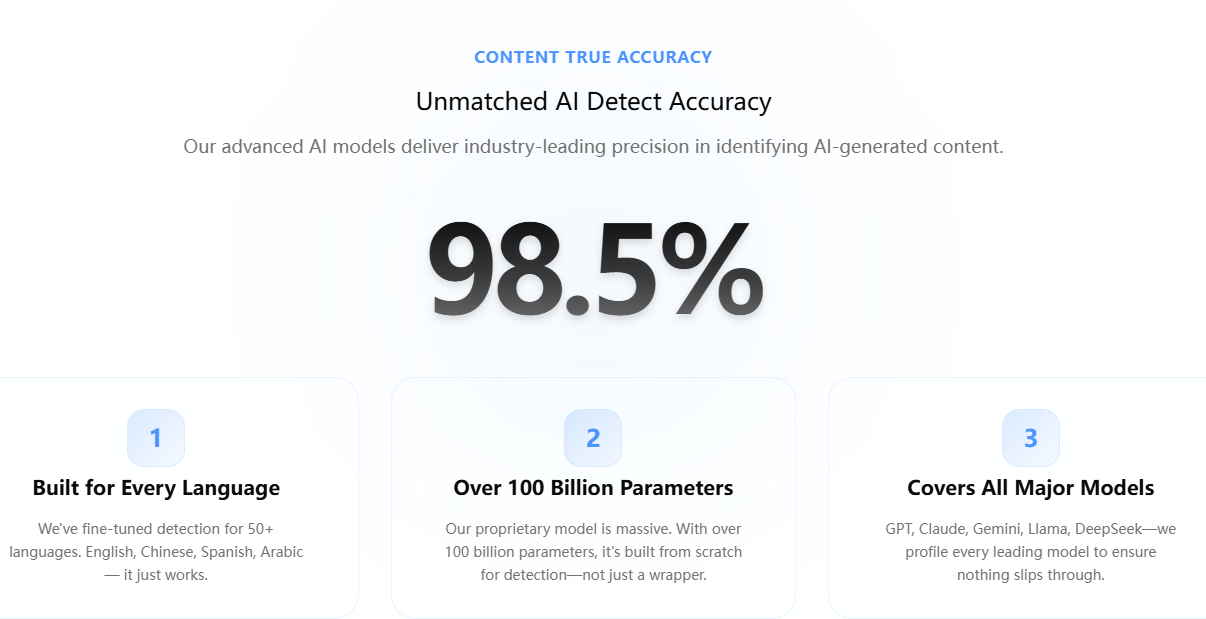
By fine-tuning our models on billions of high-quality human and AI text pairs across multiple languages, we achieved a 98.5% accuracy rate.
Nuance Matters. Privacy Matters More.
We also noticed another disturbing trend in the "free detector" market: Data harvesting.
Many free tools scrape the text you analyze to re-train their own models. If you are working on sensitive corporate documents or unpublished manuscripts, this is an unacceptable risk.
That’s why Content True was built with an "Enterprise-First" security mindset from day one. We guarantee zero data retention. Your text is analyzed in an encrypted sandbox and discarded immediately. Your IP remains yours.
The Verdict
In an age flooded with synthetic content, proving originality is becoming a crucial skill. But you need tools that are smarter than the bots they are trying to catch.
If our engine can handle the extreme complexities of Japanese, imagine the precision it brings to your English content. Stop relying on coin-flip detectors that guess. Start getting real insights into your writing.
👉 [Try Content True for Free & Check Your Writing Now]






Top comments (0)