

International trade runs on paperwork, timelines, and trust and for decades, all three have been slowed down by manual processes. A single shipment can involve dozens of documents, multiple approvals, and days of back-and-forth between exporters, customs officials, and logistics services providers. Every extra hour spent on manual document checks is an hour of lost business.
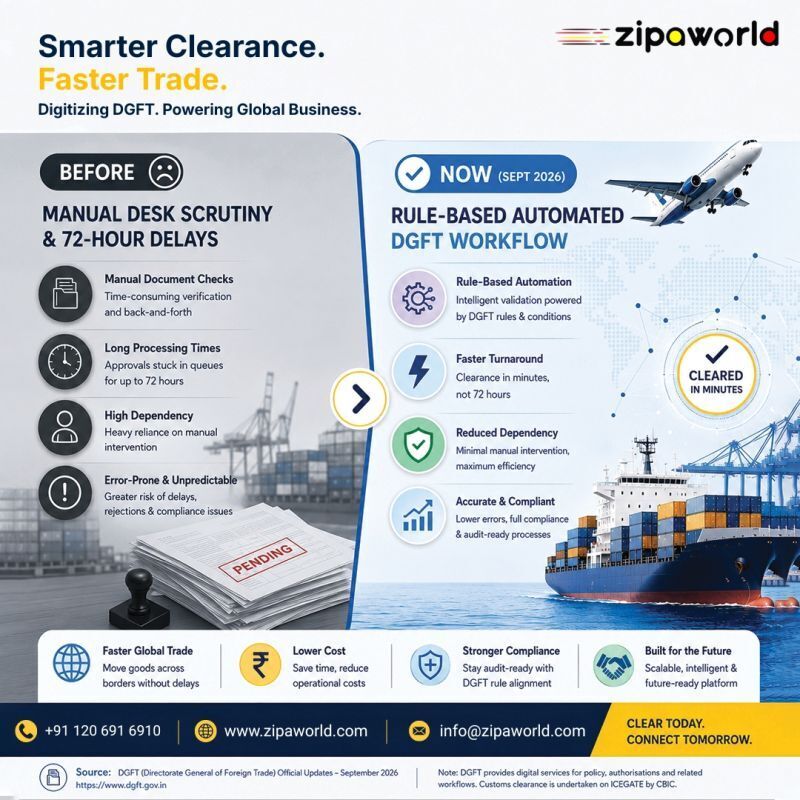
That is changing. With rule-based automation now powering customs workflows like the Directorate General of Foreign Trade’s (DGFT) digital systems, businesses are seeing customs clearance shrink from 72-hour delays to clearance in minutes. For any freight forwarder, courier company, or trading business, this shift isn’t just convenient it’s a competitive necessity.
In this blog, we break down exactly how automation is reshaping global trade, what it means for customs clearance services, and how platforms like Zipaworld are helping Indian businesses move goods faster, cheaper, and with fewer compliance headaches.
The Problem With Manual Customs Clearance
Before automation, most custom clearance process workflows looked the same across the industry:
- Manual document checks — every form, invoice, and certificate verified by hand, often requiring repeated back-and-forth between parties.
- Long processing times — approvals stuck in queues for up to 72 hours, even for straightforward shipments.
- High dependency on individuals — clearance speed depended heavily on the availability and workload of manual reviewers.
- Error-prone and unpredictable outcomes — manual entry increases the risk of delays, rejections, and compliance issues, especially when custom clearance documents are incomplete or inconsistently formatted. For businesses relying on international courier services or time-sensitive Express Delivery, these delays don’t just cost time they cost customer trust, working capital, and in some cases, entire contracts.
What Is Rule-Based Automation in Trade?
Rule-based automation applies a predefined set of regulatory rules and conditions to validate trade documentation instantly, instead of relying on manual review at every step. As of September 2026, DGFT’s updated systems reflect this shift clearly:
Before:
- Manual desk scrutiny
- Document checks by hand
- Approvals in up to 72 hours
- Heavy reliance on manual intervention
- Greater risk of delays & compliance issues Now:
- Rule-based automated DGFT workflow
- Intelligent validation powered by DGFT rules & conditions
- Clearance in minutes
- Minimal manual intervention, maximum efficiency
- Accurate & compliant, audit-ready processes In short: the system checks shipments against the rules automatically, flags exceptions, and clears compliant shipments almost instantly freeing up manual review for only the cases that truly need it.
How Automation Makes International Trade Faster
1. Faster Turnaround on Customs Clearance
Automated validation replaces sequential manual checks with instant, parallel processing. What used to take customs clearance services up to three days can now happen in minutes, directly impacting how fast goods move across borders.
2. Reduced Dependency on Manual Intervention
When routine checks are automated, human reviewers can focus on complex or high-risk shipments instead of repetitive, low-value verification work. This also reduces the impact of staffing gaps or high shipment volumes on overall speed.
3. Greater Accuracy and Compliance
Rule-based systems apply the same regulatory logic every time, reducing the inconsistencies that come with manual review. This means fewer errors in custom clearance documents, fewer rejected filings, and audit-ready records by default — a major advantage for any freight forwarding services provider managing high shipment volumes.
4. Lower Operational Costs
Faster clearance means lower demurrage, storage, and rework costs. Combined with predictable custom clearance charges, businesses get better visibility into landed costs something every importer and exporter values when planning shipments through logistics services in India.
5. A More Scalable, Future-Ready Trade Ecosystem
Automation doesn’t just solve today’s bottlenecks it builds infrastructure that can scale. As trade volumes grow, rule-based systems can handle increased loads without a proportional increase in processing time, keeping global trade genuinely global.
Why This Matters for Freight Forwarders and Courier Businesses
For any courier service provider, freight forwarders in India, or business offering domestic and international courier service, customs delays are one of the biggest unpredictable variables in the supply chain. Automated clearance directly benefits:
Express Delivery services that promise tight delivery windows
Courier delivery servicesm handling high-value or time-sensitive shipments
Freight forwarding services managing multi-modal, cross-border cargo
Businesses searching for reliable international courier services near me or logistics services near me, who need consistent, predictable turnaround times.
When clearance is fast and predictable, the entire downstream chain from warehousing to last-mile delivery becomes easier to plan and optimize.
Automation Doesn’t Stop at Customs It Extends to Warehousing Too
Faster clearance is only half the equation. Once goods clear customs, they need to move through efficient warehouse storage solutions and warehouse management solutions to reach their final destination without new bottlenecks forming.
Modern warehouse services are increasingly built around the same principles as customs automation:
Real-time inventory visibility instead of manual stock counts
System-driven putaway and retrieval instead of manual coordination
Integrated warehouse management services that sync directly with shipment and clearance data
A strong warehouse service provider that connects seamlessly with customs and courier workflows ensures that the speed gained at the border isn’t lost in storage or handling delays.
How Zipaworld Supports Faster, Smarter Global Trade
Zipaworld brings together the core pillars of modern trade freight forwarder operations, customs clearance, courier services in India, and warehouse solutions on one technology-driven platform. This means businesses don’t have to manage multiple vendors or reconcile data across disconnected systems.
With Zipaworld, businesses get access to:
- Customs clearance services aligned with the latest DGFT rule-based automation
- Freight forwarding services for both air and ocean cargo
- Express Delivery and domestic and international courier service for time-sensitive shipments
- Warehouse storage solutions and warehouse management solutions designed for scale
- Transparent custom clearance charges and clear documentation support to avoid last-minute surprises Whether you’re an established exporter or a growing business searching for logistics services near me, the goal is the same: move goods faster, stay compliant, and reduce the operational friction that slows international trade down.
The Road Ahead: Will Automation Become the Standard?
As DGFT and other regulatory bodies continue digitizing trade workflows, rule-based automation is quickly moving from a competitive advantage to a baseline expectation. Businesses that adapt early by partnering with technology-driven freight forwarders in India and logistics platforms will be better positioned to handle rising trade volumes without rising delays.
Zipaworld is built for exactly this shift: combining freight forwarding, customs clearance, courier delivery services, and warehouse management services into one connected, automation-ready platform.
Frequently Asked Questions
Q. What is the custom clearance process?
A. The custom clearance process involves submitting shipment documentation, having it validated against regulatory rules, paying applicable duties, and receiving approval to release goods. Automation has significantly shortened this process by validating documents electronically rather than manually.
Q. What documents are required for customs clearance?
A. Typical custom clearance documents include commercial invoices, packing lists, bills of lading or airway bills, import/export licenses, and any product-specific certifications. Automated systems check these documents against DGFT rules instantly, flagging any discrepancies for review.
Q. How are custom clearance charges calculated?
A. Custom clearance charges typically depend on the shipment’s value, applicable duties and taxes, and the services required (documentation handling, inspection, storage). Working with an experienced freight forwarder helps ensure charges are transparent and predictable.
Q. Why do courier and logistics companies need automation?
A. Any courier service provider or logistics services business handling cross-border shipments benefits from automation because it reduces delays, minimizes compliance errors, and improves the overall customer experience especially for Express Delivery services with strict timelines.


Top comments (0)