

In the rapidly evolving world of artificial intelligence, few releases have generated as much excitement as Alibaba Happy Horse 1.0. Launched in early April 2026 and already dominating the Artificial Analysis Video Arena, this AI video generator stands as a landmark achievement in multimodal content creation. Available for free through Flyne AI, Alibaba Happy Horse 1.0 delivers native 1080p cinematic videos with synchronized audio, unmatched motion realism, and precise prompt adherence—all from simple text descriptions or reference images.
Whether you’re a filmmaker pre-visualizing scenes, a marketer crafting viral ads, or a content creator experimenting with storytelling, Alibaba Happy Horse 1.0 on Flyne AI removes traditional barriers to professional-grade video production. This article explores the model’s architecture, groundbreaking features, real-world applications, and why it has surged to the top of independent blind-vote leaderboards in record time.
What Is Alibaba Happy Horse 1.0? The Technical Foundation of a New Era in AI Video
Alibaba Happy Horse 1.0 is a 15-billion-parameter unified Transformer model developed under the Alibaba-ATH umbrella. Unlike traditional AI video systems that rely on separate pipelines for text, images, video frames, and audio, Alibaba Happy Horse 1.0 employs a single-stream 40-layer self-attention architecture. This “sandwich” design—modality-specific layers at the edges with shared parameters in the core—allows the model to jointly generate video frames and synchronized audio in one forward pass.
The result? Videos that feel alive. Characters maintain consistent identities across shots, physics obey real-world laws, and audio (speech, ambient sound, effects) aligns perfectly with visuals. Released just days ago, the model already boasts native 1080p output, support for multiple aspect ratios (16:9, 9:16, 1:1), and multilingual lip-sync across seven languages, including Mandarin, English, Japanese, and more.
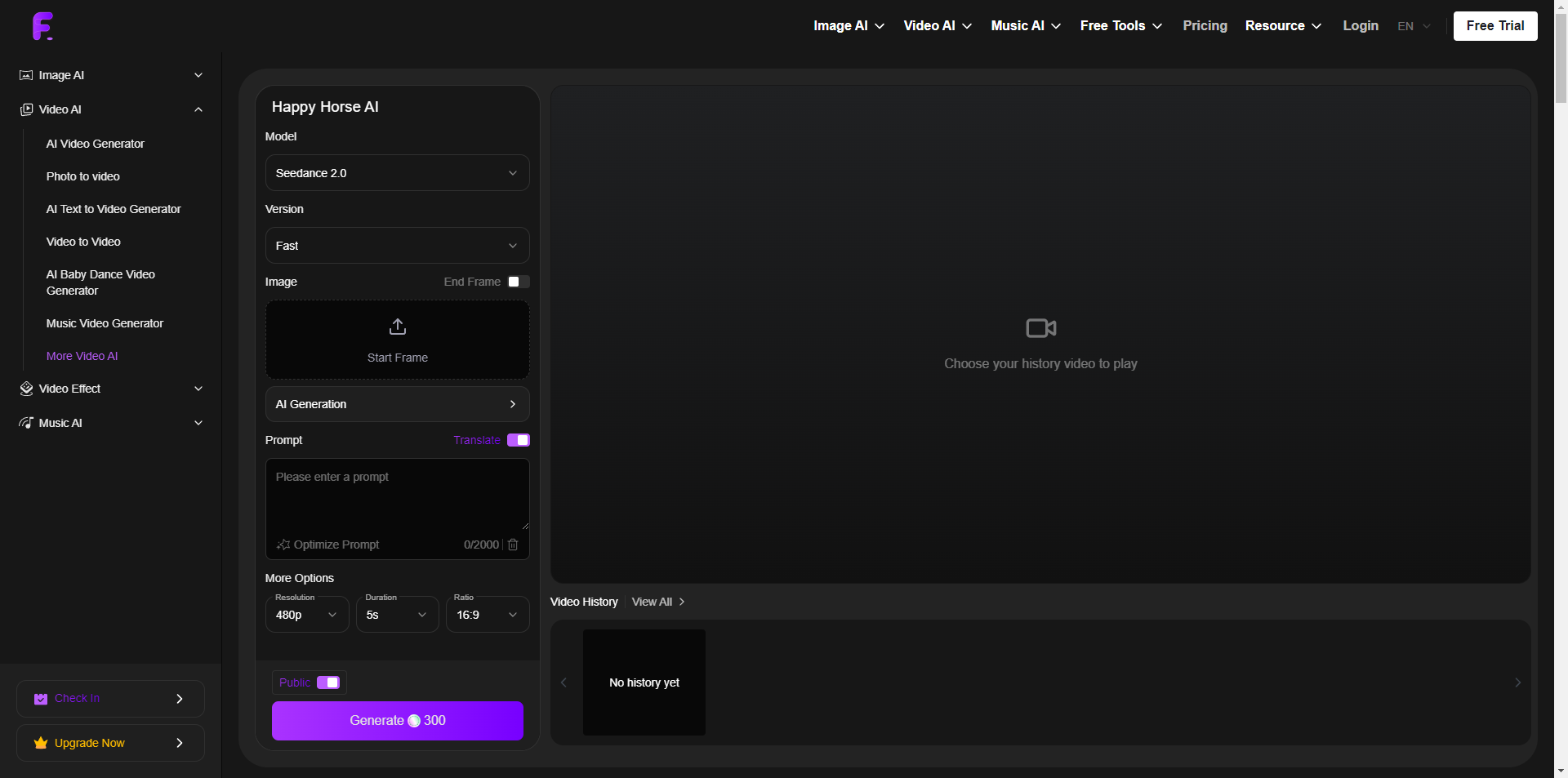
Flyne AI makes this powerhouse instantly accessible. No complex setup, no expensive APIs—just head to the platform, input a prompt or upload an image, and generate studio-quality clips in seconds.
Why Alibaba Happy Horse 1.0 Tops the Leaderboards: Benchmark Dominance Explained
Independent evaluation platforms like Artificial Analysis rely on thousands of blind user votes rather than self-reported metrics. The verdict is clear:
- Text-to-Video (No Audio): Alibaba Happy Horse 1.0 ranks #1 with an Elo of 1,389—significantly ahead of ByteDance’s Dreamina Seedance 2.0 (Elo 1,274).
- Image-to-Video: It claims the top spot with an Elo of 1,415, outperforming competitors by wide margins.
These Elo gaps aren’t marginal; a 60+ point lead translates to winning roughly 58–60% of head-to-head blind comparisons. Users consistently prefer Alibaba Happy Horse 1.0 for superior motion quality, spatial consistency, character coherence, and prompt fidelity. Issues common in earlier models—stiff movements, distorted limbs, or mismatched audio—are largely resolved here through advanced motion modeling that simulates physical laws in real time.
What makes this even more remarkable is the model’s speed and accessibility. On Flyne AI, users can generate synchronized video-audio clips without waiting for post-production fixes, slashing creative iteration time dramatically.
Core Features That Set Alibaba Happy Horse 1.0 Apart
Alibaba Happy Horse 1.0 isn’t just another text-to-video tool—it’s a complete creative engine:
- Native Audio-Visual Synchronization: Video and audio emerge together. Lip movements match dialogue rhythms, ambient sounds enhance atmosphere, and effects feel organic. No more clunky dubbing required.
- Cinematic Text-to-Video Generation: Detailed prompts yield high-tension action, emotional depth, or sweeping landscapes with stable frame rates and fluid camera work.
- High-Precision Image-to-Video Animation: Upload a static image, and the model analyzes geometry, lighting, and style to animate it naturally while preserving original aesthetics.
- Multi-Language Prompt Understanding: Supports Chinese, English, and more, minimizing translation errors and enabling global creators to work in their native tongue.
- Multi-Shot Storytelling: Maintains visual and narrative consistency across complex scenes—ideal for short films, ads, or game cutscenes.
These capabilities stem from the model’s unified architecture, which treats text, image, video, and audio tokens as part of one shared sequence. The outcome is not only technically impressive but emotionally resonant—videos that evoke the polish of Hollywood productions.
Real-World Use Cases: From Concept to Completion in Minutes
The practical power of Alibaba Happy Horse 1.0 shines in professional workflows:
- Filmmaking and Pre-Visualization: Directors generate storyboards or test sequences instantly. A single prompt can visualize a chase scene or emotional monologue, accelerating pre-production and reducing costs.
- Marketing and Social Media Content: Brands transform ad copy into cinematic clips ready for TikTok, Instagram, or YouTube. Consistent branding, dynamic motion, and built-in audio make campaigns more engaging.
- Game Development: Create cutscenes, character animations, or environmental sequences without heavy rendering pipelines. Developers report faster prototyping and richer virtual assets.
- Education and Training: Animate historical events, scientific processes, or instructional demos with synchronized narration—perfect for e-learning platforms.
On Flyne AI, users enjoy up to 300 free generations, video history tracking, and an intuitive interface that supports both quick experiments and refined iterations.

Step-by-Step Guide: Creating Your First Video with Alibaba Happy Horse 1.0 on Flyne AI
Getting started is remarkably simple:
- Visit Flyne AI Happy Horse 1.0 and select the Alibaba Happy Horse 1.0 model.
- Enter a detailed text prompt or upload a reference image. Describe scene, motion, lighting, camera angles, and mood for best results (e.g., “A lone cowboy riding through a dusty canyon at sunset, dramatic orchestral music swelling”).
- Configure options: Enable audio synchronization, choose aspect ratio, and adjust settings for length or style.
- Generate and review: The model produces a synchronized video-audio clip. Download, iterate, or refine prompts based on the output.
- Export and integrate: Use the clip in editing software or share directly.
Pro tip: Specificity wins. Include references to camera movement (e.g., “slow dolly zoom”), lighting (“golden hour glow”), and emotion (“tense anticipation”) to leverage the model’s exceptional prompt adherence.
Comparing Alibaba Happy Horse 1.0 to Other Leading AI Video Models
In a crowded field, Alibaba Happy Horse 1.0 differentiates itself through integration and quality:
- Versus Seedance 2.0 (ByteDance): Superior Elo scores, better motion realism, and native audio—without the need for separate tools.
- Versus Kling 3.0 or PixVerse: Faster inference, stronger character consistency, and built-in multilingual support.
- Open-source accessibility (with commercial licensing reported across sources) democratizes what was once enterprise-only technology.
While no model is perfect—complex multi-minute narratives or hyper-specific physics may still require human editing—Alibaba Happy Horse 1.0 raises the bar for what “good enough” means in AI-generated video.

The Broader Impact: Democratizing Creativity and Shaping the Future
Alibaba Happy Horse 1.0 isn’t merely a tool; it represents a philosophical shift. By making cinematic video generation free and frictionless on platforms like Flyne AI, it empowers independent creators to compete with big studios. This democratization could spark a renaissance in storytelling, from indie films to educational content and global cultural exchange.
Yet it also prompts deeper reflection: How will AI video reshape industries reliant on traditional production? What ethical guidelines should govern deepfakes or hyper-realistic content? As models like Alibaba Happy Horse 1.0 evolve toward longer, more coherent outputs, the line between human and machine creativity will blur further—inviting us to redefine authorship in the age of intelligence augmentation.
Frequently Asked Questions About Alibaba Happy Horse 1.0
How long are the generated videos?
Typical outputs are 5–10 seconds at 1080p, ideal for social media or storyboarding. Longer sequences can be stitched in editing tools.
Does it support audio generation?
Yes—natively synchronized sound effects, music rhythms, and speech are core strengths.
Is Alibaba Happy Horse 1.0 completely free?
Flyne AI offers generous free access (up to 300 videos), with upgrade options for heavier use.
What makes the motion so smooth?
Advanced motion modeling enforces physical laws and limb coordination, eliminating common artifacts seen in prior models.
Can I use it commercially?
Current reports confirm commercial licensing for the underlying model, making it suitable for professional projects.
Conclusion: Why Alibaba Happy Horse 1.0 on Flyne AI Is a Must-Try for Every Creator
Alibaba Happy Horse 1.0 isn’t hype—it’s a measurable leap forward, validated by blind user preferences on the world’s most trusted AI video leaderboard. With its unified architecture, cinematic quality, and seamless audio integration, it transforms text and images into compelling visual stories faster than ever before.
Ready to experience the future? Head to Flyne AI’s Happy Horse 1.0 page and start generating today. Whether you’re crafting your next viral video or prototyping a feature film, this free AI video generator might just become your most powerful creative ally.
The era of effortless cinematic production has arrived. What will you create first?






Top comments (0)