


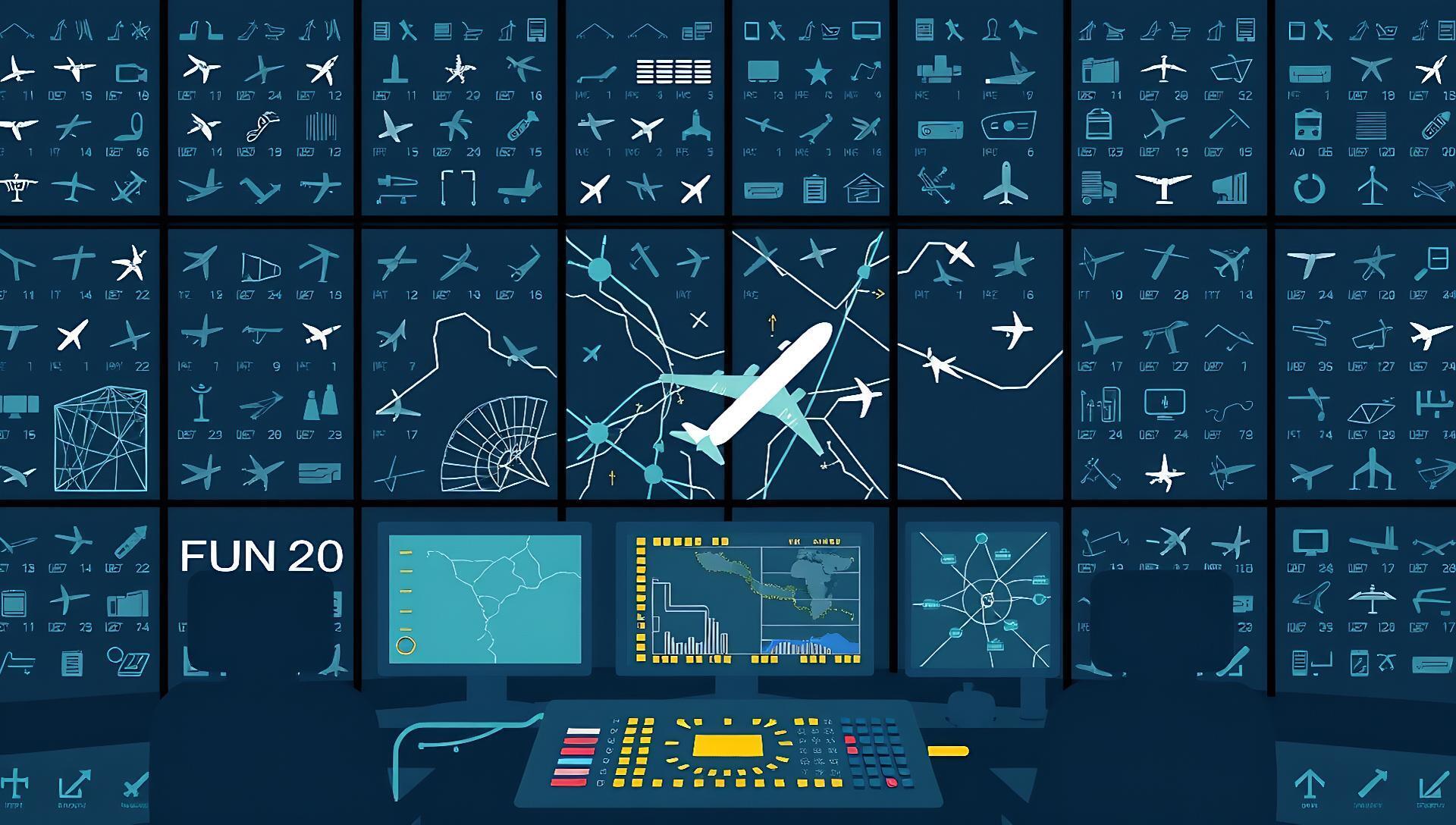
A single network router failure at a regional facility in Southern Arkansas caused a cascading nationwide disruption to air travel, a incident highlighted in a Hacker News discussion that garnered 50 points and 26 comments. The event, detailed in a Wall Street Journal report, exposed critical vulnerabilities in highly interconnected, automated systems.
System: FAA's NOTAM (Notice to Air Missions) | Outage Duration: Several hours | Impact: 10,000+ flight delays/cancellations
Root Cause: Single router failure | Redundancy: Failed
How a Local Failure Went National
The Federal Aviation Administration's NOTAM system distributes essential safety alerts to pilots. A contractor facility in Arkansas housed a key node. According to the report, this location contained a single router with no immediate backup for its specific function.
When this router failed, it corrupted the database file used to synchronize data across the system's primary and backup databases. The failure protocol itself then propagated the corrupted file, taking down the entire national NOTAM system. Pilots could not access mandatory pre-flight safety information, grounding air traffic.
The Hacker News Post-Mortem
The HN thread, with 26 comments, served as a rapid technical post-mortem. Key insights from engineers and practitioners included:
- Architecture Critique: Widespread condemnation of the single point of failure (SPOF) design for a national critical system.
- Process Failure: Comments noted that redundancy is meaningless if a failure mode can corrupt both primary and backup systems simultaneously.
- Automation Risk: The incident was framed as a classic case of automated systems amplifying a small fault into a systemic collapse.
Bottom line: The failure was not merely hardware-related but a fundamental design flaw in system redundancy and failure propagation.
A Mirror for AI and Software Systems
For AI practitioners, this is not an aviation story but a resilience engineering case study. Modern AI infrastructure—model training clusters, inference pipelines, vector databases—faces identical risks.
The architecture pattern is familiar: a primary database, a standby replica, and a synchronization process. The Arkansas failure demonstrates how a corrupted state, propagated automatically, can defeat this standard setup. In AI terms, this is equivalent to a corrupted model checkpoint being automatically distributed to all inference servers, halting service entirely.
| Failure Scenario | Arkansas NOTAM System | Typical AI/ML Training Pipeline |
|---|---|---|
| Trigger | Single router hardware fault | Single GPU memory corruption or node failure |
| Propagation | Corrupted DB file synced to backup | Corrupted checkpoint saved as "latest" and distributed |
| System Impact | National flight groundings | Training halt; stalled experiment tracking; faulty model deployment |
| Root Cause | Lack of isolated redundancy & integrity checks | Lack of checkpoint validation before promotion |
Practical Redundancy Lessons for AI Teams
The alternatives to a fragile single-point system are well-established in software but often overlooked under deadline pressure. This incident underscores their non-negotiable status.
- True Active-Active Redundancy: Systems should run in parallel, not primary/standby. For AI, this means multi-region inference endpoints with load balancers, not a single "hot" backup server that needs to spin up.
- Immutable, Validated Artifacts: Before any model checkpoint or dataset is promoted to a production pipeline, it must pass automated integrity and validation checks. Hash verification is a minimum.
- Circuit Breakers and State Isolation: A failure in one component must not be allowed to corrupt the state of another. This requires dumb replication, not "smart" synchronization that can replicate corruption.
"Implementation Steps for ML Engineers"
Who Should Review Their Systems Based on This
This case is a mandatory review prompt for specific roles:
- MLOps Engineers: If your model deployment or training pipeline has any manually configured "primary" node, it is at risk.
- AI Startup Founders: Rapid scaling often copies early, fragile infrastructure. A system that worked for 100 users will fail catastrophically at 10,000.
- Researchers Managing Large Clusters: A single corrupted shared filesystem (NFS) can wipe out weeks of experimental results across a team.
Teams running purely on managed services (e.g., training jobs on SageMaker, inference on Vertex AI) are partially insulated, but must still design for region-level failures and validate their inputs and outputs.
The Bottom Line on Systemic Resilience
The Arkansas router incident did not introduce new technical concepts. It provided a stark, expensive public reminder of old ones. For AI systems growing in complexity and societal integration, the cost of ignoring these principles escalates from flight delays to broken business processes, biased model outputs, or security breaches.
Resilience is not a feature added later. It is the product of architecture decisions made at the whiteboard stage, validated by relentless testing of failure modes. The next critical system failure may not involve a router in Arkansas, but a GPU node in a cloud region or a data pipeline script. The design lesson is identical.
The convergence of physical infrastructure and digital automation guarantees that small faults will find large consequences. Engineering robust AI requires designing for that inevitability, not hoping to avoid it.






Top comments (0)