

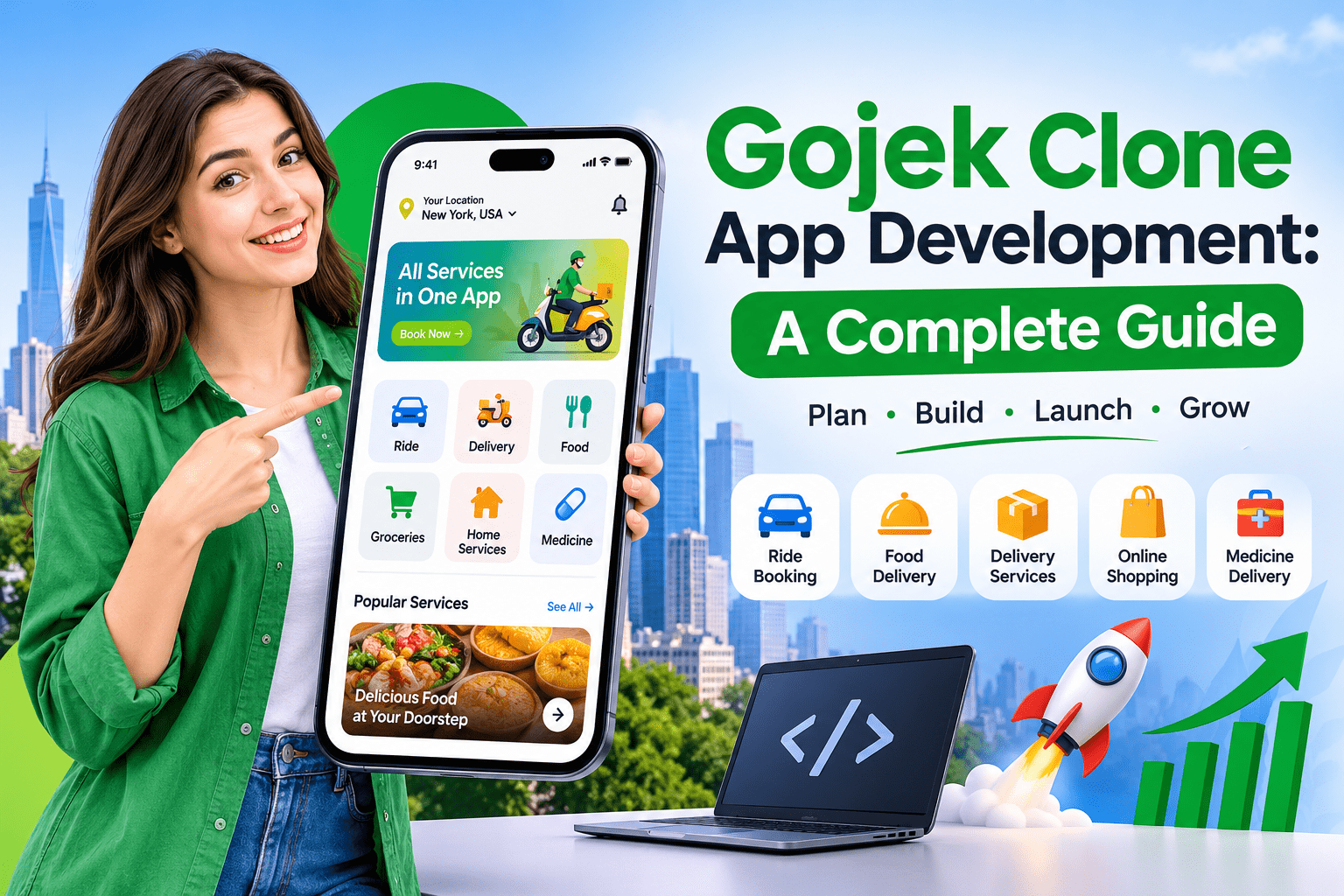
Gojek clone app development is the process of building a multi-service on-demand platform modelled on Gojek, where one customer app offers rides, food delivery, parcel delivery and payments. Every Gojek clone runs on four connected apps: customer, driver, merchant and admin. The hard parts are not the screens. They are real-time dispatch, multi-party payments and settlement, and keeping driver supply balanced across services. A custom build typically costs USD 80,000 to 300,000 and takes 6 to 14 months, depending on how many services launch on day one. A white-label platform such as DeliveryStack starts from US$1,000 and goes live in 2 to 4 weeks. The smart route for most founders is to launch one or two services in one city, prove demand, then add verticals.
What is a Gojek clone app?
A Gojek clone app is a multi-service “super app” that copies Gojek’s business model, not its code or brand. It lets one customer account book rides, order food, send parcels, buy groceries and pay through a built-in wallet. The operator runs every service from one admin panel and one shared pool of drivers and merchants.
Where the model comes from. Gojek started in Jakarta in 2010 as a call centre with 20 motorbike drivers. The app launched in January 2015, and Gojek merged with Tokopedia in May 2021 to form GoTo. Today the Gojek app bundles transport, food delivery, logistics, payments and daily services under one login.
What “clone” really means. A clone reuses the proven structure: one app, many services, shared drivers, shared wallet. You still need your own brand, your own name and your own design. Copying Gojek’s logo, name or screens invites trademark and app store problems, so treat Gojek as the reference model and nothing more.
Why founders choose this model. Each extra service earns more from the same customer and the same driver. A rider who books a bike taxi in the morning can order lunch at noon without installing a second app. That cross-use is what makes super apps hard to dislodge once they reach density in a city.
How does a Gojek clone app work?
A Gojek clone works through four apps that share one backend. The customer places a request, the dispatch engine finds the nearest suitable driver, the merchant prepares the order if one is involved, and the admin panel controls pricing, zones and payouts. Orders, payments and locations sync across all four apps in real time.
Customer app. The single entry point for every service. Customers pick a service, enter pickup and drop points, see a price, pay and track the driver live on a map.
Driver app. One app for drivers across rides, food and parcels. Drivers go online, receive jobs, navigate, confirm pickup and delivery with an OTP or photo, and see earnings per trip.
Merchant app. Used by restaurants, grocery stores and pharmacies. Merchants manage menus or catalogues, accept orders, set preparation time and view settlements.
Admin panel. The control room. Operators approve drivers and merchants, set commissions and fares per zone, watch live orders, handle refunds and read reports.
Shared core engine. Under the apps sit the services that do the real work: dispatch and routing, payments and wallet, geofenced zones, notifications and analytics. Getting this core right is most of the engineering effort in any Gojek clone.
Which services can a Gojek clone app include?
A Gojek clone can include any service where a driver moves people or goods within a city. The common set is bike taxi, car ride-hailing, food delivery, courier, grocery, pharmacy and a digital wallet. Most successful launches start with two services that share drivers, such as bike taxi plus food delivery, and add the rest later.
Bike taxi. Gojek runs this service as GoRide. Your clone needs sub-second driver matching, low fares, and helmet and safety checks.
Car ride-hailing. GoCar is Gojek’s reference here. Support vehicle classes, surge pricing and scheduled rides from the start.
Food delivery. Modelled on GoFood, this service needs a restaurant panel, prep-time-aware dispatch and live menus that merchants update themselves.
Courier and parcel. Gojek offers GoSend and GoBox. Plan for package size options, OTP proof of delivery and multi-stop routes.
Grocery and shopping. Like GoMart and GoShop, grocery needs a product catalogue, item substitutions, delivery slots and weight-based pricing.
Pharmacy. GoMed shows the model. Add prescription upload and an onboarding flow that accepts licensed stores only.
Wallet and payments. GoPay is the reference. You need top-ups, refunds to wallet, driver and merchant payouts, and compliance with local payment rules.
Bills and top-ups. Gojek offers GoTagihan and GoPulsa. These services depend on biller and telecom API integrations in each country.
The Gojek service names above come from Gojek’s App Store listing and GoPay help page. Each vertical you add brings its own rules, so choose the launch set by local demand, not by how long the feature list looks. DeliveryStack covers the main groups as ready verticals: food, grocery, courier, taxi and bike taxi.
What features does a Gojek clone app need?
A Gojek clone needs a working feature set in each of its four apps before launch. Customers need booking, live tracking and payments. Drivers need job alerts, navigation and earnings. Merchants need order and menu control. Admins need dispatch monitoring, pricing rules and payout tools. Missing any one of these breaks the order loop.
Customer app features
Sign-up and profile. Phone number login with OTP, saved addresses and saved payment methods. Keep sign-up under a minute, since every extra field loses users.
Service home screen. One grid of service tiles, a search bar and location-based promotions. This screen decides how often customers try a second service.
Booking and checkout. Upfront fare or order total, promo codes, scheduled bookings and a choice of wallet, card or cash.
Live tracking. Driver location on a map, ETA updates, in-app chat and masked calling so neither side sees the other’s real number.
Ratings, tips and reorder. Rating after every trip or order, optional tips and one-tap reorder for food and grocery.
Driver app features
Onboarding and documents. Licence, vehicle papers and ID upload with admin approval before the first job.
Job requests. Online and offline toggle, accept or decline with a countdown, and auto-assignment by distance and load.
Navigation and proof. Turn-by-turn routes, multi-stop jobs, and pickup and delivery confirmation by OTP or photo.
Earnings. Per-trip breakdown, daily totals, incentives and payout history. Transparent earnings build trust, which matters when drivers can switch to a rival app in seconds.
Merchant app features
Catalogue control. Menu or product management, item availability toggles and opening hours.
Order handling. Incoming order queue with sound alerts, accept or reject, and preparation time that feeds the customer ETA.
Settlements. Daily sales, commission deducted and payout reports the merchant can download.
Admin panel features
User management. Approve, suspend and verify drivers, merchants and customers.
Dispatch monitoring. A live map of orders and drivers, manual reassignment and alerts for late orders.
Pricing and zones. Fares, delivery fees, surge rules and commissions set per service and per geofenced zone.
Finance and reports. Refunds, payouts, tax reports and dashboards for orders, revenue and delivery time.
For a full feature list of a production platform, see the DeliveryStack platform overview.
Which advanced features set a Gojek clone apart?
Advanced features matter after launch, once you have steady order volume. The ones that pay back fastest are a shared wallet, smart dispatch that batches orders, a loyalty subscription and safety tools. AI features help too, but only when you have enough data to train them. Build these in phase two, not in the MVP.
In-app wallet. A wallet speeds up checkout, makes refunds instant and keeps money inside your ecosystem. It also brings regulation. In India, a prepaid wallet falls under RBI rules, and in Saudi Arabia under SAMA. Many founders start with a payment gateway and add a licensed wallet partner later.
Smart dispatch and batching. Assigning two food orders from the same restaurant to one rider cuts cost per delivery. Batching needs live traffic data and solid ETA logic, so it fails quietly if the base dispatch is weak.
Subscription plan. A monthly pass that gives discounts across services. Gojek runs this as Gojek PLUS. It lifts repeat use but costs margin, so price it only after you know your unit economics.
Safety tools. SOS button, live trip sharing, driver selfie verification and masked numbers. For bike taxi and women passengers, these features affect both adoption and regulator approval.
Corporate accounts. Business billing for staff rides and office meals. Corporate users order on weekdays at steady volumes, which smooths demand.
AI features. Demand forecasting to position drivers, fraud detection on promo abuse and personalised home screens. Each needs months of clean order data first. A downside: AI features add cloud and maintenance cost that a small city launch may never recover.
How do you develop a Gojek clone app, step by step?
You develop a Gojek clone in eight steps: validate one city and one or two services, define the business rules, design the four apps, build the core engine, build the apps, integrate payments and maps, test under real conditions, then launch and scale. Skipping the rules step is the most common reason custom builds overrun.
Validate the market. Pick one city and one or two services. Count local competitors, average order values and driver pay rates. A clone that copies every Gojek service on day one spreads drivers and marketing too thin.
Write the business rules. Fares, delivery fees, commissions, cancellation charges, refund policy, driver payout cycle and zone boundaries. These rules drive the code, so settle them before design starts.
Design the apps. Wireframes and UI for the customer, driver and merchant apps plus the admin panel. Test the booking flow with five to ten real users before any code is written.
Build the core engine. Dispatch, pricing, zones, wallet ledger, notifications and the order state machine. This is the slowest and most expensive step.
Build the four apps. Native or cross-platform mobile apps for customers, drivers and merchants, and a web admin panel, all on top of the core APIs.
Integrate third parties. Payment gateway, maps and routing, SMS and OTP, push notifications, and any local wallet or ID verification service.
Test under real load. Run closed pilots with real drivers and merchants. Dispatch edge cases, such as declined jobs and driver no-shows, only appear at real volume.
Launch and scale. Publish under your own App Store and Google Play accounts, recruit supply before demand, then add services and cities one at a time.
With a white-label platform, steps 3 to 6 shrink to branding and configuration.
DeliveryStack’s deployment process runs onboarding, branding, data loading and launch in four steps over 2 to 4 weeks.
What tech stack does a Gojek clone app use?
A Gojek clone needs a stack that handles live location updates, many short transactions and sudden demand spikes. A common choice is Flutter or React Native for mobile apps, Node.js for the backend, PostgreSQL plus Redis for data, WebSockets for real-time tracking and a cloud host with auto-scaling. Here is what each layer typically uses.
Mobile apps. Flutter or React Native lets one cross-platform codebase serve iOS and Android, which cuts cost. Native Swift and Kotlin suit apps with heavy background location tracking.
Admin panel and web. Next.js or React gives fast dashboards for operators and an SEO-friendly ordering website for customers.
Backend. Node.js, Go or Java handle the many concurrent connections that drivers and live orders create.
Database. PostgreSQL with PostGIS runs the geospatial queries behind nearest-driver search, while Redis holds live driver positions in memory.
Real-time layer. WebSockets, Socket.IO or MQTT push driver location and order status to every app without constant polling.
Messaging. Kafka or RabbitMQ decouples dispatch, payments and notifications, so one slow service does not block the others as volume grows.
Maps. Google Maps Platform, Mapbox or OpenStreetMap provide geocoding, routes and ETAs. Maps are often the largest variable cost in the stack.
Payments. Stripe, Razorpay or local gateways handle cards, UPI, wallets and split payouts to drivers and merchants.
Notifications. Firebase Cloud Messaging and Twilio cover push alerts, SMS and OTP verification.
Hosting. AWS, Google Cloud or Azure with Kubernetes auto-scale servers for lunch and evening demand peaks.
One caution: map API calls are billed per request. A busy driver app that refreshes location every few seconds can run up a large monthly bill, so cache routes and throttle updates from the start.
How much does Gojek clone app development cost, and how long does it take?
A custom Gojek clone costs about USD 80,000 to 300,000 and takes 6 to 14 months. The main driver is how many services launch on day one. A two-service launch in one city sits at the low end. A full super app with a licensed wallet sits at the top. A white-label platform starts from US$1,000 and launches in weeks.
White-label platform. You get branded customer, driver, merchant and admin apps on a ready core. Pricing starts from US$1,000 for the base platform, with customisation quoted separately, and launch takes 2 to 4 weeks.
Custom starter build. Two services in one city, cross-platform apps and gateway payments. Expect USD 80,000 to 120,000 and 6 to 8 months to launch.
Custom multi-service build. Four to five services across several cities, with promotions and order batching. Expect USD 120,000 to 200,000 and 8 to 11 months.
Custom super app. Six or more services, a licensed wallet, AI dispatch and corporate accounts. Budgets start around USD 200,000 and can pass USD 300,000, with 11 to 14 months to launch.
Assumptions behind the estimates. Custom figures assume roughly 4,000 to 12,000 hours of design, development, QA and project management at USD 20 to 25 per hour, in line with India-based agency rates on Aalpha’s mobile app cost calculator. The same calculator shows Western Europe and UK rates of USD 70 to 130 per hour, so the same scope there costs several times more. White-label pricing is from the DeliveryStack pricing page.
Costs that sit outside the build quote. Plan for cloud hosting, map API usage, SMS and OTP fees, payment gateway charges, app store accounts and ongoing maintenance. Maintenance alone commonly runs 15 to 20 percent of the build cost each year. Driver acquisition and launch marketing often cost more than the software.
Where custom budgets overrun. Dispatch edge cases, payment reconciliation, app store rejections over background location, and admin tools left until after launch. The DeliveryStack custom development comparison covers these late discoveries in detail.
How does a Gojek clone app make money?
A Gojek clone makes money mainly from commissions on each ride and order, plus delivery fees, surge pricing, merchant advertising, subscriptions and wallet-related income. Commission is the base. The other streams lift margin once the platform has steady volume. Relying on commission alone is risky, because thin margins on rides rarely cover discounts.
Commission. Drivers and merchants pay a percentage of each fare or order value. It is the core income, but set it too high and supply leaves for rival apps.
Delivery and service fees. Customers pay a flat or distance-based fee per order. Fees above local norms cut how often people order.
Surge pricing. Fares rise when demand beats driver supply. It balances the market but can trigger public backlash, and some markets cap fares.
Merchant advertising. Restaurants and stores pay for top placement in search and on the home screen. Too many ads erode customer trust in results.
Subscriptions. Customers pay a monthly fee for free delivery or discounts across services. Heavy users can make a poorly priced plan loss-making.
Wallet income. Fees on top-ups, bill payments and partner offers add margin, but a wallet needs a licence or a licensed partner.
Corporate accounts. Businesses pay for staff rides and meals on monthly billing. Volumes are steady, though sales cycles and credit terms are longer.
Most operators reach profitability city by city, not across the whole platform at once. Track contribution margin per order and per trip from the first week.
Should you build a Gojek clone from scratch or use a white-label platform?
Use a white-label platform if your business runs standard services, such as rides, food, grocery or courier, and speed matters. Build from scratch only if your operating model has no precedent or the software itself is what you plan to sell. A cheap clone script is the third option, and usually the riskiest.
White-label platform. Launch takes 2 to 4 weeks, starting from US$1,000 for the base platform plus quoted customisation. Dispatch and payments are already proven in live deployments, your brand appears on every screen, and updates and compliance are handled under a support plan. The trade-off is less freedom to change core logic.
Custom development. Launch takes 6 to 14 months at USD 80,000 to 300,000. You get full ownership and unlimited custom workflows, but dispatch and payments are built and tuned from zero, and your team or vendor owns every update. It is the highest-cost and slowest route.
Low-cost clone script. Scripts often cost under USD 10,000 and can launch in 1 to 3 months, plus time spent fixing problems. Code quality varies, dispatch is often weak under load, some scripts carry vendor traces, and updates after sale are rare. Hidden rework and security gaps are the main risk.
When white-label wins. You want to test demand in one city, your budget is under six figures, and you would rather spend on drivers and marketing than on rebuilding dispatch.
When custom wins. Your model breaks normal delivery patterns, you need deep integration with your own systems, or you plan to license the platform itself. Aalpha Information Systems builds custom on-demand apps for these cases.
Why scripts are risky. Many cheap scripts ship with outdated code, no source documentation and no updates when Android or iOS change their rules. Fixing them often costs more than the script did.
What are the biggest challenges in running a Gojek clone app?
The biggest challenges are business problems, not code. Founders struggle to balance driver supply with customer demand, keep unit economics positive while competing with big platforms, meet local transport and payment rules, and stop fraud. Good software helps with each, but none is solved by features alone.
Supply and demand balance. Too few drivers means long waits. Too many means drivers earn little and quit. Recruit drivers before marketing to customers, and share one driver pool across services so idle time drops.
Competing with incumbents. Gojek, Grab and other large players can fund deep discounts. A new clone wins on a niche: a smaller city, a specific vertical, better merchant terms or local language support.
Regulation. Bike taxis are restricted or banned in some regions. Wallets need licences. Data protection rules such as GDPR apply in Europe. Check transport and payment rules for each city before launch.
Fraud and abuse. Fake accounts farming promo codes, GPS spoofing by drivers and cash collection disputes. Build device checks, promo limits and clear cash reconciliation into the admin panel.
App store review. Background location, payment flows and account deletion rules cause rejections that delay launch by weeks. Prepare clear permission prompts and privacy policies early.
How can DeliveryStack help you launch a Gojek-style app?
DeliveryStack is a white-label delivery and mobility platform that gives you the Gojek model ready to brand. It includes customer, driver, merchant and admin apps on one shared engine, runs both deliveries and rides, and launches in 2 to 4 weeks. You can start with one vertical and add others from the admin panel.
One platform, two branches. Delivery apps for food, grocery and courier, and mobility apps for taxi and bike taxi, share one core engine for dispatch, payments, zones and analytics.
Your brand everywhere. Your name, logo, colours and app store listings. The DeliveryStack name does not appear in the apps, and your customer data stays yours.
Built on a long delivery record. DeliveryStack is built by Aalpha Information Systems, rated 4.9/5 from 215+ verified reviews on Clutch.
A downside to weigh. A white-label core is opinionated. If your dispatch or payout logic is truly unusual, custom features cost extra, and in rare cases a full custom build is the better fit.
Next step. Share your city, services and launch date, and get an itemised proposal. Book a DeliveryStack demo.
Frequently asked questions
Is it legal to build a Gojek clone app?
Yes, building an app with the same business model as Gojek is legal. Business models are not protected. What you cannot copy is Gojek’s name, logo, screens, code or service names such as GoRide. Use your own brand and design, and check local transport and payment licensing before launch.
How long does it take to build a Gojek clone app?
A custom Gojek clone takes 6 to 14 months, depending on the number of services and cities at launch. A two-service MVP sits near 6 to 8 months. A white-label platform such as DeliveryStack goes live in 2 to 4 weeks, because the apps and core engine are already built.
What is the difference between a Gojek clone script and a white-label platform?
A clone script is source code sold once, often with little support or updates. A white-label platform is a maintained product you license and brand as your own, with hosting, updates and compliance handled by the provider. Scripts cost less upfront but usually need costly rework.
Which services should a Gojek clone launch with?
Launch with two services that share the same drivers, such as bike taxi plus food delivery, or courier plus grocery. Shared drivers keep idle time low and costs down. Add more services only after the first two show steady repeat orders in your launch city.
Can a Gojek clone app include a digital wallet?
Yes, but a wallet that stores customer money usually needs a licence, such as RBI authorisation in India or SAMA approval in Saudi Arabia. Most new operators start with a payment gateway for cards and UPI, then add a wallet through a licensed partner once volume justifies it.
How do Gojek clone apps make money?
They earn commission on each ride and order, plus delivery fees, surge pricing, merchant advertising, subscriptions and wallet-related fees. Commission is the base income. The other streams add margin, which matters because ride commissions alone rarely cover customer discounts in the first year.
Can I add new services to my Gojek clone later?
Yes. A well-built Gojek clone uses one shared core for users, drivers, payments and dispatch, so a new service is mostly configuration plus service-specific rules. On DeliveryStack, verticals such as grocery or bike taxi are added from the admin panel without a new development project.





Top comments (0)