
Introduction
Modern IT systems generate huge amounts of data every single second. From cloud apps and servers to logs, metrics, and monitoring tools, the amount of information can quickly overwhelm any operations team. To deal with this complexity, many organizations turn to Artificial Intelligence for IT Operations, or AIOps. This approach combines AI, machine learning, data analytics, and automation to help teams make sense of operational data and fix issues faster. Platforms like TheAIOps.com act as helpful learning, consulting, and knowledge hubs for anyone looking to understand this space. Whether you are completely new to the topic or an experienced tech professional, learning how AIOps works can completely change how you manage digital infrastructure.
What Is Artificial Intelligence for IT Operations?
At its core, Artificial Intelligence for IT Operations means using big data and machine learning to handle everyday IT management tasks. Instead of treating every system alert as a separate problem, AIOps platforms bring together continuous data streams from logs, metrics, traces, and events. Machine learning models look at this data to figure out what normal system behavior looks like. When something unusual happens, the system spots it instantly, helping teams catch issues before they cause major outages.
Why It Is More Than Just Smart Monitoring
AIOps is not just regular monitoring with a fancy AI label slapped on it. It is a complete mix of operational data, analytics, observability, and automated action. By using event correlation, AIOps can link related problems spread across different cloud environments. This cuts down on annoying alert noise and helps engineers find the real root cause much faster. Best of all, it doesn't replace human IT staff—it simply gives them the right insights and automation tools to do their jobs better.
Why AIOps Matters for Modern IT Operations
The Challenge of Managing Complex Cloud Systems
Today's tech environments are messy. Between hybrid clouds, multi-cloud setups, microservices, and container clusters like Kubernetes, there are hundreds of moving parts. Traditional monitoring tools often create thousands of alerts every day. This leads to alert fatigue, where IT teams get so many notifications that they miss the critical ones. When data is scattered across different tools, troubleshooting turns into a frustrating guessing game.
How AIOps Brings Order to the Chaos
AIOps matters because it solves these exact headaches. By filtering out duplicate alerts and highlighting genuine anomalies, it lets IT teams focus on what actually matters. Predictive analytics can warn teams about potential bottlenecks before users even notice, while automated workflows speed up incident response. While it isn't a magic cure-all for every tech problem, it gives modern operations teams the leverage they desperately need.
How AIOps Works
The Step-by-Step Data Journey
To understand how AIOps actually functions, it helps to look at its normal operational flow:
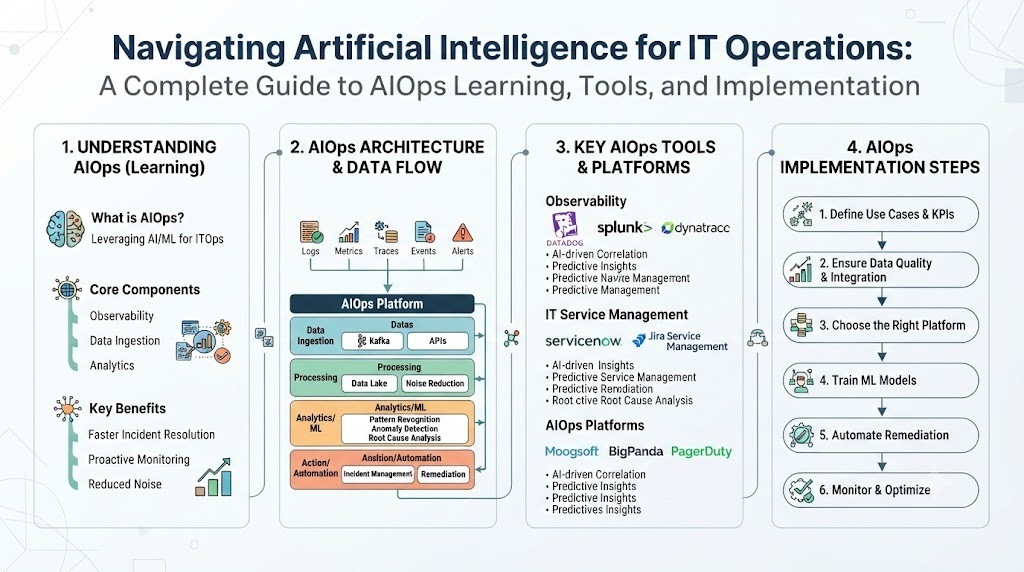
Operational Data -> Data Collection -> Processing -> Analytics -> AI/ML Analysis -> Event Correlation -> Insight -> Action -> Automation -> Continuous Learning
Turning Raw Telemetry into Useful Action
Everything starts by gathering raw telemetry from system logs, application metrics, infrastructure events, and cloud services. Once collected, this data is cleaned and normalized. Next, machine learning models analyze the data streams to spot patterns and detect anomalies. This turns raw numbers into clear, actionable insights. Teams can either review these insights manually or set up automated scripts to fix known issues instantly, while the system keeps learning from new data over time.
AIOps Architecture
The Core Layers Behind the Tech
An effective AIOps setup relies on several key technical layers working together behind the scenes:
- Data Collection and Ingestion: Gathers logs, metrics, and traces from all monitoring and cloud sources.
- Data Storage and Processing: Handles high volumes of real-time operational data safely.
- Observability and Analytics: Applies machine learning to spot unusual behavior and trends.
- Event Correlation and Root-Cause Analysis: Connects related alerts to find the core reason behind a failure.
- Incident Management and ITSM Integration: Connects insights directly with ticketing and workflow tools.
- Automation and Dashboards: Provides clear visual reports and triggers automatic fixes.
When these layers work smoothly together, engineering teams get a single, clear view of their entire digital landscape.
AIOps Training
Building Real Skills for IT Professionals
Good AIOps Training is designed to help professionals wrap their heads around modern IT challenges. A solid learning path covers AIOps fundamentals, basic machine learning concepts, IT operations principles, and observability practices. Learners get to see how logs and metrics feed into event management systems, and how anomaly detection works in real-world scenarios. The best training programs focus on practical examples rather than just textbook theory, making it much easier to apply these skills on the job.
AIOps Certification
Organizing Your Knowledge and Proving Your Skills
Working toward an AIOps Certification is a great way for IT pros to structure their learning journey. Preparing for a certification helps you organize technical concepts, test your understanding, and spot any knowledge gaps you might have. It gives you a clear roadmap to follow and shows potential employers that you take professional development seriously. Of course, a certificate is just one piece of the puzzle—it works best when combined with hands-on technical experience.
AIOps Course
What to Look for in Structured Learning
A well-designed AIOps Course should take learners step-by-step from beginner concepts to advanced implementations. A logical course usually starts with IT operations basics and monitoring tools, moves into machine learning fundamentals, and then dives into operational data management, event correlation, and root-cause analysis. Later modules typically cover automation and rollout strategies. Finding a course that matches your current skill level ensures you won't get overwhelmed or bored.
AIOps Consulting
Getting Expert Guidance Before You Buy
AIOps Consulting services help organizations figure out if they are actually ready to adopt new technologies. Consultants usually kick things off with a current-state assessment, looking closely at your existing monitoring tools, alert volumes, and team workflows. They help you pinpoint automation opportunities, choose the right use cases, and design a realistic implementation roadmap. Good consultants focus on solving your specific business problems rather than just trying to sell you expensive software.
AIOps Services
Professional Support for Digital Operations
AIOps Services cover a wide variety of professional offerings designed to help teams mature their operations. These services can include tool evaluations, monitoring and observability integration, event management optimization, and workflow design. By bringing in outside help when needed, organizations can clean up their data quality and integrate artificial intelligence into their existing IT service management systems safely and smoothly.
AIOps Tools
Grouping Tools by What They Actually Do
There are many different AIOps Tools available today, and they usually fit into specific operational categories:
- Monitoring and Observability: Tools that collect metrics, manage logs, and track distributed app traces.
- Event Management: Solutions that ingest alerts, filter noise, and group related events together.
- Analytics and Intelligence: Platforms that handle anomaly detection, pattern matching, and root-cause analysis.
- Automation and Remediation: Systems that run automated workflows, runbooks, and self-healing actions.
- ITSM Integration: Platforms that connect operational data directly into ticketing and service desks.
Choosing the right tool depends entirely on your current tech stack, team skills, security needs, and budget.
AIOps Platform
Point Tools vs. Unified Platforms
An AIOps Platform is a comprehensive software suite that brings data collection, analytics, machine learning, and automation together into one place. Unlike individual monitoring tools that only look at one piece of the puzzle, a full platform connects data across your entire organization to give you complete visibility. Because every vendor offers something a bit different, it is vital to evaluate platforms carefully to make sure they match your company's actual needs.
AIOps Implementation
Taking a Step-by-Step Approach to Adoption
A successful AIOps Implementation requires patience and a clear plan. Instead of trying to automate everything at once, organizations should start by defining a specific operational problem they want to solve. Next, review your existing monitoring data, clean up data quality, and choose a few high-priority use cases. Start small, integrate systems carefully, keep humans in the loop for important decisions, and expand your usage gradually as your team gets comfortable.
AIOps Use Cases
Real-World Scenarios Where AIOps Helps
Organizations use AIOps to solve several common operational headaches:
- Alert Noise Reduction: Filtering out repetitive, useless alerts so engineers stop getting woken up for false alarms.
- Anomaly Detection: Spotting strange behavior in application traffic before it turns into a crash.
- Event Correlation: Linking scattered alerts from different tools into one single incident ticket.
- Root-Cause Analysis: Automatically figuring out which service update or server failure caused an outage.
- Predictive Incident Detection: Warning teams about memory leaks or storage limits before they run out.
- Automated Remediation: Running automated scripts to restart services or clear caches instantly.
Each of these use cases relies on clean data, clear rules, and sensible human oversight.
AIOps and Observability
How Telemetry Feeds Intelligence
Observability and AIOps go hand in hand, but they do different things. Observability is all about collecting high-fidelity data—specifically logs, metrics, and traces—to show you what is happening inside your systems. AIOps takes that observability data and runs advanced analytics, predictions, and automated workflows on top of it. In short, observability gives you the raw facts and context, while AIOps gives you the intelligence to act on them quickly.
AIOps and DevOps
Making Continuous Delivery Smoother
DevOps teams focus heavily on fast software delivery, automation, and tight feedback loops between developers and system admins. AIOps fits naturally into this world by clearing out alert noise and automating boring manual tasks. By catching bugs and performance dips early, AIOps frees up DevOps engineers to spend less time fighting fires and more time building great features.
AIOps and SRE
Supporting Reliability and Reducing Toil
Site Reliability Engineering (SRE) is all about keeping services reliable, automating manual work, and respecting error budgets. AIOps supports SRE goals by providing predictive analytics and smart incident classification that make it easier to meet strict reliability targets. While AI can crunch data and run routine fixes, human SREs are still essential for setting goals, reviewing post-mortems, and designing resilient architectures.
Who Can Benefit From TheAIOps.com?
IT Operations Professionals
Daily operations staff can learn how to use smart monitoring, cut down on alert noise, and improve incident troubleshooting workflows.
DevOps and SRE Professionals
Reliability and delivery engineers can pick up new ways to strengthen observability practices and automate incident response.
Cloud and Infrastructure Engineers
Cloud specialists gain a better handle on maintaining visibility and performance across complex multi-cloud environments.
IT Managers and Technology Leaders
Tech leaders can use educational resources to plan practical adoption roadmaps, manage budgets, and set operational priorities.
Aspiring AIOps Engineers
Individuals looking to break into specialized roles can build a well-rounded understanding of AI, machine learning, and modern IT management.
Common AIOps Implementation Challenges
Overcoming Everyday Roadblocks
Teams jumping into AIOps often run into predictable roadblocks, such as messy data, disconnected monitoring tools, and resistance to change. Some organizations try to automate too much too fast without clear goals. You can avoid these pitfalls by cleaning up your data sources first, starting with small and focused projects, and making sure your team gets proper training along the way.
Best Practices for AIOps Adoption
Smart Rules for a Smooth Rollout
To make your AIOps journey successful, follow a few proven best practices:
- Start with a clear problem you actually need to solve.
- Clean up your monitoring data before feeding it into AI models.
- Choose one or two high-impact use cases to begin with.
- Test automated actions thoroughly in safe environments.
- Always keep humans in the loop for high-risk changes.
- Track your results, learn from mistakes, and expand slowly.
8-Step AIOps Implementation Guide
Step 1: Define the Operational Problem
Pinpoint the exact IT challenge you want to fix, like slow incident response or too many false-alarm alerts.
Step 2: Assess Existing Monitoring and Data
Audit your current logs, metrics, traces, and alert systems to see what data you actually have.
Step 3: Select Priority Use Cases
Pick a few manageable, high-value projects, such as automated event grouping or basic anomaly detection.
Step 4: Improve Data Quality and Context
Clean up your telemetry so the information going into your analytics engine is reliable and properly formatted.
Step 5: Evaluate AIOps Tools or Platforms
Compare potential software options against your technical architecture, budget, and team skill set.
Step 6: Integrate Existing Systems
Connect your monitoring, cloud platforms, and ticketing tools so data flows smoothly between them.
Step 7: Introduce Automation Carefully
Start with simple, low-risk automated workflows and keep human review mandatory for bigger actions.
Step 8: Measure, Learn, and Expand
Review what went right or wrong, tune your models, and gradually roll out successful workflows to other teams.
AIOps Engineer Skills
What You Need to Know for the Job
Becoming a skilled AIOps Engineer means picking up a mix of traditional IT and modern data skills. You need a solid base in IT operations, Linux administration, cloud computing, and basic networking. On top of that, you should understand monitoring tools, log management, basic machine learning concepts, and scripting languages. Good communication and problem-solving skills are just as important for helping different teams work together smoothly.
Practical AIOps Learning Approach
Moving From Theory to Real Experience
If you want to master AIOps, take a hands-on approach. Start by learning basic IT operations and looking into how machine learning works. Dive into observability tools and practice setting up monitoring dashboards. Work with real log data, try out simple automation scripts, and read up on real-world outage case studies. Building small practice projects is one of the fastest ways to turn theory into actual skill.
How to Choose AIOps Tools or a Platform
What to Look for When Buying Technology
Don't pick an AIOps platform just because it's popular. Instead, look closely at your actual business needs, data sources, and team skills. Check how well the tool integrates with your current stack, evaluate its machine learning maturity, and look at security standards and pricing. Choosing software that fits your team's everyday reality is much more important than buying a tool with a flashy feature list you will never use.
AIOps Career and Skill Development
Growing Your Tech Career
Learning about AIOps naturally expands your expertise across IT operations, DevOps, cloud engineering, and automation. Because the field combines operations with data analysis, professionals who understand both sides are in high demand. While career paths look different everywhere, building a well-rounded, practical skill set will keep you adaptable and ready for future tech roles.
Using TheAIOps.com as a Learning and Professional Resource
Making the Most of Educational Hubs
Platforms like TheAIOps.com offer great resources for anyone trying to wrap their head around Artificial Intelligence for IT Operations. You can start with the basics, explore monitoring and observability guides, and learn about event correlation and tools at your own pace. Using structured learning paths helps you build a solid foundation without feeling overwhelmed by corporate buzzwords or unrealistic sales pitches.
FAQ Section
What is AIOps in simple terms?
AIOps uses big data, machine learning, and automation to make IT operations faster, smarter, and easier to manage.
What does Artificial Intelligence for IT Operations mean?
It means applying AI tools to examine operational data, catch bugs early, and help IT teams run complex systems smoothly.
How does AIOps work?
It gathers data from monitoring tools, cleans it up, uses machine learning to spot weird patterns, and triggers alerts or automated fixes.
What does AIOps Training usually cover?
Training usually covers AIOps basics, system monitoring, logs, metrics, event correlation, and automated incident workflows.
What is the purpose of AIOps Certification?
Certifications help you organize your learning, test your knowledge, and show employers that you understand modern IT practices.
What should an AIOps Course include?
A good course covers IT foundations, machine learning basics, observability, anomaly detection, and real-world implementation tips.
What are AIOps Tools used for?
They are used for log management, alert filtering, event grouping, anomaly detection, and automated system remediation.
What is an AIOps Platform?
It is an all-in-one software system that brings data collection, analytics, and automation together into a single dashboard.
What does AIOps Implementation involve?
It involves finding your biggest IT bottlenecks, cleaning up data, choosing the right tools, and introducing automation slowly.
What does AIOps Consulting typically include?
Consulting involves reviewing your current monitoring setup, checking data quality, and helping you map out an adoption plan.
What skills are useful for an AIOps Engineer?
Useful skills include IT operations experience, cloud knowledge, monitoring setup, basic scripting, and incident response.
How can someone start learning AIOps?
You can start by learning basic IT monitoring, reading up on observability, and using educational platforms to study core concepts.
Additional Related FAQs
How does AIOps help with alert management?
It cuts down on alert fatigue by filtering out spam alerts and grouping related notifications into a single ticket.
How does AIOps support anomaly detection?
It uses machine learning to learn what normal system traffic looks like and flags anything unusual right away.
Can AIOps help with root-cause analysis?
Yes, by mapping out how systems connect, it helps engineers find the actual source of an outage much faster.
How is AIOps related to observability?
Observability provides the raw telemetry data like logs and metrics, while AIOps analyzes that data to give you smart insights.
How is AIOps different from traditional monitoring?
Traditional monitoring relies on fixed rules, while AIOps uses machine learning to adapt and spot unexpected issues dynamically.
How does AIOps work with DevOps and SRE?
It helps DevOps and SRE teams by reducing manual busywork, speeding up troubleshooting, and keeping systems reliable.
What challenges can organizations face during AIOps adoption?
Common problems include messy data, too many siloed tools, and rushing into automation without a clear plan.
How should an organization evaluate an AIOps platform?
Look at how easily it integrates with your current tools, its data security, its machine learning maturity, and your team's ability to use it.
Final Thoughts
Artificial Intelligence for IT Operations offers a practical way to manage the growing complexity of modern tech environments through data and automation. By blending observability data with machine learning, organizations can cut through alert noise and catch problems before they blow up. Taking a thoughtful, step-by-step approach to implementation and tools ensures that your team stays in control. Through continuous learning and reliable resources like TheAIOps.com, IT professionals can build the hands-on skills needed to support efficient, proactive, and intelligent operations.





Top comments (0)