

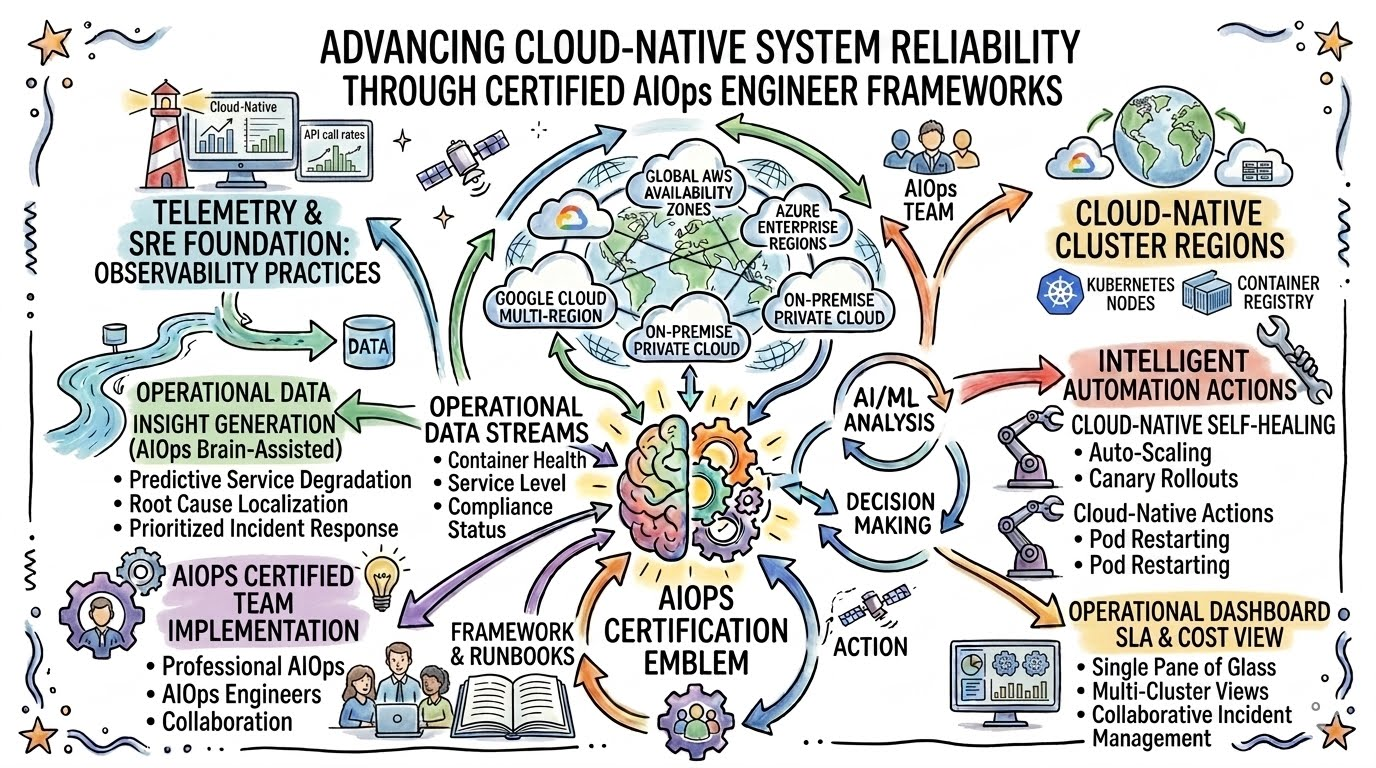
Unprecedented scaling of modern digital infrastructure creates telemetry data volumes that break traditional operations. Human oversight fails when tracking millions of ephemeral container metrics, distributed trace maps, and security events across multi-cloud environments. Engineering leaders, site reliability specialists, and software developers require an intelligent paradigm to transform raw diagnostic signals into autonomous operational decisions. Navigating this shift demands a deep mastery of algorithmic systems management, an engineering focus that the Certified AIOps Engineer educational program codifies.
Transitioning from static dashboards to predictive, self-healing platforms requires an analytical approach that combines data science pipelines with system administration. This article offers a clear, objective breakdown of the certification tracks, support frameworks, and enterprise roadmaps that shape modern operations. Professionals can use this resource to map out their technical advancement and choose their learning steps without encountering marketing hype. The training modules provided by AiOpsSchool form the foundation of this comprehensive guide.
What is the Certified AIOps Engineer?
The Certified AIOps Engineer qualification establishes an objective standard for professionals deploying machine learning systems within live corporate environments. This technical curriculum moves beyond basic alert thresholds to validate hands-on competence in event streaming, multi-source ingestion, and automated problem isolation. Candidates master the skills needed to design algorithms that find underlying architectural anomalies beneath deep layers of alert noise.
Organizations back this program because complex microservices environments produce an overwhelming volume of operational noise. Teams must deploy automated systems that identify and resolve performance drops before users experience an outage. This certification guarantees that an engineer can construct reliable data streams, choose appropriate forecasting models, and link model outputs to existing incident workflows.
Who Should Pursue Certified AIOps Engineer?
Systems engineers, cloud developers, and reliability professionals who protect platform uptime will find immediate career alignment with this certification. Site Reliability Engineers (SREs) use the training to build automated event correlation systems and reduce on-call fatigue. System administrators and network operations center staff use this educational framework to shift their skills from manual troubleshooting to code-driven automation.
The technical depth of the program also helps engineering managers, solutions architects, and technical directors build long-term operational roadmaps. Data scientists and machine learning operations (MLOps) specialists use the curriculum to tailor their models to the unique requirements of cloud telemetry. The validation framework supports engineering careers globally, opening advancement opportunities across major technology hubs in India, Europe, and the United States.
Why Certified AIOps Engineer is Valuable
The main advantage of the Certified AIOps Engineer standard comes from its emphasis on open, vendor-neutral system architectures. While commercial monitoring utilities change quickly, the fundamental logic of telemetry processing, statistical pattern matching, and automated remediation remains constant. This program keeps your skills relevant by focusing on core pipeline mechanics rather than proprietary software interfaces.
Enterprises prioritize engineers with these skills because automated anomaly detection drives down Mean Time to Resolution (MTTR) and protects revenue. Earning this credential shows employers that you can trim operational costs by replacing manual triage with automated diagnostic workflows. The certification gives you clear career advantages, qualifying you for principal engineering roles and high-visibility digital transformation projects.
Certified AIOps Engineer Certification Overview
Candidates complete their educational curriculum through the official Certified AIOps Engineer track, which the AiOpsSchool platform hosts. The program evaluates practical skills through hands-on lab challenges and scenario simulations that require resolving real-world system failures. This performance-based grading ensures that certified individuals can handle actual production incidents.
A committee of active operations experts updates the curriculum regularly to reflect changes in cloud-native technology. The certification exams verify your ability to configure high-volume data collectors, manage model retraining schedules, and build secure automation loops. The tiered certification pathway allows tech professionals to start at a level that matches their current systems engineering experience.
Certified AIOps Engineer Certification Tracks & Levels
The certification framework divides its educational journey into three distinct phases: Foundational, Associate, and Professional/Specialty. The Foundational tier establishes basic vocabulary, metrics classification, and fundamental monitoring architectures for junior staff or non-technical business leaders. The Associate certification introduces pipeline orchestration, pattern recognition logic, and custom alerting thresholds for mid-level technical staff.
The Professional and Specialty tracks address advanced architecture, enterprise-wide model deployments, multi-cloud log aggregation, and deep automation loops. These specialized pathways allow veteran engineers to merge AIOps systems with related engineering fields like DevSecOps, cloud financial operations, or database reliability. This logical structure supports an engineer’s career advancement from an individual contributor up to an enterprise platform architect.
Complete Certified AIOps Engineer Certification Table
| Track | Level | Who it’s for | Prerequisites | Skills Covered | Recommended Order |
|---|---|---|---|---|---|
| Operations | Foundational | Helpdesk Technicians, IT Buyers | Basic computing literacy | Metrics terminology, Core AIOps concepts | First |
| Systems | Associate | Cloud Engineers, SREs | Foundational pass, Basic scripting | Ingestion configuration, Event grouping | Second |
| Architecture | Professional | Principal Engineers, SRE Leads | Associate pass, Advanced Linux | Model optimization, Automated healing | Third |
| Security | Specialty | SecOps Engineers, Compliance Leads | Associate pass, Basic cryptography | Threat telemetry parsing, Attack isolation | Fourth (Optional) |
| Finance | Specialty | Cloud Cost Analysts, FinOps Leads | Cloud billing awareness | Spending forecasting, Idle resource detection | Fifth (Optional) |
Detailed Guide for Each Certified AIOps Engineer Certification
Foundational Level
Certified AIOps Engineer – Foundational
What it is
This baseline credential verifies an engineer's grasp of foundational observability concepts, primary telemetry types, and standard cloud monitoring topologies. It confirms that a professional understands how metrics, logs, events, and distributed traces function within a cloud ecosystem.
Who should take it
Technology buyers, junior support desk analysts, product owners, and aspiring cloud professionals should take this exam to build their core operational vocabulary.
Skills you’ll gain
- Recognizing the differences between time-series metrics and log messages
- Categorizing the structural layers of an enterprise observability pipeline
- Identifying the limitations of legacy, static monitoring alert systems
- Defining the core vocabulary of machine learning within IT operations
Real-world projects you should be able to do
- Build a unified monitoring dashboard that displays primary system metrics from a cloud compute instance.
- Draw a complete data flowchart tracking telemetry from an application front-end down to a centralized storage cluster.
Preparation plan
- 7–14 Days: Go through the introductory video modules, review core concept definitions, and pass the practice quizzes on the portal.
- 30 Days: Read basic documentation on open-source observability standards and spend four hours analyzing different system log formats.
- 60 Days: Skip this extended study path unless you are entering the tech sector from a completely unrelated field.
Common mistakes
- Studying advanced machine learning mathematical models instead of focusing on fundamental monitoring terminology and pipeline concepts.
- Failing to distinguish between structured application logs and unstructured system events during testing scenarios.
Best next certification after this
- Same-track option: Certified AIOps Engineer – Associate
- Cross-track option: Foundational Public Cloud Certificate
- Leadership option: Agile Product Delivery Certificate
Associate Level
Certified AIOps Engineer – Associate
What it is
This intermediate exam tests your hands-on implementation skills, focusing on building data pipelines, parsing telemetry records, and applying statistical models. It proves an engineer can configure real-time data streams and use algorithms to isolate anomalous system events.
Who should take it
DevOps specialists, systems administrators, database caretakers, and cloud developers with two or more years of hands-on infrastructure experience.
Skills you’ll gain
- Setting up telemetry collection agents like OpenTelemetry, Fluentd, or Logstash
- Applying statistical math to establish dynamic baseline performance thresholds
- Creating rule groups that bundle isolated alert signals into unified incidents
- Configuring script triggers via webhooks to handle basic infrastructure issues
Real-world projects you should be able to do
- Construct a production-ready ingestion pipeline that converts unstructured application logs into clean database records.
- Configure an event-clustering engine that reduces target alert volumes by fifty percent across an active staging environment.
Preparation plan
- 7–14 Days: Attempt this short timeline only if you write automation scripts daily and manage production logging systems.
- 30 Days: Complete the associate learning path, spend fifteen hours in the lab environment, and review three full practice tests.
- 60 Days: Dedicate month one to data structures and parsing methods, then spend month two working through event correlation labs.
Common mistakes
- Writing fragile log-parsing patterns that break or drop packets when production systems face sudden traffic surges.
- Concentrating entirely on machine learning outputs while ignoring data validation and pipeline health.
Best next certification after this
- Same-track option: Certified AIOps Engineer – Professional
- Cross-track option: Linux Administration Professional Certificate
- Leadership option: Scrum Master Practical Certificate
Professional/Specialty Level
Certified AIOps Engineer – Professional
What it is
This advanced validation confirms your capability to architect enterprise operations platforms, manage production machine learning lifecycles, and design automated remediation systems. It certifies that a practitioner can build self-healing cloud infrastructure webs.
Who should take it
Senior site reliability engineers, principal infrastructure architects, and platform engineering leads responsible for massive, distributed corporate ecosystems.
Skills you’ll gain
- Engineering robust data buses that process millions of infrastructure metrics per second
- Deploying and fine-tuning specialized time-series forecasting models in production
- Designing closed-loop automated playbooks that fix recurring system issues safely
- Managing multi-tenant data compliance, privacy masking, and retention rules
Real-world projects you should be able to do
- Code an automated remediation loop that spots application memory leaks, isolates the target container, captures diagnostics, and restarts the service.
- Unify different logging feeds from three distinct public cloud backends into a single, coordinated incident sorting platform.
Preparation plan
- 7–14 Days: Avoid this brief window unless you already design custom AIOps tools for a large enterprise daily.
- 30 Days: Review multi-cloud networking designs, complete all advanced lab challenges, and practice tuning time-series models.
- 60 Days: Analyze deep system failure histories, code custom event processors, and master mathematical time-series decomposition.
Common mistakes
- Using ad-hoc scripting for individual nodes instead of building declarative, scalable automation policies.
- Launching self-healing workflows without safety brakes, causing unintended cascading network disruptions during an outage.
Best next certification after this
- Same-track option: Certified AIOps Engineer – Specialty (Finance or Security)
- Cross-track option: MLOps Platform Architecture Expert
- Leadership option: Technical Director Strategic Certificate
Choose Your Learning Path
DevOps Path
This pathway embeds algorithmic intelligence directly into continuous integration and delivery pipelines. Engineers master telemetry collection patterns first, use deployment analysis models to guard staging environments, and construct real-time feedback loops to alert developers about production anomalies. The journey converts a standard deployment specialist into an engineer of automated, self-correcting software delivery systems.
DevSecOps Path
Professionals on this track merge security logging fabrics with general infrastructure metrics to expose complex, low-frequency digital attacks. You learn to feed firewall data, audit trails, and container compliance logs into processing engines to catch anomalous patterns. The curriculum guides candidates through automated threat mitigation and programmatic infrastructure containment.
SRE Path
This popular engineering route focuses completely on maximizing platform uptime and stripping away manual operational toil. Engineers learn to calculate dynamic service level objectives using predictive algorithms rather than static historical metrics. The training focuses on automated root-cause isolation, alert clustering, and building reliable multi-step remediation playbooks.
AIOps Path
This specialized track serves engineers who manage large data-streaming platforms, analytics infrastructure, and operational data fabrics. It details how to scale high-throughput event buses, minimize time-series data storage costs, and optimize the underlying hardware cluster that powers analytical models.
MLOps Path
Engineers here oversee the deployment, monitoring, and overall lifecycle of machine learning models within IT operations environments. This track trains professionals in model version control, infrastructure-focused feature stores, data drift detection, and automated model retraining pipelines.
DataOps Path
This discipline keeps the data fueling operations engines clean, structured, and consistent across all enterprise environments. Specialists focus on telemetry schema validation, data pipeline automation, data quality score calculations, and secure data masking for staging systems.
FinOps Path
This financial specialty solves cloud cost optimization challenges by introducing automated budget anomaly tracking and resource utilization modeling. Candidates learn to correlate billing summaries with real-time compute utilization data to predict spending trends and down-scale idle cloud resources automatically.
Role → Recommended Certified AIOps Engineer Certifications
| Role | Recommended Certifications |
|---|---|
| DevOps Engineer | Certified AIOps Engineer – Foundational, Certified AIOps Engineer – Associate |
| SRE | Certified AIOps Engineer – Associate, Certified AIOps Engineer – Professional |
| Platform Engineer | Certified AIOps Engineer – Associate, Certified AIOps Engineer – Professional |
| Cloud Engineer | Certified AIOps Engineer – Foundational, Certified AIOps Engineer – Associate |
| Security Engineer | Certified AIOps Engineer – Associate, Specialty Track (Security) |
| Data Engineer | Certified AIOps Engineer – Foundational, Specialty Track (Data) |
| FinOps Practitioner | Certified AIOps Engineer – Foundational, Specialty Track (Finance) |
| Engineering Manager | Certified AIOps Engineer – Foundational |
Next Certifications to Take After Certified AIOps Engineer
Same Track Progression
Earning your professional certificate opens the door to advanced specializations that target high-scale distributed data fabrics and streaming computation engines. This pathway requires mastering real-time message brokers, complex event processing systems, and non-relational time-series storage. Advancing along this track marks you as an expert on large-scale enterprise observability systems.
Cross-Track Expansion
Platform engineering experts often expand their skills by branching into deep data science, massive distributed database management, or advanced multi-cloud networking frameworks. Learning to build unique deep learning engines or managing globally sharded databases provides the cross-functional knowledge required to manage modern platform architectures.
Leadership & Management Track
Engineers aiming for strategic management roles should pivot toward structured corporate leadership and technology governance certificates. This pathway covers executive communication strategies, IT service management methodologies, tech-sector risk analysis, and corporate procurement processes.
Training & Certification Support Providers for Certified AIOps Engineer
- DevOpsSchool organizes comprehensive, instructor-led training courses that emphasize core infrastructure principles, practical command-line execution, extensive lab projects, and curated exam preparation materials for systems engineers worldwide.
- Cotocus delivers high-end corporate upskilling programs, providing detailed multi-cloud sandbox environments, custom enterprise training tracks, and immersive operational labs to prepare tech teams for associate and professional exams.
- Scmgalaxy supplies an extensive open-access knowledge base containing step-by-step logging guides, sample examination blueprints, configuration templates, and collaborative discussion forums focusing on advanced system automation.
- BestDevOps operates focused technical bootcamps that prioritize concrete platform skills, training students in shell scripting, log transportation setups, and system integration strategies to clear tough certification lab tests.
- devsecopsschool.com hosts specialized technical paths that blend cloud security frameworks with operations pipelines, focusing on automated log compliance, secure configuration testing, and algorithmic event monitoring.
- sreschool.com concentrates on enterprise platform availability paradigms, delivering detailed classes regarding SRE methodologies, incident response code generation, error budget mathematics, and system failure simulation labs.
- aiopsschool.com represents the official educational anchor for the entire certification track, providing core curriculum blueprints, authorized training sandboxes, official study guides, and the secure exam delivery portal.
- dataopsschool.com targets the health and integrity of enterprise data pipelines, offering specialized courses that detail telemetry validation rules, streaming architecture scaling, and large-scale analytical storage optimization.
- finopsschool.com teaches modern cloud financial management, supplying structured courses that connect cloud infrastructure utilization metrics with corporate budget forecasting techniques and automated waste remediation practices.
Frequently Asked Questions
1. Does the associate exam require previous experience with complex data science?
No, the assessment focuses on systems engineering, data collection pipelines, and scripting, making it accessible to traditional systems engineers.
2. What happens if my testing machine crashes during the hands-on lab portion?
The proctoring platform saves your active virtual laboratory states, allowing you to resume your work once your connection returns.
3. Do technology firms value this credential during their interview screening processes?
Yes, modern enterprises look for this qualification when staffing automated site reliability and platform engineering groups.
4. How does the grading system verify my answers inside the practical lab exercises?
Automated verification tools inspect your laboratory workspace to ensure your code and pipeline setups meet the testing requirements.
5. Can I open reference websites or use programming assistants during the evaluation?
No, the testing system enforces a secure, isolated testing environment that blocks all external websites and digital materials.
6. Does this certification pathway require recurring membership fees to stay active?
No, you do not need to pay annual fees to keep your earned certification active during its validity period.
7. Which scripting language should I learn first to prepare for the associate labs?
Python is the best language to focus on, as it serves as the primary tool for parsing telemetry and configuring algorithms in the labs.
8. Is there an option to purchase bulk exam vouchers for corporate engineering teams?
Yes, enterprise training managers can arrange bulk licensing packages directly with the certification provider.
9. How frequently do the program directors update the technical exam questions?
The technical board reviews and updates the question banks every year to include modern cloud-native standards.
10. Can an engineer skip the foundational test and challenge the associate tier directly?
Yes, systems professionals with two or more years of hands-on experience can bypass the foundational level completely.
11. What is the minimum passing score required to clear the professional certification?
Candidates must score seventy percent or higher across the combined scenario questions and lab modules to pass.
12. Does the exam focus on a single cloud vendor like Amazon Web Services?
No, the curriculum maintains strict vendor neutrality, teaching principles that apply across all public and private clouds.
FAQs on Certified AIOps Engineer
1. Which software configurations allow an ingestion pipeline to collect multi-source infrastructure logs without exhausting memory during an outage?
Engineers must deploy lightweight, edge-based collection daemons that filter and parse log records locally before sending them over the network. Placing a distributed message broker like Apache Kafka between these edge collectors and your central storage tier buffers data surges, protecting your analytical systems from memory exhaustion during major infrastructure failures.
2. How do site reliability professionals configure models to spot performance drift in systems telemetry before outages occur?
You must establish statistical pipelines that run continuous distance tests, like the Kolmogorov-Smirnov test, comparing live time-series data streams against historical baseline profiles. When these tests show that current system behaviors deviate significantly from your baseline model distribution, the pipeline triggers an alert indicating data drift and flags the model for retraining.
3. What operational risks arise when connecting unsupervised machine learning models directly to automated incident tracking platforms?
Unsupervised models can cluster alerts based on coincidental timestamps rather than true system dependencies, generating misleading or inaccurate incident tickets. This behavior misdirects on-call engineers during critical incidents, meaning teams must manually validate clustering logic before enabling automatic ticketing.
4. Can you describe how an engineer confirms that a self-healing playbook works safely before enabling it in production?
Teams use dedicated staging environments running chaos engineering tools to deliberately inject specific infrastructure faults, like synthetic CPU spikes or disk exhaustion. You then monitor your AIOps pipeline to verify that it accurately identifies the failure and triggers the correct automation script without creating secondary system problems.
5. How does the curriculum define the exact functional split between an MLOps pipeline and an AIOps solution?
MLOps provides a general framework for building, versioning, testing, and deploying any machine learning model into production safely. AIOps represents a specific implementation of these concepts, focusing exclusively on using machine learning algorithms to parse, analyze, and fix IT infrastructure issues.
6. What programmatic safety features prevent an automated remediation loop from getting stuck during network splits?
You must write strict execution limits, maximum retry loops, and circuit-breaker flags directly into your automation playbooks. If a self-healing script fails to fix an infrastructure issue after three attempts, the circuit breaker must stop the playbook and immediately escalate the ticket to a human engineer.
7. Why do open telemetry standards take precedence over proprietary collection agents within modern analytics architectures?
The OpenTelemetry specification provides a unified, open-source standard for formatting logs, traces, and metrics into a single data model. This consistency removes vendor lock-in, allowing companies to send identical system data to different backend analytics platforms without rewriting their application code.
8. How do cost-forecasting algorithms inside the FinOps track handle expected holiday traffic surges without triggering budget alarms?
The algorithms use seasonal time-series decomposition to separate predictable traffic cycles from unusual spikes in cloud spending. By factoring in historical calendar trends, like holiday retail surges, the model adjusts its baseline spending limits to prevent false cost anomaly alerts.
Final Thoughts: Is Certified AIOps Engineer Worth It?
Pursuing the Certified AIOps Engineer pathway requires a realistic assessment of your day-to-day work and the size of your infrastructure. If you manage simple, monolithic applications or predictable server setups, the advanced machine learning models taught in this program will exceed your requirements. For engineers working with distributed microservices, multi-cloud clusters, or high-volume data streams, this credential provides immediate tactical advantages.
The systems engineering field is shifting away from manual monitoring toward automated, algorithmically driven management. Traditional operational practices cannot scale to meet the data demands of modern cloud-native environments. Earning a practice-focused credential through the official training portal helps you master these data streams and lead enterprise automation projects with confidence. Review the available specializations, select the track that matches your technical focus, and begin working through the labs methodically.






Top comments (0)