

Last spring I ran twelve user interviews for a feature decision. I recorded every one of them. I attended every one of them. And when it came time to write the summary that was supposed to inform the decision, I had almost nothing quotable to show for eleven of the twelve.
This is the story of how that happened, why my own process was the problem, and what I changed.
Twelve recordings and almost nothing usable
The pattern was consistent. During the call I would hear something sharp, a sentence that reframed how I understood the problem. I would write it down in my notes. Then someone would ask me a follow-up three weeks later and I would find my note said something like "pricing feels arbitrary??" with no memory of what preceded it or how the participant actually phrased it.
I had the recordings. What I did not have was a way to use them. Scrubbing through a 45 minute audio file to find one sentence is technically possible and practically never happens. So the recordings sat in a folder and the interviews decayed into whatever survived in my notes.
The expensive part is not the lost quote. It is that the decision ends up shaped by the parts of an interview that were easy to remember, which are usually the parts that confirmed what I already believed.
My notes were the bottleneck, not my recording
I assumed the fix was better note-taking. I tried a structured template, then two tags per answer, then typing quotes verbatim while nodding along. Each version made me worse at listening and none of them produced material I trusted.
The realisation was uncomfortable: my notes were never going to carry the content, because the thing that made a quote valuable was the exchange around it. A participant saying "it feels arbitrary" is one observation. Her saying it after I asked whether the tier boundaries were defensible is a finding. Notes capture the fragment. What I needed was the structure.
What I needed a transcript to actually do
Once I framed it that way, the requirements were obvious and embarrassingly specific.
It needed to tell apart who was speaking, because half the meaning sits in whether something was volunteered or pulled out of someone. It needed to keep timestamps so I could jump from a line back to the audio and check tone. It needed to be searchable, so "find every mention of migration" took seconds rather than an afternoon. It needed to export into something beyond plain text, because engineers wanted quotes in documents and I wanted rows I could count. And it needed to work when the interview was not in English, which was starting to happen more often.
None of these are exotic. Almost every transcription tool will promise you the first one. The difference showed up in whether the output was usable without an hour of manual fixing.
The pipeline that finally worked
What I landed on was Interview Transcript Generator from Video Transcriber AI. It accepts an uploaded recording or a compatible public link, which covered both my Zoom exports and the one interview a colleague sent as a link to hosted video, and it comes back with speaker labels and timestamps attached to each turn.
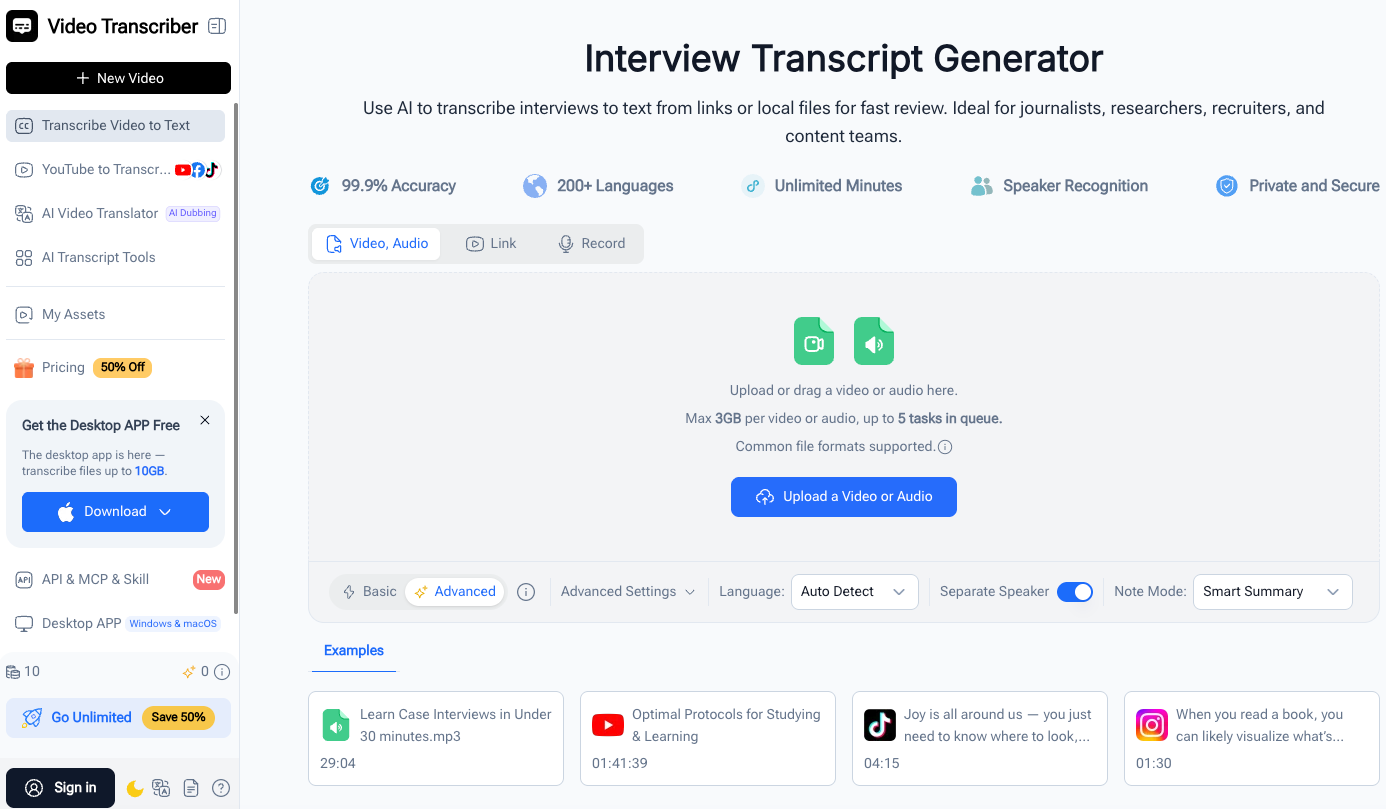
The specific thing that sold me was not accuracy in the abstract. It was that speaker separation is applied during processing rather than bolted on afterwards. I no longer had a single block of prose with no indication of who said what, which had been my default experience with transcription tools. It also handles more than 200 languages, and selecting the language before processing noticeably improved the results on the two non-English interviews.
Setup is three steps that I now do by rote: add the recording, set the language and options, then review and export. The review step is where the online editor earns its keep, because I can fix a name once and have it corrected in every export format rather than finding the same typo in four downloaded files.
Treating the summary as a map, not a source
Every one of these tools now offers an AI summary, and every one of them should be treated the same way: it is a table of contents, not evidence.
I use the summary for one job, deciding which interviews to read first and which themes to look at. Then I go to the transcript itself for anything that will appear in writing. The useful follow-up feature is being able to ask questions of the transcript to locate where a topic came up, which is a much better use of the model than asking it to characterise an interview for you.
The habit is simple. Anything that leaves my keyboard and reaches another person came from the transcript, and I checked it against the audio. Nothing comes from the summary.
The part nobody tells you about names and numbers
Almost every factual correction I have ever had to make in a transcript was either a proper noun or a number. Product names, competitor names, an unusual surname, and figures like "thirty percent" versus "thirteen percent".
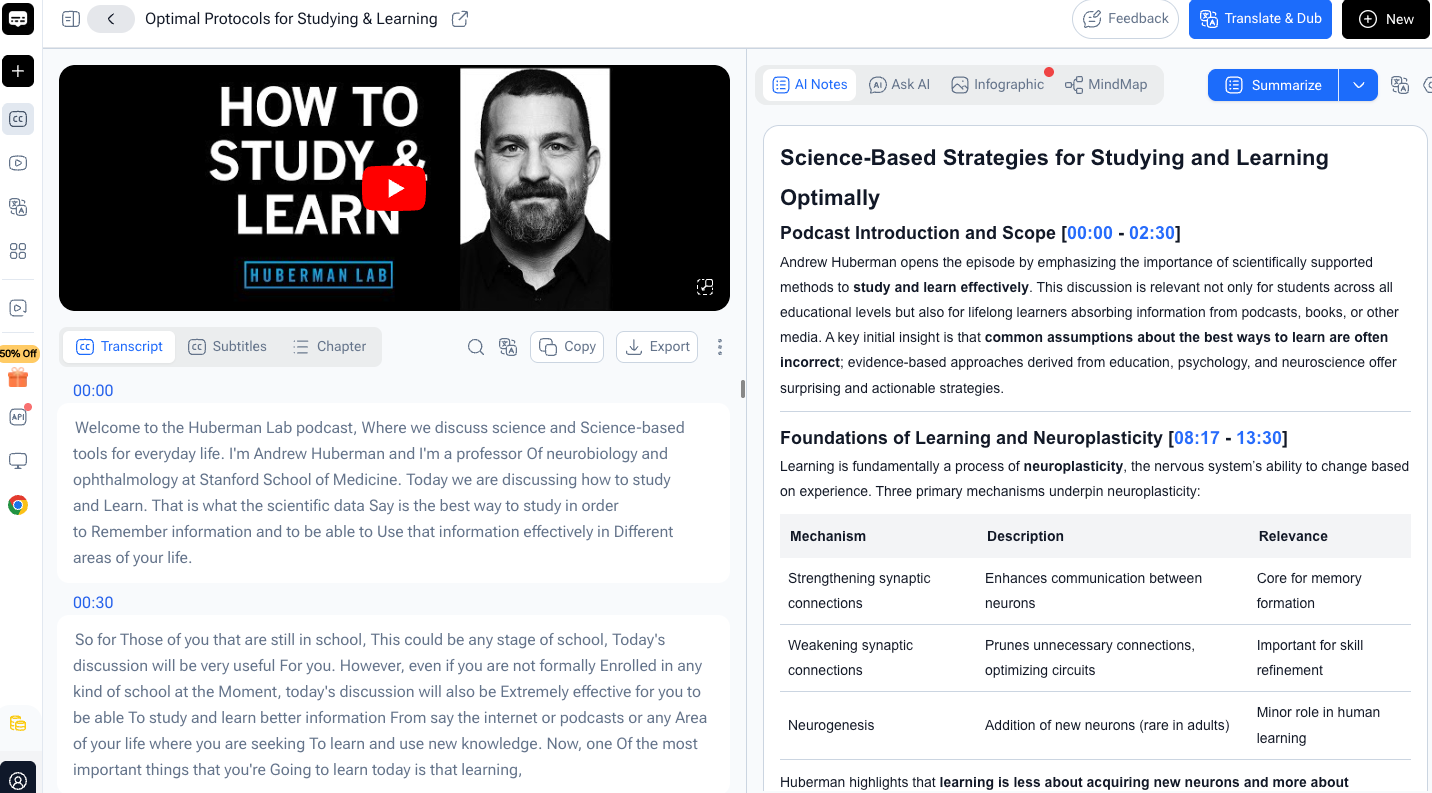
There is a custom term feature for exactly this, and using it is the single highest-leverage minute I spend per interview. Before processing, I paste in the names and acronyms I know will appear. It does not catch everything, but it takes that correction pass from "find and fix forty things" down to a handful of genuine surprises.
The numbers still need my ears. If a quote contains a figure, I replay it. This takes seconds and has saved me from publishing two wrong numbers in the last year.
Where it still trips me up
It is not magic and I do not want to pretend otherwise.
Crosstalk defeats it. In a panel-style interview where people talk over each other, you get text that reads fluently but is not reliable about who said what, and no label is going to fix a recording where three voices overlap. Poor audio is the same story: a cafe interview will transcribe into something that looks plausible and is wrong in ways that are hard to spot without listening.
There is also an advanced mode that removes filler words, false starts, and repeated phrases. I use it because it makes transcripts far easier to read, and I always keep an uncleaned export alongside it. Hesitation carries meaning. When someone says "I mean, I guess, maybe around forty", that hedging is the answer, and silently deleting it turns a considered estimate into a confident claim they did not make.
Finally, the maximum file size varies depending on where you read it. I stopped guessing and just check what the uploader says that day.
What I do differently now
The change is smaller than it sounds and bigger than it feels. I stopped trying to capture interviews in real time and started treating them as recordings to be processed afterwards.
Transcription is cheap, so every interview gets one, including the boring ones, because the boring ones are where I used to stop writing things down.
If you run interviews for research, hiring, reporting, or content, Video Transcriber AI's Interview Transcript Generator is the one I settled on after trying several. Export the CSV, search it before you read it, and keep a raw copy of anything you intend to quote. The decision you make afterwards will be built on what people actually said, which turns out to be a different thing from what you remember them saying.





Top comments (0)