

Introduction
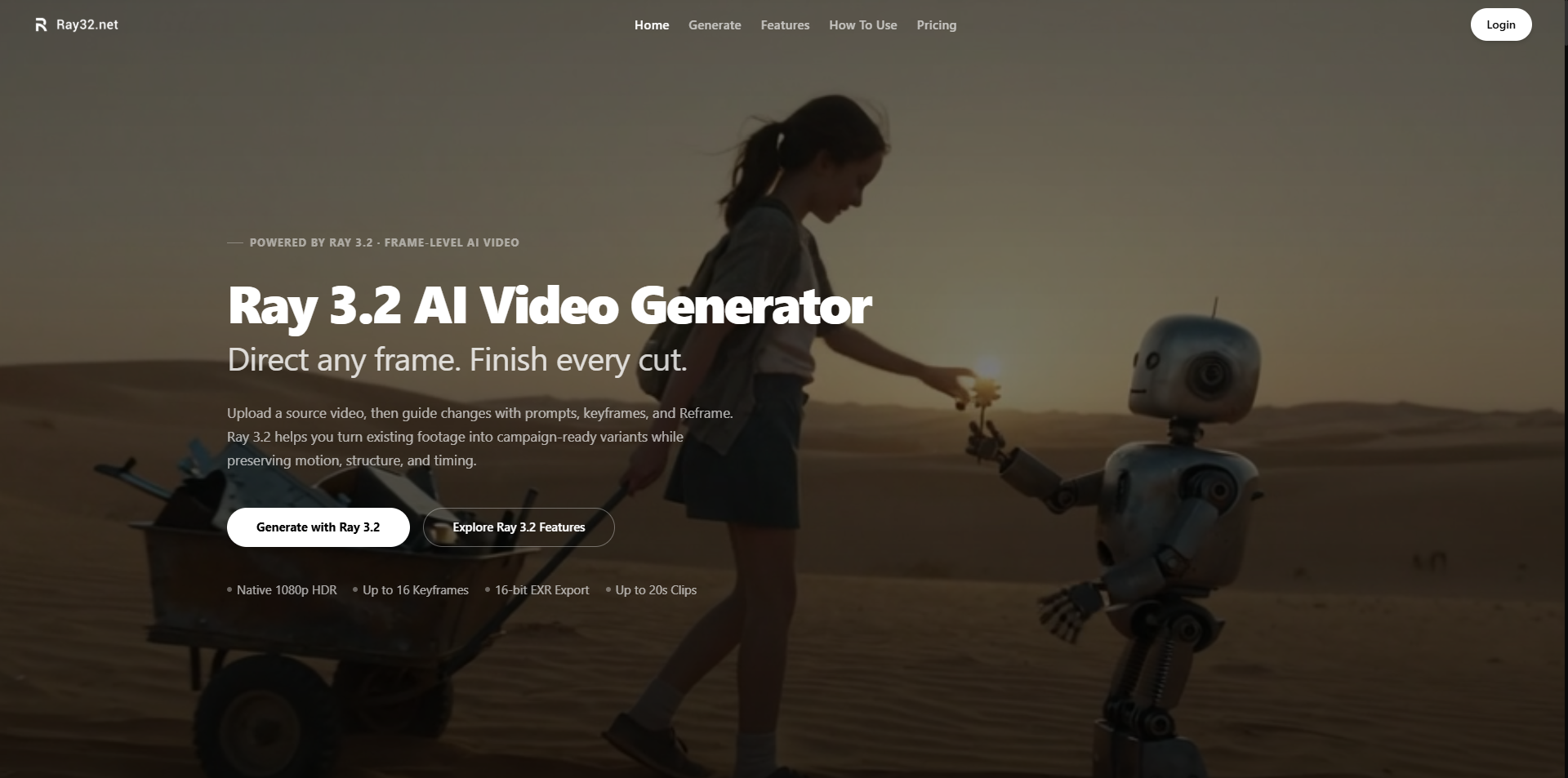
For prompt engineers, filmmakers, marketers and VFX designers tired of inconsistent, uncontrollable AI video outputs, Ray 3.2 AI Video Generator delivers a production-grade tool built around precise prompt control and studio-ready visual standards. Most mainstream AI video platforms only offer basic text-to-video functions with little timeline customization, often resulting in character drift, lighting jumps and mismatched motion. Ray 3.2 reworks this workflow by combining four integrated creation pipelines, frame-level keyframe management, native professional HDR color and seamless VFX pipeline compatibility — all running fully in cloud browsers without demanding local GPUs or complicated software installation. It is designed to translate detailed prompt instructions into smooth, logically consistent footage ideal for concept prototyping, commercial ads, previsualization and cross-platform social content.
Four Unified Production Workflows Powered by Prompt Input
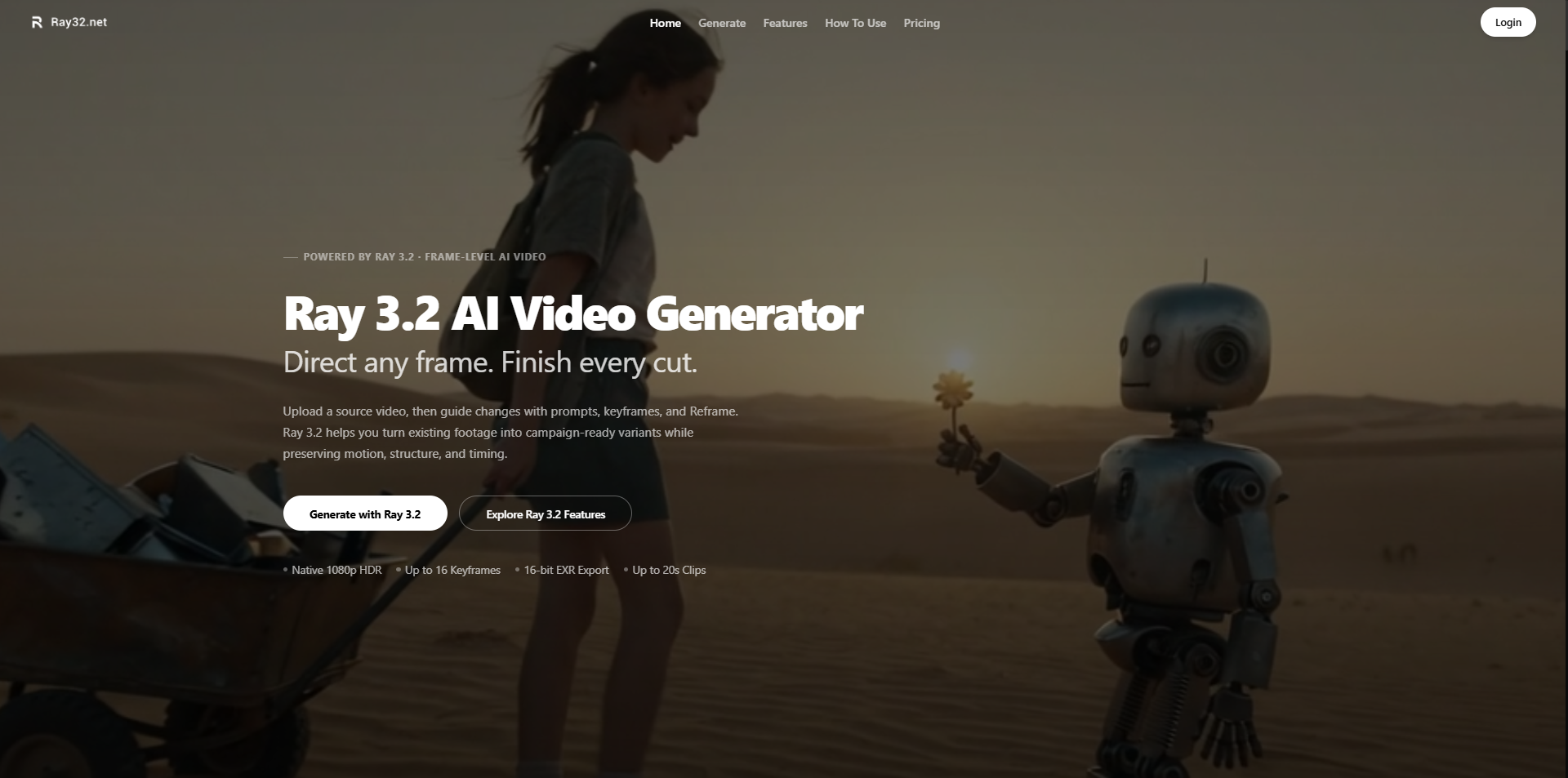
What makes Ray 3.2 stand out to prompt builders is its all-in-one system that adapts to any starting material, fully guided by written prompts paired with reference assets.
The first pipeline is Text to Video. Creators input detailed prompts covering subject actions, camera movements, lighting atmosphere and scene composition to generate standalone 5 or 10-second cinematic clips. Multiple aspect ratios are supported, and reference images can be attached to lock character design, environment tone and artistic style, eliminating repeated prompt refinement for consistent series shots. This workflow works perfectly for trailer prototypes, brand concept clips and rapid creative testing.
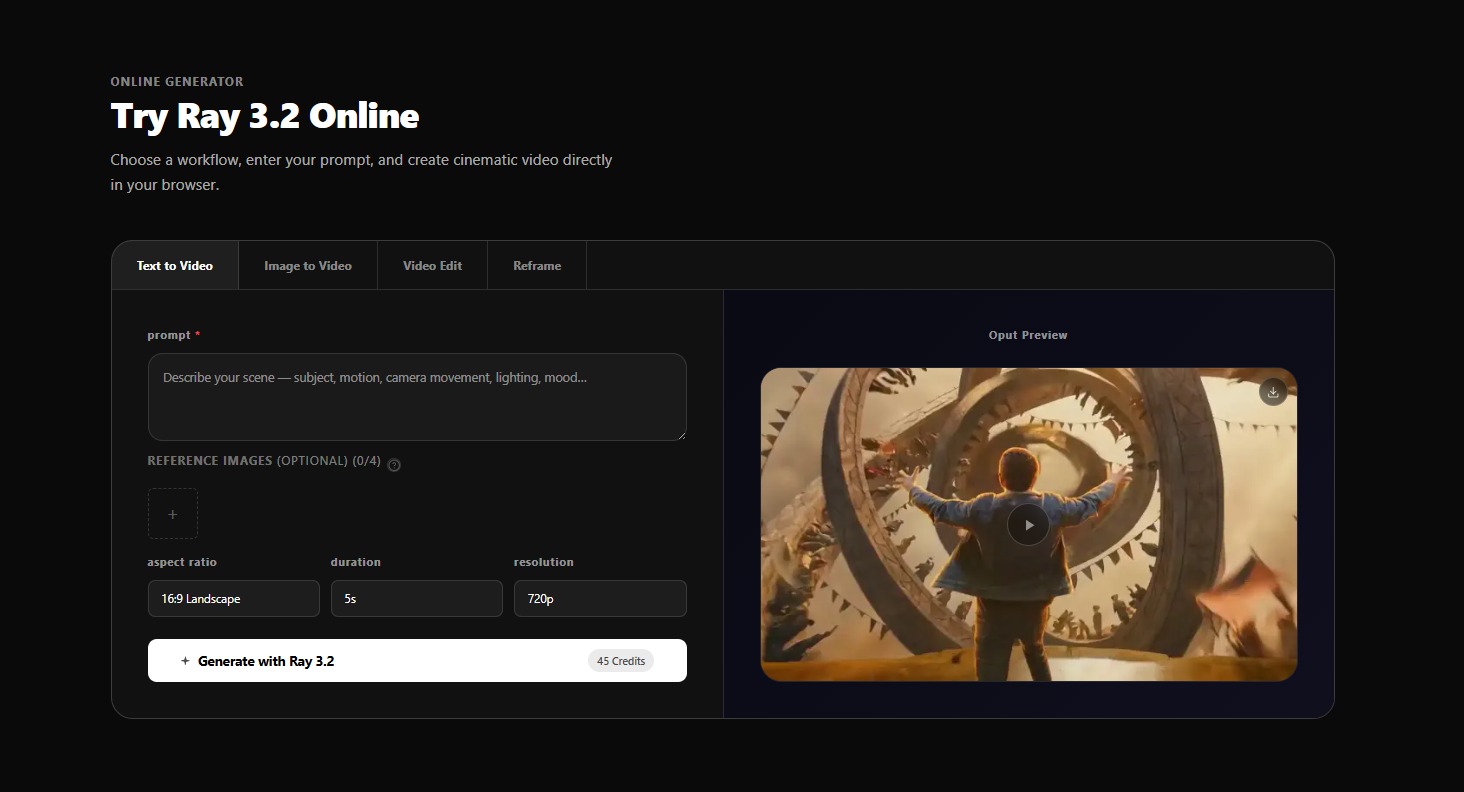
Second, Image to Video turns static concept art, character portraits and illustration files into moving sequences. Users describe desired camera paths, emotional shifts and movement logic via prompts, while the model retains every visual detail of the original image. Up to 16 customizable keyframes let prompt users mark exact timestamps for motion transitions, solving the common problem of erratic frame jumps seen in simpler image-animation tools. Game and animation creators rely heavily on this workflow to pitch cutscene drafts before full production.
Third, Video Edit (Modify Video V2) serves as Ray 3.2’s core footage transformation feature. After uploading raw recorded clips, users input text prompts to swap backgrounds, alter character costumes, adjust global lighting or replace product elements — while preserving all original actor timing, body language and performance. The system tracks up to eight human faces simultaneously with accurate skeletal pose tracking, removing distorted facial features and limb warping that plagues many competing video-to-video models. Clips can extend up to 20 seconds at native 1080p resolution, making it ideal for generating multiple campaign variants without reshooting.
*Fourth, Video Reframing streamlines multi-platform content delivery *
through prompt-guided intelligent filling. Instead of simply cropping footage to fit vertical, square or ultra-wide ratios, Ray 3.2 generates matching background content aligned with the original scene’s lighting and mood. A single 16:9 master shot can be quickly converted into vertical short clips for Reels, TikTok and Shorts, drastically cutting down repetitive prompt work for social media teams.
Frame-Level Control & Professional-Grade Visual Output
The biggest advantage for prompt engineers using Ray 3.2 AI Video Generator is its multi-keyframe framework, a feature rarely seen on cloud-based AI video tools. Every clip supports up to 16 independent keyframe anchors on the timeline, allowing creators to write targeted prompts for specific frames to adjust lighting shifts, camera speed and character action beats. This frame-by-frame directional capability drastically reduces prompt iteration cycles, as users no longer need to rewrite full scene prompts to fix single moment inconsistencies.
On technical output standards, Ray 3.2 generates authentic native 16-bit HDR color rather than post-production filter overlays. It supports direct export of 16-bit EXR files under the industry-standard ACES2065-1 color space, which imports cleanly into DaVinci Resolve, Nuke and major Adobe creative tools without format conversion. Every render holds full gradeable color data, minimizing hour
s of post-processing correction work for VFX and post-production teams.
Beyond core generation tools, Ray 3.2 includes advanced production functions that expand prompt-driven creative possibilities. Motion Transfer extracts movement patterns from source footage and maps them onto new characters or environments while retaining original choreography. Environment Change and Relighting let users rewrite entire scene settings, seasons and light conditions through simple prompt descriptions. Character Transformation alters character appearances, outfits or species without breaking existing performance continuity, while Campaign Localization generates region-specific scene variants from one master clip via adjusted prompt parameters.
Cloud-Native Access & Enterprise API Integration
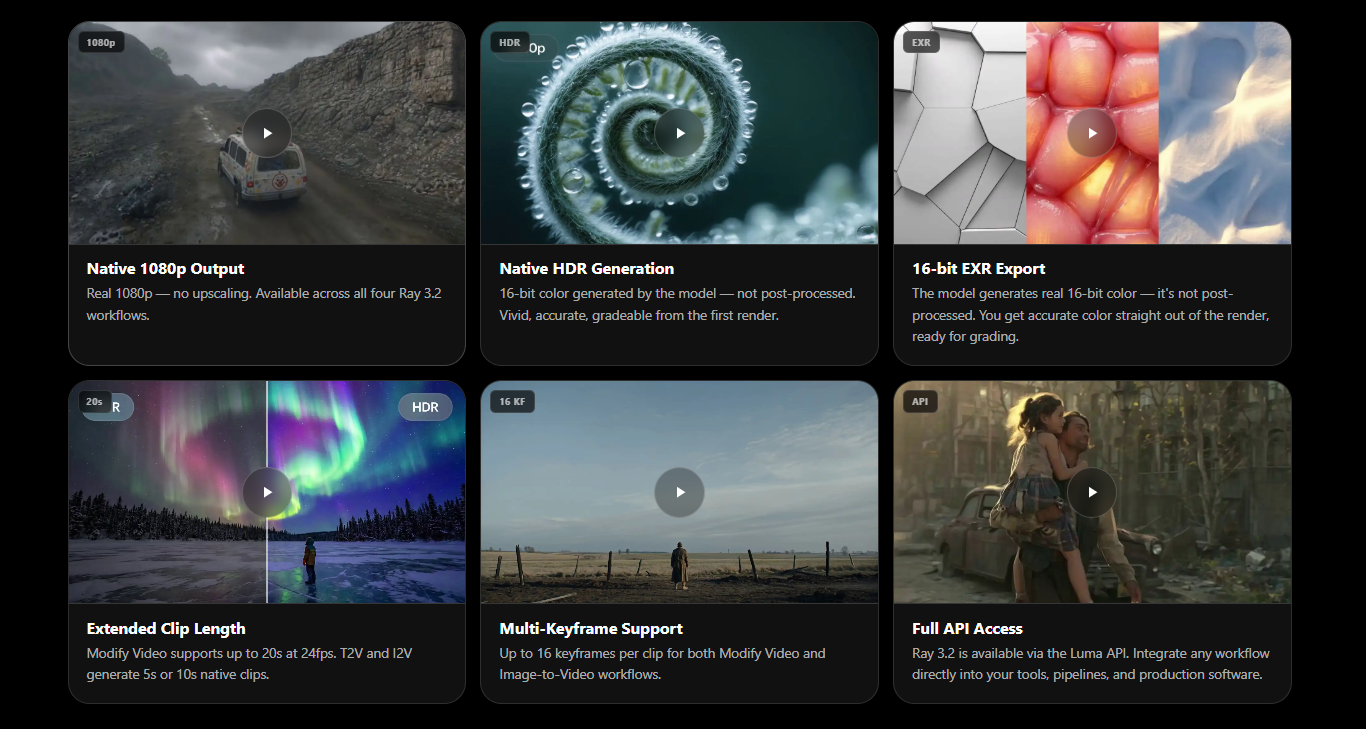
Ray 3.2 operates entirely on remote cloud infrastructure, removing hardware barriers for independent prompt creators and large studio teams alike. Users access the complete toolset via standard web browsers, upload assets, input structured prompts, adjust resolution and duration parameters, then export finished footage as MP4, HDR or EXR files in minutes.
For agencies and development teams building custom production pipelines, a full open API enables seamless integration of all four core workflows into internal asset management software. Developers can automate batch rendering and standardized prompt-driven content generation for fashion, e-commerce, entertainment and marketing clients, supporting scalable high-volume visual asset creation.
Real-World Industry Applications
Ray 3.2 caters to diverse verticals that demand prompt-controllable, broadcast-quality video content. Film and previsualization teams use text-to-video workflows to test camera angles and story beats ahead of principal photography. Advertising agencies leverage video editing and localization features to produce market-specific commercial variants from a single master shot. Game designers animate concept illustrations for cinematic cutscene pitching, while social media teams utilize reframing tools to rapidly produce platform-native short-form content. VFX studios rely on HDR and EXR exports to integrate AI-generated assets directly into complex composite pipelines, cutting production timelines significantly.
Closing Thoughts
As prompt engineering becomes central to professional visual creation, tools that balance precise textual control with cinema-quality output stand apart from generic AI generators. Ray 3.2 AI Video Generator fills a critical gap for creators who need full prompt authority over every frame, paired with industry-standard color and file exports suitable for commercial release. Its four unified workflows, 16-point keyframe customization, stable multi-character tracking and cloud-based accessibility make it an essential asset for solo prompt practitioners, boutique design agencies and large post-production studios seeking faster, more controllable AI video creation workflows.





Top comments (0)