

Introduction
Certified MLOps Manager is a professional certification designed for people who want to manage machine learning projects in a reliable, repeatable, and production-ready way. It helps you understand how to take ML models from experimentation to stable, secure, and scalable deployment using modern MLOps practices. This certification focuses on both technical workflows and practical management skills so you can lead ML operations in real-world teams.
*What it is *
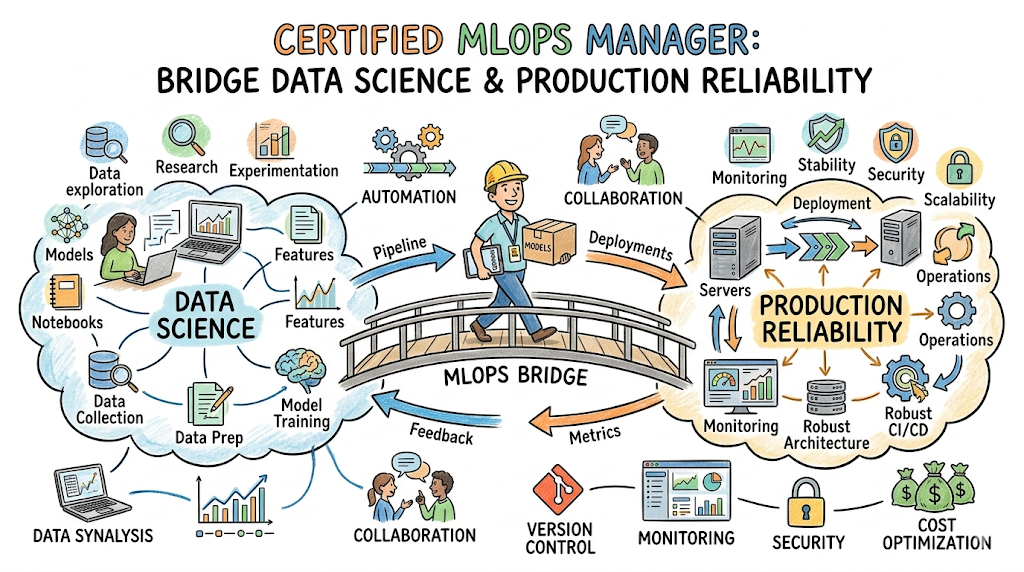
Certified MLOps Manager is a certification that focuses on how to run ML projects like serious production systems, not just experiments. It covers processes, tools, pipelines, monitoring, governance, and team workflows. The aim is to help you bridge the gap between data science and reliable operations so models can deliver real business value.
Who should take it
This certification is ideal for working professionals who are involved in machine learning, data, or platform work and want to move into a more responsible and management-focused role. It is suitable for MLOps engineers, data engineers, ML engineers, DevOps engineers, SREs, team leads, and technical managers who handle ML systems. It is also useful for senior data scientists who want to understand how to productionize models and manage the operational side of ML.
Certified MLOps Manager Certification Overview
The Certified MLOps Manager certification focuses on how to design, build, and manage production-ready ML systems using MLOps principles, tools, and best practices. You learn how to plan pipelines, manage environments, use CI/CD for ML, monitor model performance, handle data drift, and ensure reliability, security, and cost control. The program explains concepts in simple language but always connects them to real-world scenarios such as recommendation systems, fraud detection models, forecasting models, and AI-enabled applications in production.
Program delivery, levels, assessment, and structure
The program is delivered via a dedicated course hosted on the AIOpsSchool website, where you get structured learning modules, hands-on practice, and certification assessment under one platform. The certification path is usually broken into clear levels such as foundation, practitioner, and manager so learners can grow from basics to advanced leadership responsibilities in MLOps. Assessment is typically done through scenario-based questions, practical tasks, and use-case oriented evaluations that test how you think and make decisions in realistic ML operations environments. Ownership of the certification stays with the provider, and you receive a verifiable digital certificate once you clear the required exams or project evaluations, making it easier to showcase your skills to employers and clients.
Skills you'll gain
- Understanding of end-to-end ML lifecycle management, from data to deployment
- Designing and running ML pipelines using CI/CD and automation practices
- Setting up monitoring for model performance, drift, and data quality
- Working with experiment tracking, model versioning, and model registry tools
- Managing ML environments, dependencies, and reproducibility for teams
- Applying security, compliance, and governance principles in ML systems
- Collaborating with data scientists, engineers, and business stakeholders
- Planning ML infrastructure for scalability, reliability, and cost efficiency
- Handling incident response and rollback strategies for ML models
- Building roadmaps and processes for continuous improvement in MLOps
Real-world projects you should be able to do after it
- Build and manage a complete MLOps pipeline for a fraud detection or risk scoring model
- Set up automated training, testing, and deployment for a recommendation or personalization system
- Implement monitoring and alerting for an ML model used in production dashboards or APIs
- Design and roll out a model registry and approval workflow inside a data platform
- Plan and document an MLOps strategy for a product team that uses machine learning features
- Run A/B tests, canary releases, and rollback plans for new model versions
- Create cost optimization and scaling strategies for ML workloads in the cloud
- Define governance, access control, and audit practices for ML artifacts and data
- Coordinate with multiple teams to ship an ML feature from idea to stable production
- Lead a post-incident review after a model-related production issue and improve processes
Common mistakes
- Treating ML as one-time model delivery instead of an ongoing lifecycle
- Ignoring data quality, drift, and monitoring once the model is deployed
- Over-focusing on tools and ignoring processes, documentation, and ownership
- Not involving operations, security, and compliance teams early in ML projects
- Running manual deployments without proper CI/CD, testing, or rollback plans
- Keeping model knowledge only in the data science team with no shared visibility
- Mixing experimental and production environments without clear separation
- Neglecting cost management and resource planning for training and inference
- Failing to align ML metrics with business metrics that matter to stakeholders
- Skipping clear runbooks, playbooks, and standard operating procedures
Best next certification after this
After completing Certified MLOps Manager, a good next step is a certification that deepens either your platform, operations, or AI governance skills. Many professionals move towards advanced AIOps or SRE certifications to learn more about reliability, observability, and automation for large-scale systems. Others choose a data engineering or cloud architect certification to broaden their understanding of data platforms and cloud-native infrastructure that support ML workloads.
Complete Topic name Certification Table
| Track | Level | Who it’s for | Prerequisites | Skills Covered | Recommended Order |
| DevOps | Intermediate | DevOps engineers managing CI/CD and releases | Basic Linux, Git, CI/CD knowledge | Pipelines, automation, containers, infrastructure as code | Take after a basic DevOps or cloud foundation | – |
| DevSecOps | Intermediate | Security-aware engineers and DevOps teams | DevOps basics and security fundamentals | Secure SDLC, scanning, policy as code, threat modeling | After DevOps skills are stable | – |
| SRE | Advanced | SREs and reliability-focused engineers | Strong operations and monitoring background | SLOs, error budgets, incident response, reliability patterns | Ideal after DevOps or platform engineering | – |
| AIOps/MLOps | Advanced | MLOps managers, ML engineers, data engineers | ML basics and production systems knowledge | ML pipelines, monitoring, automation, governance, lifecycle | Take when you are serious about ML in production |
| DataOps | Intermediate | Data engineers, analytics engineers, BI owners | SQL, ETL/ELT, data modeling experience | Data pipelines, testing, data quality, orchestration | Good after basic data engineering | – |
| FinOps | Intermediate | Cloud and finance practitioners | Cloud billing and services understanding | Cloud cost control, budgeting, usage optimization | Best when you run workloads at scale | – |
Choose your path (6 learning paths)
- DevOps: Start with a core DevOps certification, learn CI/CD, containers, and automation, then move towards SRE or platform engineering as your systems grow.
- DevSecOps: Build DevOps skills first, then learn how to embed security into pipelines, infrastructure, and code, working closely with security and compliance teams.
- SRE: Focus on reliability, observability, and incident management so you can keep both traditional and ML services running smoothly at scale.
- AIOps/MLOps: Specialize in managing ML and AI systems in production, combining ML, data, and operations skills to make AI reliable and trustworthy.
- DataOps: Work on data pipelines, data quality, and collaboration between data and analytics teams so the data feeding ML and BI systems is consistent and reliable.
- FinOps: Learn how to balance cloud performance, features, and cost so your ML and other workloads stay efficient and sustainable for the business.
Role → Recommended certifications
| Role | Recommended certifications |
| DevOps Engineer | Core DevOps, container and Kubernetes certification, and then AIOps/MLOps to work closer with ML teams |
| SRE | SRE-focused certification plus AIOps/MLOps to handle reliability of ML-based systems and services |
| Platform Engineer | Cloud architect or platform engineering certification followed by AIOps/MLOps to support ML platforms |
| Cloud Engineer | Cloud provider certifications combined with AIOps/MLOps to design and run ML infrastructure in the cloud |
| Security Engineer | DevSecOps and governance certifications with exposure to AIOps/MLOps for securing ML pipelines and data |
| Data Engineer | Data engineering or DataOps certification, then AIOps/MLOps to handle production data pipelines for ML |
| FinOps Practitioner | FinOps certification plus AIOps/MLOps so you can manage cloud costs for ML workloads effectively |
| Engineering Manager | Leadership-focused certification plus AIOps/MLOps so you can guide teams working on ML and AI projects |
List of Top institutions which provide help in Training cum Certifications for Certified MLOps Manager
DevOpsSchool is known for offering structured training and practical workshops that help professionals understand real project workflows and prepare for certifications in DevOps and related fields. Cotocus focuses on industry-oriented programs with hands-on labs and mentoring so learners can apply concepts directly in their jobs. Scmgalaxy delivers training that combines tools, processes, and culture topics, making it easier to adopt DevOps and ML practices in real teams. BestDevOps curates learning paths that align with current market needs and certification standards, helping you stay relevant in a fast-changing technology landscape. Devsecopsschool specializes in integrating security into DevOps and MLOps workflows, Sreschool is focused on reliability engineering skills, while Aiopsschool, Dataopsschool, and Finopsschool cover AI operations, data operations, and cloud cost management so you can build a complete and future-ready skill set across modern engineering roles.
Next certifications to take (3 options: same track, cross-track, leadership)
For the same track, you can pursue an advanced AIOps or MLOps certification that goes deeper into automation, observability, and large-scale ML systems. For cross-track growth, consider a DataOps, SRE, or DevSecOps certification to strengthen your understanding of data, reliability, or security around ML workloads. For leadership, a manager or architect-level certification in cloud, platform engineering, or AI strategy can help you move into roles where you drive direction, not just implementation.
FAQs (10 questions & answers)
What is the Certified MLOps Manager certification?
Certified MLOps Manager is a professional credential that verifies you can manage machine learning systems end-to-end, from data and training to deployment, monitoring, and continuous improvement.
Do I need to be an expert data scientist to take this certification?
No, you do not have to be a deep data science expert, but you should understand basic ML concepts and be comfortable working with technical teams and production systems.
How is Certified MLOps Manager different from a normal ML or data science certification?
Normal ML certifications focus mostly on building models, while Certified MLOps Manager focuses on running those models reliably in production with proper pipelines, monitoring, governance, and processes.
What kind of roles can benefit from Certified MLOps Manager?
Roles like MLOps engineer, ML engineer, data engineer, DevOps engineer, SRE, platform engineer, and technical manager can all benefit from this certification because they handle real systems in production.
Is there any coding requirement for this certification?
Some basic scripting or familiarity with tools and pipelines is helpful, but the main focus is on process, architecture, and management of ML systems rather than only writing complex code.
How long does it usually take to prepare for Certified MLOps Manager?
The time needed depends on your background, but many professionals can prepare in a few focused weeks to a couple of months if they already understand ML basics and DevOps or data workflows.
Does this certification cover only one set of tools or multiple tools?
The certification content usually discusses common patterns, practices, and tool types, so you can apply your knowledge across multiple platforms and not be locked into a single vendor or product.
Will Certified MLOps Manager help in my career growth?
Yes, it can make you more valuable because companies now want people who can not only build ML models but also run, monitor, and improve them safely in production environments.
Can beginners in MLOps start directly with this certification?
Beginners with some basic understanding of ML and cloud or DevOps concepts can start with this certification, but they may need to spend extra time on the fundamentals before going deep into advanced topics.
Is the certification more technical or more managerial?
It is a mix of both, with a strong practical focus: you learn enough technical detail to work with tools and pipelines, and enough management insight to lead ML operations and coordinate across teams.
why CHOSSE AIOpsschool ?
You should choose AIOpsschool because it focuses specially on AI and ML operations, not just general IT training. The platform is designed for modern roles like MLOps engineer and MLOps manager, so the content and labs are aligned with what companies actually need in production. You get structured learning paths, real-world examples, and guidance that connects theory with daily work in ML projects. This makes your learning practical, job-ready, and easier to explain to recruiters and hiring managers.
Conclusion
Certified MLOps Manager is a powerful certification for anyone who wants to take machine learning beyond experiments and make it work reliably in the real world, across teams, systems, and business goals. It gives you a clear way to understand the ML lifecycle, pipelines, monitoring, governance, and collaboration so you can own ML projects from start to finish instead of only focusing on model building. With strong next steps into AIOps, SRE, DataOps, DevSecOps, and FinOps, plus support from training institutions like DevOpsSchool, Cotocus, Scmgalaxy, BestDevOps, Devsecopsschool, Sreschool, Aiopsschool, Dataopsschool, and Finopsschool, you can grow your skills and career in a structured and confident way that matches the demands of modern engineering and AI-driven organizations.



Top comments (0)