

Introduction
In today’s world, every company wants to use data in a fast, safe, and smart way. Teams want clean data, useful dashboards, and reports that are always up to date. At the same time, they do not want delays, mistakes, or long manual work. The CDOE – Certified DataOps Engineer certification is made for this new reality. It helps engineers learn how to build smooth, automated, and reliable data pipelines that run every day like a well‑managed machine.
*What it is *
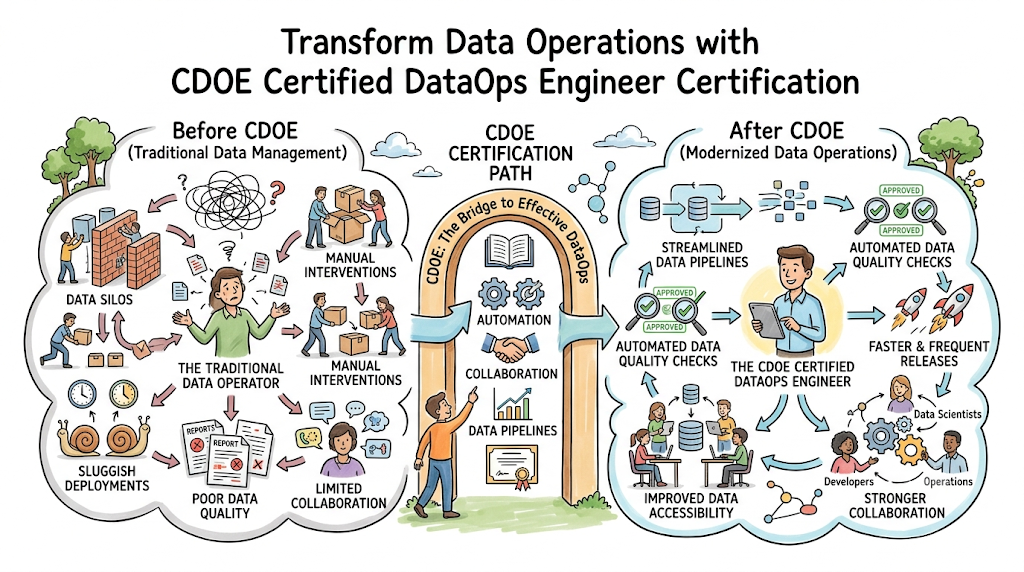
The CDOE – Certified DataOps Engineer is a role‑based certification for people who build and run data pipelines. It teaches you how to make data workflows automated, tested, monitored, and easy to improve. You learn how to turn manual and fragile data work into strong, repeatable, and observable data systems.
Who should take it
This certification is a good fit for many kinds of technical professionals:
- Data Engineers who want to make their pipelines more automated and reliable.
- DevOps Engineers who also support data platforms and want to bring DevOps thinking into data work.
- Platform Engineers and Cloud Engineers who build and manage the platforms where data runs.
- DataOps Engineers or people who want to become DataOps Engineers.
- BI, Analytics, and ML professionals who depend on stable data flows for their dashboards and models.
- Technical leads and engineering managers who guide teams that work with data, analytics, and automation.
If your work touches data pipelines, data platforms, or analytics, this certification can add a lot of value for you.
CDOE – Certified DataOps Engineer Certification Overview
The CDOE – Certified DataOps Engineer program is designed to change the way you think about data work. Instead of treating data pipelines as one‑time scripts, you learn to treat them like products. You add version control, automation, testing, monitoring, and feedback. The program covers DataOps principles, pipeline design, CI/CD for data, data quality, observability, governance, and many real‑world patterns. By the end, you should be able to build data workflows that are stable, fast, and easy to improve.
Program delivery, levels, assessment, ownership, structure
The CDOE – Certified DataOps Engineer program is delivered through a dedicated DataOps course and is hosted on the learning platform of DataOpsSchool. Learners get access to lessons, labs, assignments, and exam guidance in a structured path. The certification itself is owned and managed by DataOpsSchool, which defines what topics are covered, updates the content over time, and sets the standard for the exam.
In practical and simple terms, the structure usually looks like this:
- Foundation level – Here you learn basic DataOps concepts, the data lifecycle, simple pipelines, and important words and ideas.
- Professional level – Here you learn how to build more complex pipelines, set up CI/CD for data, add tests, and set up monitoring and alerting.
- Advanced level – Here you go deeper into large‑scale systems, governance, cross‑team collaboration, and advanced observability for big or critical data platforms.
The exam style is often a mix of objective questions, scenario‑based questions, and sometimes practical or project‑like tasks. This means you are tested not only on what you know in theory, but also on how you can apply it to real situations.
State that the program is delivered via course and hosted on website
The CDOE – Certified DataOps Engineer program is delivered through a dedicated DataOps certification course designed by DataOpsSchool. The complete training, including content, labs, assignments, and exam information, is hosted on the official learning platform of DataOpsSchool. From that single place, learners can access all resources and follow the full journey from beginner to certified professional.
Explain certification levels, assessment approach, ownership, and structure in practical terms
- Certification levels: You usually start with foundation concepts, then move to professional or practitioner skills, and finally to advanced content. This matches the normal growth of a career from beginner to expert.
- Assessment approach: The exam will normally include multiple choice questions, scenario or case‑based questions, and in some cases practical tasks or project‑style checks. You should be ready to show both understanding and application.
- Ownership: DataOpsSchool owns and manages the certification, decides the syllabus, updates topics as tools change, and issues the certificate to successful candidates.
- Structure: The learning path is broken into modules, such as DataOps basics, pipeline design, CI/CD for data, testing and quality, monitoring and observability, security and governance, and case studies. Each module contains both theory and hands‑on practice.
Skills you’ll gain
- Clear understanding of DataOps principles and how they apply across the full data lifecycle.
- Ability to design and build automated data pipelines from different sources to data warehouses, data lakes, or analytics platforms.
- Skills to set up CI/CD for data pipelines, with version control, automated tests, and controlled releases.
- Knowledge to design and implement data quality checks, validation steps, and testing strategies.
- Experience in monitoring and observability for data workflows, including metrics, logs, and alerts.
- Understanding of security, governance, and compliance needs in data environments.
- Ability to work with cloud‑based data platforms and modern data tools.
- Skills for incident management, troubleshooting, and root cause analysis in data pipelines.
- Better collaboration habits so you can work smoothly with data scientists, analysts, DevOps, and business teams.
- Confidence to document processes, build standards, and create repeatable patterns for future data projects.
Real‑world projects you should be able to do after it
- Build an automated ETL or ELT pipeline that pulls data from multiple systems into a central data store.
- Set up a CI/CD workflow for your data pipelines, including code review, testing, and automated deployment.
- Create monitoring dashboards that show the freshness, quality, and health of your data pipelines.
- Design a full data workflow to feed business dashboards that refresh on a schedule and follow clear quality steps.
- Move old manual scripts and one‑off jobs into a standard, version‑controlled, automated DataOps pipeline.
- Plan and implement data quality rules that protect key business data from errors and bad inputs.
- Build a data workflow that supports machine learning feature pipelines and fits well with MLOps practices.
- Prepare runbooks and incident response steps for common data issues, such as failed jobs, schema changes, or missing data.
Common mistakes
- Treating DataOps as only a collection of tools, and forgetting that culture, communication, and process are equally important.
- Ignoring data quality and skipping tests, which leads to broken reports and loss of trust.
- Not setting up proper observability, which makes it hard to see where a pipeline is slow or broken.
- Over‑engineering the first solution instead of starting small, learning from feedback, and improving step by step.
- Preparing for the certification exam with only theory and not doing real or sample hands‑on projects.
- Leaving governance, security, and access control for later instead of building them into the design.
- Not connecting DataOps work to business outcomes like faster delivery, fewer incidents, or better decisions.
Best next certification after this
The best next certification depends on your direction:
- If you want to stay in the same area, choose an advanced DataOps or Data Engineering certification. This will deepen your skills in big data, streaming, and data platform design.
- If you want to move across tracks, pick an AIOps, MLOps, or SRE certification. This will let you connect DataOps with machine learning life cycle or with high reliability for complex systems.
- If you want to move into leadership, choose a cloud architecture, DevOps leadership, or engineering management type of certification, which helps you design and guide DataOps transformation at a team or organization level.
CDOE – Certified DataOps Engineer – Certification Structure
| Track | Level | Who it’s for | Prerequisites | Skills Covered | Recommended Order |
|---|---|---|---|---|---|
| DataOps | Foundation | Beginners in data, DevOps, or cloud | Basic IT and data knowledge | DataOps basics, data lifecycle, simple pipelines, important concepts and words | 1st |
| DataOps | Professional | Working data, DevOps, or cloud engineers | Foundation skills or equal experience | Automated pipelines, CI/CD for data, testing, monitoring, cross‑team collaboration | 2nd |
| DataOps | Advanced | Experienced engineers, architects, and tech leads | Professional‑level skills and real projects | Large‑scale DataOps, governance, observability, multi‑team workflows, enterprise data platforms | 3rd |
Choose your path
You can combine CDOE with many learning paths:
- DevOps – Focus on CI/CD, infrastructure as code, and automation, then add DataOps to handle data pipelines with the same discipline.
- DevSecOps – Learn about secure pipelines, security checks, and policy as code, then apply those ideas to protect data flows and sensitive information.
- SRE – Focus on reliability, service level objectives, and incident response, and then apply that mindset to data platforms and pipelines.
- AIOps/MLOps – Learn how to run and monitor machine learning systems and then connect those skills with DataOps for feeding models with good, trusted data.
- DataOps – Make DataOps your main track and go deep into end‑to‑end data lifecycle automation, testing, and team collaboration.
- FinOps – Learn how to manage cloud cost and then use those skills to design cost‑efficient data platforms and pipelines.
Role → Recommended certifications
| Role | Recommended certifications (examples) | Focus Area |
|---|---|---|
| DevOps Engineer | DevOps, cloud DevOps, then CDOE – Certified DataOps Engineer | Automation, CI/CD, integration of app and data pipelines |
| SRE | SRE or reliability engineering certifications plus DataOps‑aware programs | Reliability of services and data platforms |
| Platform Engineer | Kubernetes and platform engineering, cloud platform certs, then CDOE | Platforms for scalable and reliable data workloads |
| Cloud Engineer | Cloud associate or professional level, data engineering tracks, plus CDOE | Cloud‑native data platforms and services |
| Security Engineer | Security and DevSecOps certifications plus data security and governance training | Secure and compliant data pipelines |
| Data Engineer | Data engineering and big data certifications, then CDOE – Certified DataOps Engineer | Pipelines, transformations, and automation |
| FinOps Practitioner | FinOps and cloud cost management certifications plus data platform cost optimization | Cost‑efficient data infrastructures and workloads |
| Engineering Manager | Architecture, leadership, Agile, plus awareness of DataOps, DevOps, and cloud paths | Leading teams that adopt DataOps culture and practices |
This mapping is flexible. You can adjust it based on your background and long‑term goals.
List of top institutions which provide help in training and certifications for CDOE – Certified DataOps Engineer
There is a group of training brands that focus on modern engineering skills such as DevOps, DataOps, SRE, security, AI operations, and cloud cost management. Together, they create learning paths that support certifications like CDOE – Certified DataOps Engineer and other related programs. These institutions aim to provide structured courses, hands‑on labs, and exam‑oriented guidance so that learners can grow from basics to advanced levels in a clear and practical way.
- DevOpsSchool – DevOpsSchool focuses on DevOps, cloud, and automation training, helping learners build strong foundations that support DataOps and other modern engineering roles.
- Cotocus – Cotocus works as a consulting and training group that powers many of these specialized schools, offering structured journeys in DevOps, cloud, DataOps, and related skills for working professionals.
- Scmgalaxy – Scmgalaxy delivers training in DevOps tools, configuration management, and automation, building essential skills for engineers who later want to move into DataOps profiles.
- BestDevOps – BestDevOps serves as a knowledge and training hub around DevOps and associated certifications, guiding learners toward the right programs and content for growth.
- Devsecopsschool – Devsecopsschool focuses on DevSecOps, where security is integrated into development and operations, which is very useful when you design secure DataOps pipelines.
- Sreschool – Sreschool specializes in Site Reliability Engineering and teaches reliability, observability, and incident handling, all of which are important for stable data platforms.
- Aiopsschool – Aiopsschool brings training around AIOps and intelligent operations, helping engineers use analytics and automation to improve system and data reliability.
- Dataopsschool – Dataopsschool is fully dedicated to DataOps and offers focused programs and certifications like CDOE for data‑centric engineering roles.
- Finopsschool – Finopsschool works on FinOps and cloud cost management, teaching you how to make your cloud and data workloads cost‑effective and well managed.
Next certifications to take (same track, cross‑track, leadership)
- Same track (DataOps / Data Engineering) – Choose an advanced DataOps or Data Engineering certification that dives deeper into data platform architecture, big data systems, and streaming data.
- Cross‑track (AIOps/MLOps or SRE) – Take an AIOps, MLOps, or SRE certification to connect DataOps with machine learning operations or high‑reliability engineering for complex, large systems.
- Leadership (Architecture / Management) – Go for a cloud architecture, DevOps leadership, or engineering management type of certification if you want to lead DataOps transformation and guide teams.
FAQs on CDOE – Certified DataOps Engineer
What is the CDOE – Certified DataOps Engineer certification?
The CDOE – Certified DataOps Engineer certification is a professional proof that you can design, automate, and run reliable data pipelines using DataOps principles, tools, and practices.Why should I consider CDOE for my career?
It shows that you can move data work from manual scripts and fragile jobs to automated, monitored, and repeatable workflows, which is highly valued in data‑driven companies.Who is the CDOE – Certified DataOps Engineer certification for?
It is for data engineers, DevOps and cloud engineers, DataOps engineers, SREs, BI and analytics professionals, and technical leads who are involved in data platforms and pipelines.Do I need strong programming skills before taking CDOE?
You do not need to be an expert programmer, but basic scripting and comfort with data tools and cloud platforms will make the course and exam much easier.What topics are covered in the CDOE program?
The program covers DataOps fundamentals, pipeline design, CI/CD for data, data quality and testing, monitoring and observability, governance, security, and real‑world patterns and case studies.How is the CDOE exam conducted?
The exam is usually online and uses a mix of multiple choice questions, scenario‑based questions, and sometimes practical or project‑style evaluation, depending on the official format.How long does it take to prepare for CDOE?
Many working professionals can prepare in a few weeks by following the official course, doing hands‑on labs, and regularly practicing with realistic data pipeline scenarios.Does CDOE focus on one specific tool or platform?
The main focus is on DataOps principles and patterns that work across many tools, but examples often use popular data platforms, orchestration tools, and cloud services.Can I combine CDOE with other certifications?
Yes. It works very well with DevOps, cloud, SRE, security, and MLOps certifications because DataOps sits in the middle of data, automation, and operations.What kind of roles can I target after CDOE?
After CDOE, you can aim for roles like DataOps Engineer, Senior Data Engineer, DevOps or Platform Engineer focused on data systems, or technical lead for data reliability and automation.
why CHOSSE Dataopsschool ?
Choosing Dataopsschool is a smart move if you want a focused, practical path into DataOps. Dataopsschool is part of a group of specialized schools that cover DevOps, DevSecOps, SRE, AIOps, DataOps, and FinOps, so the learning content is designed with modern engineering roles in mind. Their programs are usually hands‑on, with labs, exercises, and real examples, which means you are not just reading theory, you are doing real work like a DataOps Engineer. This makes it easier to move from learning to certification and then to applying DataOps practices in your day‑to‑day job.
Conclusion
The CDOE – Certified DataOps Engineer certification is a powerful option if you want to bring DevOps‑style automation, quality, and speed into data engineering and analytics. It helps you move away from manual, fragile data tasks and towards automated, observable, and repeatable data workflows. With the right training support and a clear plan that connects DataOps with other tracks like DevOps, SRE, AIOps, and FinOps, you can build a strong, future‑ready career as a DataOps‑focused engineer or leader.






Top comments (0)