
Introduction
Modern enterprise systems generate massive volumes of logs, metrics, and network traces every single second. Therefore, traditional manual monitoring and rule-based incident responses are no longer sufficient to maintain high availability. The AiOps Certified Professional (AIOCP) program equips engineers with the practical methodologies needed to integrate machine learning, automation, and predictive intelligence into enterprise IT operations. This comprehensive roadmap is designed for site reliability engineers, cloud architects, and system administrators who want to transition from reactive troubleshooting to intelligent, automated operations.
Furthermore, platform engineering teams utilize artificial intelligence to eliminate repetitive toil and accelerate mean time to resolution across distributed architectures. Consequently, learning these integrated paradigms allows technical practitioners to build resilient, self-healing platforms that scale efficiently. This detailed guide breaks down the curriculum, prerequisites, career impact, and strategic role mapping to help professionals make informed, high-value career decisions.
What is the AiOps Certified Professional (AIOCP)?
The AiOps Certified Professional (AIOCP) represents a specialized, industry-aligned credential establishing operational excellence in artificial intelligence for IT operations. Rather than focusing purely on abstract machine learning theory, this program focuses directly on production-grade implementation. It teaches practitioners how to ingest telemetry data, discover hidden performance anomalies, correlate distributed events, and trigger automated remediation workflows reliably.
Modern enterprise platforms run on complex hybrid and multi-cloud footprints that overwhelm standard operational dashboards. As a result, operations teams require structured machine learning pipelines to parse contextual signals from noise. The program bridges the crucial gap between data science algorithms and live infrastructure operations. Through applied architectural patterns, engineers master continuous observability, root-cause clustering, dynamic thresholding, and automated runbooks inside enterprise IT ecosystems.
Who Should Pursue AiOps Certified Professional (AIOCP)?
This credential serves working infrastructure engineers, cloud specialists, and reliability practitioners seeking to modernize their operational capabilities. Site Reliability Engineers (SREs), DevOps engineers, and cloud architects benefit immensely by incorporating machine learning into their telemetry pipelines. Additionally, cybersecurity analysts and data engineers gain critical insights into predictive anomaly detection, distributed logging infrastructure, and automated system compliance.
Furthermore, engineering managers, enterprise architects, and technical team leads can leverage this knowledge to guide modernization initiatives across their organizations. Whether working in fast-paced software organizations globally or supporting massive enterprise transformations in dynamic tech hubs like India, this credential establishes clear technical proficiency. It enables practitioners at every level to replace legacy monitoring with automated, intelligent operations.
Why AiOps Certified Professional (AIOCP) is Valuable Now and Beyond
Enterprise infrastructure environments are expanding in complexity due to microservices, serverless computing, and edge deployments. Consequently, human operators cannot manually interpret the sheer volume of operational telemetry generated across these systems. Organizations worldwide are aggressively investing in intelligent automation to maintain system uptime, prevent revenue loss from outages, and optimize infrastructure spending.
Mastering predictive operations ensures long-term career durability regardless of specific platform changes over time. Because the core architectural principles focus on telemetry ingestion, dynamic thresholds, noise reduction, and automated closed-loop remediation, these skills transfer across tools. Investing time into this domain delivers substantial returns by elevating engineers into strategic platform architects who protect business-critical digital assets.
AiOps Certified Professional (AIOCP) Certification Overview
The program delivers a thorough, rigorous assessment framework engineered to validate applied engineering capability rather than rote memorization. Candidates demonstrate competence across data pipeline construction, statistical anomaly detection, incident correlation, and event-driven automation engines. The curriculum enforces a strict, production-oriented approach that replicates the operational incidents enterprise teams face daily.
The assessment methodology combines objective technical evaluations with practical, scenario-driven implementations. Candidates must design data collection pipelines, configure algorithmic event grouping, and execute automated recovery playbooks on simulated live environments. This verifiable structure ensures that certified professionals possess the hands-on expertise needed to lead operational transformations within enterprise engineering teams.
Why Choose DevOpsSchool
DevOpsSchool has established a strong reputation as a trusted global platform for enterprise technical training and professional certifications. The institute focuses exclusively on practical, role-based education, ensuring that learners work with production-grade environments rather than isolated academic setups. Every curriculum is regularly updated by experienced industry practitioners to reflect modern enterprise engineering standards, cloud-native patterns, and operational practices.
Furthermore, the organization provides extensive post-training support, including access to curated learning repositories, community forums, and comprehensive reference architectures. With a track record of upskilling thousands of engineers worldwide, the platform emphasizes hands-on execution and real-world applicability. This structured learning ecosystem helps professionals master complex operational concepts efficiently, accelerating their career progression across high-growth engineering domains.
AiOps Certified Professional (AIOCP) Certification Tracks & Levels
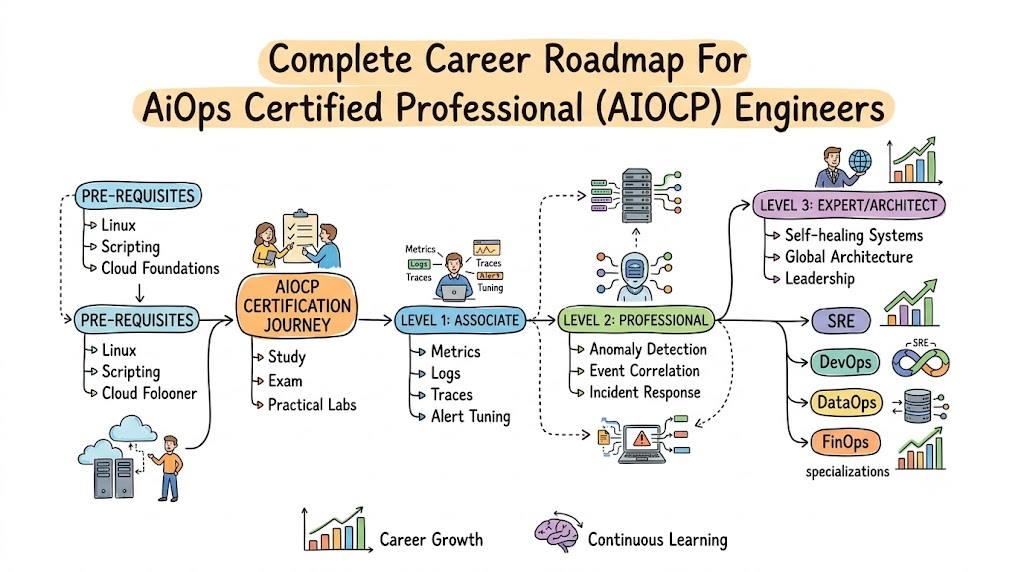
The certification structure follows a progressive learning path designed to support continuous professional development:
- Foundation Level: Introduces the fundamental concepts of operational telemetry, metric collection, statistical analysis, and basic machine learning applications in systems monitoring.
- Professional Level: Centers on implementing production-ready data pipelines, anomaly detection models, alert deduplication, automated event correlation, and self-healing infrastructure runbooks.
- Advanced Level: Focuses on designing enterprise-scale architectures, predictive capacity forecasting, autonomous remediation frameworks, and continuous operational intelligence across multi-cloud environments.
These progressive levels enable infrastructure professionals to systematically build expertise, moving from foundational monitoring principles to complex, automated operations.
Complete AiOps Certified Professional (AIOCP) Certification Table
| Track | Level | Who it's for | Prerequisites | Skills Covered | Recommended Order |
|---|---|---|---|---|---|
| Operational Intelligence | Foundation | Systems Administrators & Junior Engineers | Basic Linux & Cloud Fundamentals | Telemetry Ingestion, Basic Log Aggregation, Alerting Principles | Step 1 |
| Production Intelligence | Professional | SREs, DevOps & Cloud Engineers | 2+ Years in Infrastructure or DevOps | Anomaly Detection, Alert Correlation, Runbook Automation, Event Filtering | Step 2 |
| Enterprise Architecture | Advanced | Principal Engineers & Enterprise Architects | 5+ Years in Platform Architecture | Autonomous Remediation, Capacity Forecasting, Multi-Cloud Telemetry | Step 3 |
Detailed Guide for Each AiOps Certified Professional (AIOCP) Certification
AiOps Certified Professional (AIOCP) – Foundation Level
What it is
This entry-level validation confirms a foundational understanding of operational telemetry, baseline metrics, and modern monitoring concepts. It demonstrates that an engineer can configure core observability collectors and identify basic operational issues.
Who should take it
Junior DevOps engineers, system administrators, and technical support engineers seeking to understand modern intelligent monitoring pipelines.
Skills you'll gain
- Telemetry data collection across diverse infrastructure nodes.
- Configuring centralized log aggregation and index management.
- Understanding dynamic metric thresholds versus static alerting rules.
- Basic pattern matching across distributed system traces.
Real-world projects you should be able to do
- Deploy a centralized telemetry collection pipeline for a multi-node cluster.
- Configure log parsing rules to structure unstructured application logs.
- Establish baseline monitoring dashboards tracking primary golden signals.
Preparation plan
- 7–14 Days: Focus on Linux system internals, metric collection types, and basic pipeline architectures.
- 30 Days: Build end-to-end telemetry ingestion labs using open-source collectors.
- 60 Days: Master log structuring, alerting fundamentals, and statistical baselining across multiple servers.
Common mistakes
- Relying solely on legacy static thresholds without learning statistical baselines.
- Neglecting the importance of log parsing and structured schemas.
- Overlooking basic networking fundamentals during data ingestion.
Best next certification after this
- Same-track option: AiOps Certified Professional (AIOCP) – Professional Level
- Cross-track option: Certified SRE Practitioner
- Leadership option: Certified Platform Operations Lead
AiOps Certified Professional (AIOCP) – Professional Level
What it is
This credential validates an engineer's ability to build and maintain intelligent operational pipelines, deploy unsupervised anomaly detection, and implement automated incident response mechanisms in live environments.
Who should take it
DevOps engineers, Site Reliability Engineers, and cloud platform specialists with hands-on experience in production environments.
Skills you'll gain
- Implementing unsupervised machine learning models for anomaly detection.
- Reducing alert fatigue through intelligent event deduplication and clustering.
- Building automated incident correlation engines across distributed systems.
- Constructing event-driven runbooks for rapid auto-remediation.
Real-world projects you should be able to do
- Build an automated noise-reduction pipeline filtering redundant alerts.
- Design a predictive incident grouping mechanism for microservice architectures.
- Implement self-healing automated scripts triggered by specific metric anomalies.
Preparation plan
- 7–14 Days: Review time-series forecasting, clustering algorithms, and automation frameworks.
- 30 Days: Construct end-to-end incident management workflows with custom remediation scripts.
- 60 Days: Deploy and tune unsupervised anomaly detection models on production-scale telemetry datasets.
Common mistakes
- Failing to fine-tune algorithms, leading to high false-positive rates.
- Writing auto-remediation scripts without proper safety guardrails.
- Ignoring contextual metadata in distributed event correlation.
Best next certification after this
- Same-track option: AiOps Certified Professional (AIOCP) – Advanced Level
- Cross-track option: Certified DevSecOps Professional
- Leadership option: Certified Engineering Operations Director
AiOps Certified Professional (AIOCP) – Advanced Level
What it is
This top-tier certification validates mastery in architecting large-scale predictive infrastructure, cross-platform telemetry analysis, autonomous systems, and strategic enterprise operational intelligence.
Who should take it
Principal architects, lead reliability engineers, and technical directors responsible for enterprise-wide infrastructure resilience and platform strategies.
Skills you'll gain
- Designing distributed, fault-tolerant telemetry architectures for multi-cloud systems.
- Developing long-term predictive capacity and cost-optimization models.
- Establishing governance, safety boundaries, and compliance for autonomous self-healing engines.
- Creating cross-organizational operational intelligence platforms.
Real-world projects you should be able to do
- Architect an enterprise-scale telemetry ingestion platform processing terabytes daily.
- Implement predictive autoscaling models based on historical traffic patterns.
- Establish an end-to-end autonomous healing platform with automated rollback capabilities.
Preparation plan
- 7–14 Days: Focus on high-throughput data architectures and governance frameworks.
- 30 Days: Design distributed tracing models for large-scale multi-cloud topologies.
- 60 Days: Architect and execute comprehensive predictive scaling and autonomous self-healing scenarios.
Common mistakes
- Neglecting enterprise security and compliance requirements during automated operations.
- Designing overly complex architectures that increase operational maintenance overhead.
- Underestimating data storage costs for long-term historical telemetry retention.
Best next certification after this
- Same-track option: Continuous Operational Research Specialist
- Cross-track option: Enterprise Cloud FinOps Architect
- Leadership option: Vice President of Platform Engineering Certification
Choose Your Learning Path
DevOps Path
The DevOps learning journey centers on integrating predictive intelligence directly into CI/CD pipelines and deployment workflows. Practitioners learn how to use machine learning to detect deployment anomalies, perform automated canary rollbacks, and analyze deployment risk metrics before code reaches production. Consequently, teams deliver software faster with significantly fewer operational regressions.
DevSecOps Path
The DevSecOps path merges intelligent operations with automated continuous security monitoring. Engineers explore behavioral analysis models to identify malicious access patterns, anomalous API traffic, and compliance drift in real time. As a result, organizations maintain continuous compliance while proactively neutralizing infrastructure vulnerabilities before exploitation occurs.
SRE Path
The Site Reliability Engineering path focuses on error budgets, automated root-cause isolation, and proactive incident mitigation. Practitioners master dynamic service-level objective tracking, intelligent incident routing, and event correlation engines. This ensures that SRE teams resolve service disruptions quickly and keep system uptime high.
AIOps Path
The dedicated AIOps path delivers deep, specialized knowledge in operational data pipelines, machine learning telemetry analysis, and autonomous remediation engines. Engineers gain advanced skills in noise reduction, contextual event enrichment, and building self-healing system runbooks. This path prepares professionals to serve as subject matter experts for intelligent operational transformation.
MLOps Path
The MLOps path addresses the challenges of deploying, monitoring, and maintaining machine learning models in production environments. Practitioners learn automated feature store management, data drift detection, continuous model training pipelines, and low-latency inference serving. Consequently, teams ensure that operational models remain accurate and reliable over time.
DataOps Path
The DataOps path focuses on building reliable, automated data delivery pipelines across distributed enterprise architectures. Engineers master continuous data quality monitoring, schema validation, data pipeline observability, and automated data governance frameworks. This approach guarantees that downstream analytics and operational models consistently receive accurate, high-quality data.
FinOps Path
The FinOps path blends operational intelligence with continuous cloud financial optimization. Professionals learn how to implement algorithmic anomaly detection for cloud spend, forecast capacity requirements, and automate resource right-sizing. As a result, engineering teams eliminate cloud waste and align infrastructure investments directly with business growth.
Role to Recommended AiOps Certified Professional (AIOCP) Certifications
| Role | Recommended Certifications |
|---|---|
| DevOps Engineer | AiOps Certified Professional (AIOCP) – Professional Level |
| SRE | AiOps Certified Professional (AIOCP) – Professional Level |
| Platform Engineer | AiOps Certified Professional (AIOCP) – Advanced Level |
| Cloud Engineer | AiOps Certified Professional (AIOCP) – Foundation Level |
| Security Engineer | AiOps Certified Professional (AIOCP) – Professional Level |
| Data Engineer | AiOps Certified Professional (AIOCP) – Professional Level |
| FinOps Practitioner | AiOps Certified Professional (AIOCP) – Foundation Level |
| Engineering Manager | AiOps Certified Professional (AIOCP) – Advanced Level |
Next Certifications to Take After AiOps Certified Professional (AIOCP)
Same Track Progression
After mastering core automated operations, engineers should pursue advanced research and specialized competencies within operational machine learning. Deepening expertise in specialized areas, such as continuous deep learning for telemetry analysis and distributed stream processing, ensures that practitioners remain at the cutting edge of platform automation.
Cross-Track Expansion
Broadening technical capabilities into complementary engineering fields strengthens an engineer's overall impact. Combining intelligent operations with DevSecOps security automation, specialized MLOps pipeline engineering, or advanced Cloud FinOps frameworks creates versatile practitioners capable of solving diverse cross-functional challenges.
Leadership & Management Track
For senior practitioners transitioning into management, pursuing leadership credentials focused on platform strategy and enterprise governance is essential. These paths build competencies in managing distributed platform teams, measuring return on operational investments, and steering large-scale organizational transformations.
Training & Certification Support Providers for AiOps Certified Professional (AIOCP)
The Core Platform Authority
DevOpsSchool stands as a premier educational platform dedicated to advancing professional skills in modern cloud-native architectures, automation, and intelligent operations. The platform delivers meticulously structured programs that emphasize real-world industrial relevance, hands-on laboratory exercises, and expert-led mentorship. By focusing on practical engineering skills rather than abstract theory, it prepares practitioners to solve complex operational challenges effectively. The platform continually updates its course materials to reflect evolving enterprise standards, providing engineers with relevant tools and actionable frameworks. Consequently, learners receive comprehensive support throughout their educational journey, enabling them to build production-grade competencies and accelerate their careers in platform engineering.
DevOpsSchool
DevOpsSchool provides industry-leading instruction across DevOps, Cloud, SRE, and intelligent operational methodologies. The platform features immersive, project-driven training modules curated by experienced enterprise practitioners. Engineers gain practical exposure to live systems, troubleshooting workflows, and enterprise automation patterns. The platform also offers extensive support networks, post-training resources, and community forums that help students continuously refine their technical skills.
Cotocus
Cotocus specializes in delivering enterprise-grade technical enablement and hands-on consulting services globally. The organization trains technical teams in modern cloud architectures, container orchestration, and continuous delivery systems. Their courses focus on practical scenario simulations, enabling engineers to solve real operational bottlenecks. Through dedicated technical coaching, they help enterprise teams build resilient platform infrastructure.
Scmgalaxy
Scmgalaxy serves as a comprehensive knowledge hub and community portal dedicated to software configuration management, DevOps tooling, and operational best practices. The platform provides detailed tutorials, technical articles, and instructional resources covering modern automation tools. Practitioners rely on its extensive repository of community-tested solutions to resolve complex production challenges and optimize daily deployment workflows.
BestDevOps
BestDevOps offers curated insights, platform reviews, and professional guides focused on the modern DevOps ecosystem. The platform helps engineers stay current with emerging toolchains, automation frameworks, and infrastructure trends. By analyzing technical developments and industry benchmarks, it assists technical professionals in making informed decisions about tooling and certifications.
devsecopsschool.com
devsecopsschool.com focuses exclusively on embedding security practices into continuous delivery and cloud-native platform workflows. The platform provides hands-on training covering vulnerability scanning, automated compliance auditing, and secure coding patterns. Engineers learn how to establish automated security guardrails that protect production environments without slowing delivery.
sreschool.com
sreschool.com is dedicated to Site Reliability Engineering principles, practical observability, and system resilience frameworks. The platform teaches engineers how to manage service-level objectives, design fault-tolerant systems, and structure effective incident responses. Through applied exercises, practitioners learn to eliminate operational toil and maintain high reliability across distributed architectures.
aiopsschool.com
aiopsschool.com specializes in applying artificial intelligence, machine learning algorithms, and predictive analytics to IT operations. The curriculum covers telemetry data pipelines, anomaly detection models, alert correlation, and automated self-healing frameworks. Engineers gain the skills required to transform traditional manual monitoring into automated, predictive operational platforms.
dataopsschool.com
dataopsschool.com provides specialized training focused on building automated, high-reliability data delivery pipelines. The platform teaches engineers modern data pipeline observability, automated schema validation, and continuous data quality testing. Practitioners learn how to eliminate data bottlenecks and maintain reliable data flows across enterprise systems.
finopsschool.com
finopsschool.com focuses on cloud financial management, cost allocation, and resource optimization strategies. The platform trains engineers and managers to analyze cloud consumption patterns, implement algorithmic spending anomaly detection, and forecast future infrastructure costs. This enables organizations to align cloud investments with strategic business goals.
Frequently Asked Questions (General)
- What makes an intelligent operations certification valuable for my career? It validates your ability to manage complex, modern infrastructure by leveraging automated machine learning pipelines instead of relying solely on manual, reactive troubleshooting.
- How long does it typically take to complete a professional-level infrastructure certification? Most working engineers complete the curriculum and hands-on labs within thirty to sixty days of consistent, structured study.
- Are there mandatory prerequisites before starting an operations certification? While basic Linux administration and cloud computing knowledge are recommended, foundational levels are structured to accommodate motivated beginners.
- How do hands-on lab exams compare to multiple-choice assessments? Practical lab exams validate real engineering capabilities by requiring candidates to solve live operational challenges, deploy configurations, and fix broken systems in real time.
- Will this certification help me transition from a system administrator role to SRE? Yes, mastering automated anomaly detection, telemetry ingestion, and runbook automation provides the exact skills required for modern Site Reliability Engineering roles.
- How frequently should I renew or upgrade my technical credentials? Upgrading credentials every two to three years ensures your skills stay aligned with rapidly evolving enterprise technologies and methodologies.
- Can software developers benefit from earning an operations credential? Yes, understanding production telemetry, distributed tracing, and automated operational resilience helps developers write more reliable, cloud-native applications.
- What is the return on investment for earning an enterprise platform certification? Certified professionals often qualify for senior platform engineering positions, leading to higher compensation and increased career opportunities globally.
- How do I balance studying for a certification while working full-time? Dedicate five to seven hours weekly to hands-on lab exercises and practical implementations rather than trying to memorize theoretical concepts.
- Do employers value vendor-neutral certifications as much as cloud-specific ones? Vendor-neutral certifications teach transferable architectural patterns and core principles, making engineers adaptable across multi-cloud and hybrid environments.
- Should I learn programming before pursuing infrastructure automation? Basic proficiency in scripting languages like Python or Bash is helpful for writing automation runbooks and configuring data collection pipelines.
- What is the best sequence for completing multiple infrastructure certifications? Begin with foundational monitoring, progress to professional-level automated operations, and conclude with specialized architecture or leadership credentials.
FAQs on AiOps Certified Professional (AIOCP)
- What primary technical challenges does the AiOps Certified Professional (AIOCP) solve? The program tackles data fragmentation, alert fatigue, and delayed incident resolution. By applying machine learning models to operational telemetry, engineers learn to filter noise, detect anomalies early, and automate incident response. This shifts IT teams from constant firefighting to building proactive, resilient platforms.
- How does the curriculum balance data science theory with practical systems engineering? The program prioritizes applied operational engineering over deep mathematical theory. Candidates focus on selecting suitable algorithms, tuning operational pipelines, ingesting telemetry data, and building automated runbooks. This hands-on approach ensures engineers can implement solutions directly in production environments.
- What specific telemetry data formats will I work with throughout the program? Candidates gain extensive hands-on experience handling structured and unstructured log files, time-series metrics, distributed network traces, and real-time event streams. The exercises emphasize standardizing diverse telemetry sources into clean schemas for machine learning analysis.
- Can I complete the practical laboratory assignments using open-source tools? Yes, the curriculum uses widely adopted open-source frameworks for data collection, time-series analysis, and event correlation. This vendor-neutral approach guarantees that your skills remain transferable across diverse enterprise tech stacks.
- How does earning this credential improve incident resolution times in production? The training teaches you how to design automated event correlation engines and dynamic threshold baselines. These systems pinpoint root causes across distributed components, helping teams isolate faults and resolve incidents faster.
- What level of mathematical or statistical background is required to succeed? A basic understanding of statistical concepts—such as standard deviation, percentiles, moving averages, and clustering—is entirely sufficient. The course teaches you how to apply these concepts practically using automated platforms.
- How does this certification help organizations reduce cloud infrastructure expenses? You learn to build predictive capacity forecasting models that evaluate historical utilization patterns. This allows teams to automate rightsizing and schedule dynamic scaling, preventing over-provisioning and cutting cloud waste.
- What types of enterprise automated remediation are covered in the training? The curriculum covers event-driven automations, including dynamic worker restarts, automated container failover, dynamic traffic rerouting, and automated log collection. Every scenario emphasizes implementing safety boundaries and fallback controls.
Final Thoughts: Is AiOps Certified Professional (AIOCP) Worth It?
Investing in professional credentials requires a careful assessment of your time, effort, and long-term career goals. As enterprise architectures grow more complex, manual monitoring methods are proving inadequate for modern production needs. Organizations need platform engineers who can build intelligent, automated systems that manage telemetry at scale and maintain high system reliability.
The AiOps Certified Professional (AIOCP) delivers a practical, production-focused curriculum that equips you with these in-demand skills. Rather than focusing on abstract theory or temporary tools, it teaches foundational principles of telemetry analysis, predictive anomaly detection, and automated remediation. If you want to move beyond routine firefighting, eliminate operational toil, and establish yourself as a strategic platform engineer, earning this credential is an excellent step forward for your career.






Top comments (0)