

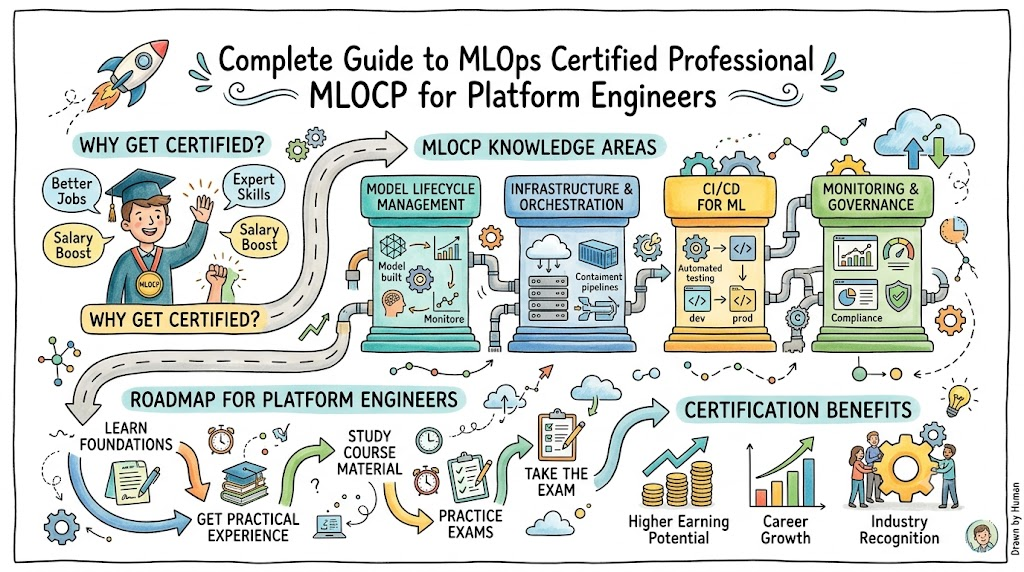
Introduction
Machine learning teams frequently struggle to deploy models reliably into enterprise environments. The MLOps Certified Professional (MLOCP) delivered by DevOpsSchool solves this operational gap by bridging data science experimentation with cloud-native delivery practices. Modern engineering ecosystems require robust pipelines that automate training, tracking, containerization, deployment, and real-time monitoring.
This comprehensive guide serves practicing software engineers, platform architects, site reliability specialists, and technical leads seeking to master operational machine learning. Readers will gain actionable clarity regarding curriculum tracks, industry applicability, skill prerequisites, and long-term career growth paths across global and distributed enterprise engineering teams.
What is the MLOps Certified Professional (MLOCP)?
The MLOps Certified Professional (MLOCP) represents a specialized engineering standard created to validate end-to-end operational mastery of production machine learning lifecycles. Traditional software delivery mechanisms often fail when applied directly to artificial intelligence systems due to dynamic data drift, complex model dependencies, and massive compute requirements.
This program focuses on production-ready patterns rather than isolated theoretical modeling concepts. Practitioners learn to build resilient automated workflows that govern data versioning, model artifact storage, continuous testing, secure deployment strategies, and telemetry instrumentation. The curriculum directly reflects modern enterprise standards by enforcing infrastructure as code, declarative continuous delivery, and cross-functional operational governance across complex multi-cloud environments.
Who Should Pursue MLOps Certified Professional (MLOCP)?
The credential directly benefits professionals operating at the intersection of infrastructure, software development, data operations, and enterprise system reliability. System administrators, site reliability engineers, software architects, cloud engineers, and data analysts will find direct practical value in these operational modules.
Beginners with fundamental Linux and programming experience can rapidly bridge the gap to advanced production practices, while senior practitioners can formalize their architectural skills. Engineering managers and team leads gain the necessary strategic insight to govern reliable machine learning pipelines effectively. The curriculum addresses high-demand production challenges encountered by engineering units across India, North America, Europe, and the global enterprise landscape.
Why MLOps Certified Professional (MLOCP) is Valuable
Enterprise investment in artificial intelligence demands sustainable, compliant, and cost-effective operational frameworks. Toolsets change frequently, but the architectural principles of automated testing, immutable artifact management, model validation, and observability remain fundamental to modern infrastructure teams.
Engineers holding proven deployment capabilities protect companies from costly pipeline failures, undocumented model regressions, and unmonitored system outages. Mastering repeatable pipeline automation guarantees high return on personal time investment, securing durable career stability across platform engineering, cloud operations, and applied data infrastructure roles.
MLOps Certified Professional (MLOCP) Certification Overview
The certification operates through structured curriculum paths hosted on DevOpsSchool, ensuring consistent assessment rigor and practical alignment. Candidates progress through interactive labs, real-world scenario testing, architecture design sessions, and comprehensive implementation challenges.
Assessment modules focus entirely on operational execution, requiring learners to build working CI/CD pipelines, configure continuous monitoring systems, and automate containerized deployments. This rigorous structure ensures that certified engineers possess production-ready capabilities capable of immediately supporting enterprise infrastructure.
Why Choose DevOpsSchool
DevOpsSchool stands out as an established platform delivering high-impact, industry-focused technical education led by seasoned practitioners. The institution provides hands-on, mentor-led programs backed by real enterprise production architectures rather than basic academic overviews.
Learners benefit from extensive lab environments, real-time feedback, detailed architectural blueprints, and collaborative peer learning networks. The platform continuously updates its curriculum to reflect evolving industry tools, ensuring professionals acquire practical capabilities directly aligned with current enterprise demands.
MLOps Certified Professional (MLOCP) Certification Tracks & Levels
The qualification structure separates core competencies into foundation, professional, and advanced architectural tiers. The foundation tier establishes core operational fundamentals, containerization workflows, and basic versioning patterns for emerging engineers.
The professional tier tackles multi-stage automated pipelines, scalable infrastructure provisioning, model registries, and automated validation gates. The advanced tier addresses complex distributed computing architectures, enterprise governance, security compliance, and dynamic observability across production environments.
Complete MLOps Certified Professional (MLOCP) Certification Table
| Track | Level | Who it is for | Prerequisites | Skills Covered | Recommended Order |
|---|---|---|---|---|---|
| Infrastructure & Ops | Foundation | Junior DevOps, SysAdmins | Linux, Git, Python basics | Containers, GitOps, Basic CI/CD | Step 1 |
| Core Pipeline Engineering | Professional | SREs, Platform Engineers | CI/CD, Cloud, Docker | Model Registry, Feature Stores, Automated Testing | Step 2 |
| Distributed Architecture | Advanced | Principal Architects, Leads | Kubernetes, MLOCP Professional | Scaled Training, Multi-Cloud Orchestration, Governance | Step 3 |
Detailed Guide for Each MLOps Certified Professional (MLOCP) Certification
MLOps Certified Professional (MLOCP) – Foundation Level
What it is
This entry-level certification validates an engineer's comprehension of fundamental automation, containerized packaging, and collaborative version control applied directly to machine learning assets.
Who should take it
Junior software engineers, system administrators, technical support engineers, and fresh graduates aiming to establish a solid operational baseline in modern continuous delivery workflows.
Skills you will gain
- Containerizing predictive workloads efficiently using Docker.
- Implementing Git-based collaborative versioning for code and small datasets.
- Constructing basic automation workflows using modern continuous integration servers.
- Provisioning standard cloud compute instances using declarative scripting templates.
Real-world projects you should be able to do
- Package a sample predictive Python application into an optimized, lightweight container image.
- Configure an automated pipeline that runs unit tests whenever team members commit new code.
- Deploy an isolated inference endpoint on a virtual cloud instance using automated scripts.
Preparation plan
- 7–14 Days: Focus on core containerization mechanics, basic command-line Linux administration, and fundamental Git branching strategies.
- 30 Days: Complete hands-on tutorials combining continuous integration tools with container registries and remote deployment targets.
- 60 Days: Build end-to-end prototype pipelines that build, test, and package sample models from scratch without manual intervention.
Common mistakes
- Ignoring code testing practices and jumping straight into complex cloud tools.
- Storing large binary datasets directly inside Git repositories instead of external object stores.
- Neglecting basic access permissions and credential isolation during initial pipeline configuration.
Best next certification after this
- Same-track option: MLOps Certified Professional – Professional Level
- Cross-track option: Certified Kubernetes Administrator
- Leadership option: Agile DevOps Practitioner
MLOps Certified Professional (MLOCP) – Professional Level
What it is
This credential validates an engineer's capability to architect, implement, and maintain enterprise-grade automated deployment pipelines, model registries, and validation suites.
Who should take it
Practicing DevOps engineers, cloud specialists, site reliability engineers, and data engineers responsible for maintaining production deployment systems.
Skills you will gain
- Designing scalable continuous training and continuous deployment (CT/CD) architectures.
- Integrating dedicated model registries with versioned metadata tracking.
- Setting up automated model performance validation gates before production deployment.
- Managing distributed configuration files and pipeline secrets across environments.
Real-world projects you should be able to do
- Build a deployment pipeline that triggers automated retraining when upstream data schemas change.
- Implement a blue-green deployment strategy for live model inference microservices.
- Establish a centralized artifact repository tracking lineage from source code to binary weights.
Preparation plan
- 7–14 Days: Review advanced continuous delivery patterns, canary release mechanisms, and artifact governance standards.
- 30 Days: Implement full integration labs connecting feature repositories, build agents, and automated test runners.
- 60 Days: Architect resilient staging-to-production deployment pipelines featuring automated rollbacks and regression tests.
Common mistakes
- Failing to automate data validation checks alongside traditional unit tests.
- Deploying updates directly to production clusters without intermediate canary or shadow stages.
- Hardcoding infrastructure parameters instead of utilizing dynamic environment variables.
Best next certification after this
- Same-track option: MLOps Certified Professional – Advanced Level
- Cross-track option: DevSecOps Certified Professional
- Leadership option: Certified Platform Engineering Lead
MLOps Certified Professional (MLOCP) – Advanced Level
What it is
This advanced validation confirms mastery over distributed infrastructure orchestration, complex observability systems, drift remediation, and enterprise security governance.
Who should take it
Principal infrastructure architects, staff reliability engineers, platform leads, and technical directors overseeing large-scale, mission-critical operational environments.
Skills you will gain
- Orchestrating distributed training clusters across multi-node compute pools.
- Implementing comprehensive telemetry systems tracking data drift and concept degradation.
- Enforcing role-based access control and encryption standards across all data flows.
- Architecting automated incident response and automated rollback workflows for degraded systems.
Real-world projects you should be able to do
- Deploy an observability stack that alerts engineers when inference accuracy drops below target thresholds.
- Implement a multi-tenant compute cluster that dynamically scales resources based on incoming queue traffic.
- Author an enterprise governance framework ensuring end-to-end data lineage and compliance auditing.
Preparation plan
- 7–14 Days: Deep dive into distributed system observability, telemetry collection agents, and cluster networking architectures.
- 30 Days: Configure complex monitoring stacks with custom alert policies tracking statistical data distribution changes.
- 60 Days: Design and execute a fault-tolerant multi-cluster platform incorporating dynamic auto-scaling and immutable audit logging.
Common mistakes
- Monitoring only system metrics (CPU, RAM) while ignoring operational model performance metrics.
- Building fragile single-region architectures vulnerable to unexpected cloud service interruptions.
- Over-engineering cluster topologies without establishing clear cost-allocation policies.
Best next certification after this
- Same-track option: Enterprise Platform Architect
- Cross-track option: FinOps Certified Practitioner
- Leadership option: Chief Technology Officer Executive Program
Choose Your Learning Path
DevOps Path
This pathway focuses on expanding core infrastructure automation practices into specialized model delivery workflows. Engineers master immutable artifact storage, version control strategies, automated build agents, and continuous deployment systems. The curriculum empowers teams to unify standard web application delivery with complex analytical microservice deployments smoothly.
DevSecOps Path
Security-focused professionals learn to embed compliance scans, vulnerability assessments, and access controls into every delivery stage. Participants master container image scanning, cryptographic signing of artifacts, runtime anomaly detection, and secrets management. This track ensures that enterprise deployment pipelines remain resilient against external vulnerabilities and internal compliance breaches.
SRE Path
Site reliability engineers focus on maintaining high availability, low latency, and robust system health across live predictive services. The coursework covers error budgets, service-level objectives (SLOs), automated traffic shifting, and rapid incident response protocols. Engineers develop the skills necessary to keep complex, data-heavy systems dependable under heavy user traffic.
AIOps Path
This specialization focuses on applying operational intelligence to IT systems management and infrastructure monitoring. Engineers explore automated root-cause analysis, dynamic threshold alerting, anomaly detection in system logs, and predictive incident mitigation. Completing this track enables teams to streamline enterprise IT operations using data-driven automation.
MLOps Path
This dedicated operational path delivers deep mastery over the full lifecycle of production machine learning workloads. Practitioners master continuous training triggers, data versioning pipelines, feature repository management, and real-time model monitoring. The program transforms standard developers into platform specialists capable of managing high-throughput analytical systems.
DataOps Path
Data-focused engineers master the automated orchestration, quality testing, and continuous delivery of complex data pipelines. Modules focus on schema migration testing, automated pipeline scheduling, data catalog integration, and real-time streaming architectures. This foundation ensures that downstream operational models consistently receive clean, reliable, and validated information.
FinOps Path
Financial operations specialists learn to track, analyze, and optimize the massive compute and storage costs associated with complex workloads. The curriculum covers cloud resource tagging, dynamic instance scheduling, cluster right-sizing, and departmental cost-allocation models. Engineers acquire practical tools to maximize business return on modern infrastructure investments.
Role to Recommended MLOps Certified Professional (MLOCP) Certifications
| Role | Recommended Certifications |
|---|---|
| DevOps Engineer | MLOCP Foundation, MLOCP Professional |
| SRE | MLOCP Professional, MLOCP Advanced |
| Platform Engineer | MLOCP Professional, MLOCP Advanced |
| Cloud Engineer | MLOCP Foundation, MLOCP Professional |
| Security Engineer | MLOCP Professional, DevSecOps Certified Professional |
| Data Engineer | MLOCP Foundation, DataOps Certified Specialist |
| FinOps Practitioner | MLOCP Foundation, FinOps Certified Practitioner |
| Engineering Manager | MLOCP Professional, Platform Engineering Lead |
Next Certifications to Take After MLOps Certified Professional (MLOCP)
Same Track Progression
Engineers completing core operational certifications should advance directly into specialized cluster orchestration and distributed systems engineering. Deepening expertise in multi-region deployments, automated scaling policies, and low-latency inference routing establishes high-value technical authority within enterprise engineering organizations.
Cross-Track Expansion
Broadening technical capabilities into DevSecOps, FinOps, or advanced DataOps creates versatile platform engineers capable of solving diverse organizational bottlenecks. Cross-domain mastery enables professionals to safeguard systems against compliance risks while keeping operational compute expenses tightly managed.
Leadership & Management Track
Experienced technical specialists transitioning into leadership positions should pursue platform leadership and engineering management programs. These frameworks focus on team alignment, engineering velocity optimization, organizational risk management, and strategic technology adoption across enterprise departments.
Training & Certification Support Providers for MLOps Certified Professional (MLOCP)
The Core Platform Authority
DevOpsSchool serves as a premier technical education institution dedicated to empowering engineers with practical, enterprise-grade capabilities. The organization delivers comprehensive training programs spanning modern DevOps, cloud infrastructure, containerization, site reliability engineering, and operational automation. With a curriculum designed by practicing industry veterans, the platform emphasizes real-world architectural design, hands-on laboratory exercises, and robust delivery methodologies. Engineers and enterprise teams rely on this platform to bridge critical skill gaps, adopt modern engineering standards, and achieve validated technical proficiencies aligned with global workplace expectations.
DevOpsSchool
DevOpsSchool provides comprehensive educational modules focused on modern infrastructure automation, continuous integration practices, and enterprise cloud operations. The platform offers hands-on, mentor-led sessions that prepare working professionals for complex real-world operational challenges.
Cotocus
Cotocus delivers specialized technical consulting and enterprise enablement programs designed to accelerate cloud transformation initiatives. Their training structures emphasize production readiness, platform modernization, and modern infrastructure governance.
Scmgalaxy
Scmgalaxy serves as an established technical community and knowledge repository dedicated to source code management, continuous delivery, and infrastructure automation. The portal offers extensive technical documentation, guides, and practical tutorials for practicing engineers.
BestDevOps
BestDevOps focuses on curating industry best practices, architectural templates, and practical guides across the DevOps ecosystem. The platform supports engineers looking to refine delivery processes and optimize operational workflows.
DevSecOpsSchool
DevSecOpsSchool specializes in embedding automated security standards into modern software delivery pipelines. The curriculum provides deep coverage of container vulnerability analysis, pipeline security scanning, and regulatory compliance automation.
SRESchool
SRESchool concentrates on site reliability engineering principles, enterprise observability frameworks, and incident response automation. Learners acquire direct skills in defining service level objectives, error budgeting, and resilient system architecture.
AIOpsSchool
AIOpsSchool delivers focused coursework on operational intelligence, automated system monitoring, and predictive IT management. The programs guide engineers in deploying modern monitoring agents and automated root-cause detection engines.
DataOpsSchool
DataOpsSchool addresses the operational challenges of building, testing, and delivering high-throughput data engineering pipelines. The platform teaches automated data quality testing, schema governance, and robust pipeline orchestration.
FinOpsSchool
FinOpsSchool provides structured education on cloud financial management, resource utilization optimization, and infrastructure cost transparency. The training empowers engineering teams to maintain financial accountability across cloud environments.
Frequently Asked Questions (General)
- How difficult is the certification process for working engineers? The assessment focuses primarily on practical implementation rather than memorization, making it manageable for engineers with hands-on systems experience.
- What is the typical time required to complete the preparation? Most working professionals successfully prepare within thirty to sixty days by dedicating five to seven hours weekly to hands-on laboratory exercises.
- Are there mandatory technical prerequisites before starting? Candidates should possess a working knowledge of command-line Linux, basic Python scripting concepts, and fundamental version control workflows using Git.
- What return on investment can professionals expect? Certified engineers demonstrate validated operational competence, which directly enhances career mobility, role expansion, and compensation potential across global platform teams.
- In what sequence should I complete the certification levels? Learners should proceed sequentially from Foundation to Professional, concluding with the Advanced level to ensure comprehensive skill acquisition.
- Does this certification help professionals working in traditional IT roles? Yes, traditional system administrators and operations engineers acquire modern automation and containerization skills required for cloud platform transitions.
- How does the exam evaluate candidate competencies? The evaluation uses hands-on performance tasks, architecture review scenarios, and practical deployment challenges simulating real enterprise production environments.
- Is this credential recognized across international job markets? The curriculum aligns with global engineering standards, making the certification valuable across enterprise organizations in North America, Europe, India, and beyond.
- Can software developers benefit from this credential? Developers gain the necessary operational insight to containerize, test, and deploy their own analytical services without requiring dedicated operations support.
- How often should engineers refresh their certified credentials? Maintaining technical currency through advanced follow-up tracks or renewal assessments every two to three years ensures skills remain aligned with industry practices.
- Do I need access to expensive enterprise hardware to practice? Standard cloud provider free tiers or local containerized development environments provide sufficient resources to complete all necessary training exercises.
- How does this certification support engineering leadership candidates? Technical leads gain clear architectural visibility into deployment risks, governance frameworks, and infrastructure cost factors, enabling informed strategic decision-making.
FAQs on MLOps Certified Professional (MLOCP)
- What specific operational challenges does the MLOCP program address? The program addresses fundamental pipeline reliability, data lineage tracking, automated model validation, continuous deployment, and telemetry monitoring across distributed production systems.
- How does MLOCP differ from generic data science certifications? Data science programs concentrate on theoretical mathematics and model development, whereas MLOCP focuses entirely on deployment automation, platform engineering, and operational uptime.
- What pipeline automation tools are covered during the course? Learners gain hands-on proficiency with container engines, continuous integration servers, artifact registries, feature stores, and automated infrastructure provisioning frameworks.
- How does MLOCP prepare engineers to handle production data drift? The training teaches engineers to configure real-time telemetry systems, automated metric tracking, alert policies, and triggered retraining workflows for degrading models.
- Is the MLOCP certification applicable to multi-cloud enterprise setups? Yes, the architectural patterns and deployment frameworks taught throughout the program apply universally across major public clouds and on-premises environments.
- What role does container orchestration play within this certification? Containerization forms a core pillar, enabling engineers to package dependencies cleanly, manage compute resources dynamically, and deploy scalable inference microservices reliably.
- How does completing MLOCP benefit Site Reliability Engineers? SREs learn how to establish actionable service level indicators, manage error budgets for analytical workloads, and automate incident response mechanisms effectively.
- Can teams complete the MLOCP program via enterprise corporate training? Enterprise teams can enroll through structured corporate enablement tracks designed to align internal engineering workflows with modern production delivery standards.
Final Thoughts: Is MLOps Certified Professional (MLOCP) Worth It?
Engineering teams no longer struggle with developing analytical models; their primary challenge lies in deploying, maintaining, and scaling those models reliably in production environments. Without robust automation pipelines, enterprises face delayed release cycles, unmonitored system degradation, and unsustainable operational overhead.
The MLOps Certified Professional (MLOCP) program directly targets this operational bottleneck by delivering practical, industry-tested engineering capabilities. For software engineers, platform architects, and infrastructure specialists seeking long-term technical relevance, acquiring structured deployment mastery represents a dependable, high-impact career investment.






Top comments (0)