

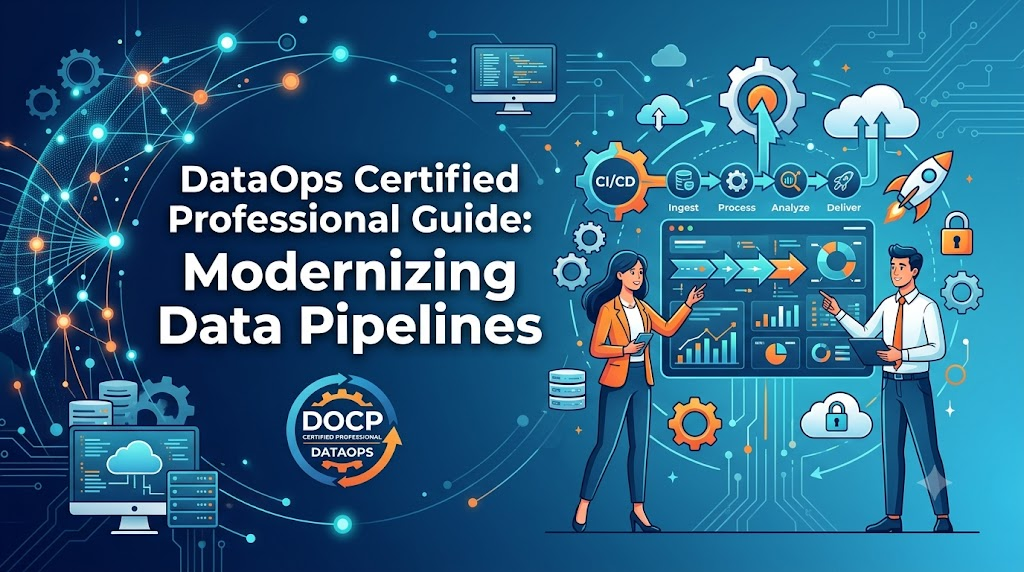
Data has shifted from an operational archive into the active fuel driving real-time analytics, automated enterprise workflows, and advanced artificial intelligence platforms. However, as corporate data ecosystems scale across multi-cloud infrastructure, event-driven streaming buses, and modern analytical warehouses, operational friction inevitably emerges. Traditional data management practices frequently stall when confronted with fragile extraction scripts, unannounced schema shifts, manual code deployments, and fragmented communication between platform and analytics teams.
This operational friction makes DataOps a necessity. Adapting core principles from Agile software engineering, Lean manufacturing, and DevOps culture, DataOps treats data pipelines as production-grade software applications. It embeds continuous testing, continuous integration and deployment (CI/CD), telemetry monitoring, and transparent governance directly into every stage of the data lifecycle.
Successfully driving this paradigm shift demands more than subscribing to new cloud services—it requires proven technical leadership. Professionals who earn the DataOps Certified Professional (DOCP) designation showcase the practical expertise and strategic vision needed to construct, maintain, and scale resilient data infrastructure.
Understanding the DataOps Certified Professional (DOCP) Role
A DataOps Certified Professional is an engineering specialist who connects the dots between data engineering, analytics, software development, and system operations. Rather than simply writing isolated SQL transformations or managing standalone database tables, a DOCP certified practitioner oversees the entire end-to-end data lifecycle.
+-----------------------------------------------------------------------+
|                       DataOps Mindset & Strategy                       |
+------------------------------------+----------------------------------+
                                     |
    +--------------------------------+--------------------------------+
    |                                                                 |
    v                                                                 v
+---------------------------------+             +----------------------------------+
|   Data Engineering & Pipelines  |             |      DevOps & Infrastructure     |
| • Extract, Transform, Load (ETL)|             | • CI/CD Automation               |
| • Orchestration & Lineage       |             | • Containerization (Docker/K8s)  |
| • Data Modeling                 |             | • Infrastructure as Code (IaC)   |
+---------------------------------+             +----------------------------------+
    |                                                                 |
    +--------------------------------+--------------------------------+
                                     |
                                     v
+-----------------------------------------------------------------------+
|                     Data Quality, Governance & Observability          |
| • Continuous Testing & Validation   • Real-Time Monitoring & Alerts  |
+-----------------------------------------------------------------------+
Core Focus Areas of a DOCP
- Pipeline Automation: Building continuous deployment pipelines for database schemas, analytical models, and transformation scripts.
- Proactive Quality Engineering: Implementing automated validation checkpoints within ingestion steps to catch corrupted records long before they hit executive dashboards.
- Observability & Lineage Tracking: Deploying monitoring frameworks that track schema drift, data freshness, volume changes, and system dependencies in real time.
- Cross-Team Collaboration: Establishing shared standards so software developers, data engineers, and business analysts work from a single operational playbook.
Why Organizations Value DataOps Talent
Data volumes continue to grow exponentially, but engineering headcount rarely keeps pace. Without automated deployment workflows, data engineers spend up to 80% of their day firefighting broken jobs, responding to user tickets, and manually patching database scripts.
Forward-looking organizations prioritize hiring and training DataOps Certified Professionals to achieve tangible business results:
- Faster Time-to-Value: Moving new data pipelines or dashboard updates from initial concept to production in hours rather than months.
- Uncompromising Data Integrity: Preventing invalid, missing, or corrupted inputs from reaching critical executive reports and operational AI systems.
- Scalable Architecture Management: Expanding multi-cloud data operations without forcing a linear increase in maintenance costs.
- Reliable Incident Recovery: Leveraging version-controlled code and automated rollbacks to restore pipeline operations swiftly whenever failures occur.
Core Pillars of a Modern DataOps Ecosystem
To master the domains covered by the DataOps Certified Professional path, one must examine the fundamental pillars that make up a resilient DataOps framework.
1. Version Control for All Assets
In a mature DataOps setup, pipeline code, metadata, infrastructure configurations, and orchestration DAGs (Directed Acyclic Graphs) live in centralized version-controlled repositories. This structure guarantees every update to a data product remains fully traceable, reviewable, and reversible.
2. Continuous Delivery for Data (CI/CD)
Applying CI/CD to data workflows means treating SQL transformations, orchestrator scripts, and analytical models like versioned software products. Every proposed code change triggers automated unit and integration tests against isolated staging environments before merging to production branches.
3. Automated Validation Frameworks
Quality testing must execute systematically across multiple pipeline stages:
- Pre-Ingestion: Checking structural formats and incoming payload schemas.
- Post-Transformation: Validating business logic rules, primary key constraints, and distributional boundaries.
- Pre-Consumption: Confirming freshness SLAs and complete dataset loads prior to reporting tool connections.
4. End-to-End Data Observability
Data Observability delivers deep operational visibility into system health based on telemetry metrics. Key indicators include:
- Freshness: Is the underlying table updated within expected timeframes?
- Volume: Did the expected quantity of records land successfully?
- Schema: Have any upstream systems unexpectedly dropped, added, or renamed columns?
- Distribution: Do numerical values fall within historical statistical norms?
- Lineage: Which raw source tables feed this metric, and what downstream assets depend on it?
Comparing Legacy Data Management with DataOps Practices
Comparing conventional data handling with an automated DataOps framework highlights the concrete improvements a DataOps Certified Professional brings to an enterprise.
| Feature / Dimension | Legacy Data Management | DataOps Practices |
|---|---|---|
| Release Management | Sequential, manual script runs; rare release windows | Iterative, automated deployments; continuous integration cycles |
| Quality Control | Reactive; bugs caught after business users flag bad reports | Proactive; automated unit tests and statistical checks across execution |
| Deployment Execution | Manual execution of queries directly on live servers | Automated CI/CD pipelines backed by version control repositories |
| System Visibility | Disconnected log files; manual root-cause investigation | Unified observability dashboards, dynamic lineage, and instant alerts |
| Recovery Strategy | Emergency manual patches, direct DB edits, extended downtime | Automated rollbacks, pipeline circuit breakers, and sandbox isolation |
| Team Operations | Isolated functional silos (Data Engineering vs. Analytics vs. Ops) | Shared operational workflows built on unified, collaborative tools |
Real-World Operational Scenarios
To see how a DataOps Certified Professional puts these strategies into practice, consider these common operational scenarios.
Scenario 1: Preventing Unannounced Schema Changes from Disrupting Analytics
-
The Problem: An application backend team updates a production database, changing the field
user_idtoaccount_uuid. The overnight transformation job fails silently, resulting in blank KPI metrics on C-suite reporting dashboards the next morning. - The DOCP Solution: The DataOps Specialist embeds continuous schema-validation checks into the ingestion pipeline. Upon detecting the unannounced structural shift, an automated circuit breaker immediately pauses execution and alerts the team with precise lineage impact details, allowing resolution before corrupted data reaches analytical layers.
Scenario 2: Accelerating Development Sandboxes for Machine Learning
- The Problem: Data scientists face a month-long wait for infrastructure teams to manually provision database instances and load sample datasets for a churn prediction model.
- The DOCP Solution: Using Infrastructure as Code (IaC) and container orchestration tools, the DataOps Specialist builds automated, self-service sandbox environments. Data scientists spin up isolated staging environments with pre-anonymized datasets in under 20 minutes using simple command-line triggers.
Key Advantages of Earning the DOCP Credential
For technical practitioners, completing the DataOps Certified Professional path unlocks clear career and technical advantages:
- Validation of Cross-Domain Expertise: Proves mastery spanning software engineering, cloud platforms, workflow automation, and data platform architecture.
- Strong Market Demand: Companies seeking to stabilize chaotic data pipelines actively recruit professionals capable of applying software rigor to analytics operations.
- Improved System Efficiency: Enables engineers to reduce execution failure rates, optimize cloud compute usage, and eliminate unnecessary pipeline maintenance.
- Clear Career Progression: Prepares technical staff for strategic leadership roles, including Lead DataOps Engineer, Platform Architect, or Manager of Data Engineering.
Mistakes to Avoid When Implementing DataOps
Even with advanced platforms, organizations frequently run into roadblocks during DataOps transitions due to strategic missteps. A DataOps Certified Professional helps teams avoid these common traps:
- Viewing DataOps as Only a Software Purchase: Buying modern data stack tools without updating team communication, testing workflows, or release standards yields minimal results.
- Neglecting Lineage Mapping: Constructing complex processing steps without keeping dynamic lineage records leaves engineers blind to downstream impacts when upstream sources change.
- Over-Engineering Early Automation: Trying to build automated recovery paths for every edge case on day one can paralyze adoption momentum. Focus first on high-impact workflows and basic quality tests.
- Skipping Security and Privacy Controls: Accelerating deployments without integrating automated access checks and data masking creates compliance risks in production environments.
- Ignoring Key Operational Metrics: Failing to track baseline KPIs—such as deployment frequency, pipeline recovery times (MTTR), and data error rates—makes demonstrating transformation ROI difficult.
Essential Practices for a Scalable Data System
To maintain operational stability over time, DataOps Certified Professionals follow proven engineering standards:
- Mandate Isolated Development Workspaces: Require team members to develop and test within reproducible staging sandboxes that mirror production settings.
- Implement Automated Circuit Breakers: Set up safety triggers designed to halt downstream execution automatically when critical data quality assertions fail.
- Standardize Pipeline Modules: Create reusable workflow templates for ingestion, transformation, and deployment to help new team members onboard quickly.
- Focus on Actionable Observability: Prioritize telemetry that highlights clear root causes rather than sending unhelpful, generic alert emails.
- Promote Shared Responsibility: Organize regular cross-team design reviews, shared release schedules, and blameless post-mortem discussions between engineering, analytics, and ops teams.
Recommended Roadmap to DOCP Certification
Building a career as a DataOps specialist involves progressive technical development across several core areas.
Step 1: Solidify Fundamentals
  ├── Master Version Control (Git) & Branching Strategies
  ├── Refine Advanced SQL & Relational/Non-Relational Data Modeling
  └── Develop Proficiency in Python or Scala for Data Scripting

Step 2: Master Infrastructure & Orchestration
  ├── Learn Cloud Platforms (AWS, Azure, or GCP) & Containerization (Docker)
  ├── Build Infrastructure as Code (IaC) using Terraform or CloudFormation
  └── Master Workflow Orchestrators (Apache Airflow, Prefect, or Dagster)

Step 3: Implement Automated Testing & Observability
  ├── Implement Data Testing Frameworks (dbt tests, Great Expectations)
  └── Configure Data Observability & Lineage Tracking Systems

Step 4: Earn the DOCP Certification & Apply Skills
  ├── Complete Deep-Dive Learning & Hands-on Lab Assignments
  └── Pass the DataOps Certified Professional (DOCP) Exam
Practical Advice for Certification Candidates
- Construct End-to-End Sample Projects: Build an open-source data pipeline featuring automated tests, GitHub Actions CI/CD workflows, and telemetry monitoring dashboards.
- Master the Underlying Process: Focus heavily on Agile standards and DevOps principles, as DataOps relies just as much on clear workflows and communication as it does on software.
- Concentrate on Platform-Agnostic Concepts: Prioritize core technical principles—such as branching models, automated test design, and observability metrics—which apply regardless of vendor choices.
Frequently Asked Questions (FAQs)
1. What experience is recommended before studying for the DataOps Certified Professional (DOCP) exam?
While candidates come from various technology paths, a solid grasp of basic data engineering concepts, scripting skills (such as Python and SQL), and foundational cloud platform operations provides an ideal starting point.
2. How does DataOps differ from standard DevOps?
DevOps focuses on automating the release lifecycle of stateless software applications, platform deployments, and cloud infrastructure. DataOps adapts those concepts to address the unique demands of stateful data platforms, dynamic schemas, analytical pipelines, and continuous data validation.
3. What technical tools does a DataOps Certified Professional work with?
Practitioners work across the modern data stack, using version control systems (Git), container environments (Docker, Kubernetes), workflow orchestrators (Apache Airflow, Dagster), transformation frameworks (dbt, Great Expectations), and data observability platforms.
4. Is the DataOps Certified Professional track useful for technical managers?
Yes. Engineering managers, data architects, and analytics leaders use DataOps principles to reorganize team workflows, improve system reliability, and eliminate delivery bottlenecks across engineering groups.
5. How much preparation time is usually required for the DOCP exam?
Preparation time depends on prior technical background. Experienced data engineers or DevOps practitioners often prepare effectively in four to six weeks, while individuals new to automation concepts may require two to three months of hands-on study.
6. Which business sectors see the biggest impact from DataOps implementation?
Any organization processing complex, high-velocity data gains substantial benefits. Key sectors include financial services, healthcare networks, online retail, telecommunications, and SaaS platforms where reliable data directly impacts operational revenue and regulatory compliance.
Conclusion
As modern enterprise data architectures grow increasingly complex, organizations can no longer afford to rely on fragile, manual processing runs and reactive bug fixing. Implementing DataOps standards converts data management from a high-risk bottleneck into a predictable, automated engine.
Achieving the DataOps Certified Professional (DOCP) credential confirms an engineer's capability to automate complex data workflows, enforce continuous data quality standards, and align cross-functional teams. By combining software discipline with data management, certified experts play a vital role in building reliable, data-driven organizations.






Top comments (0)