
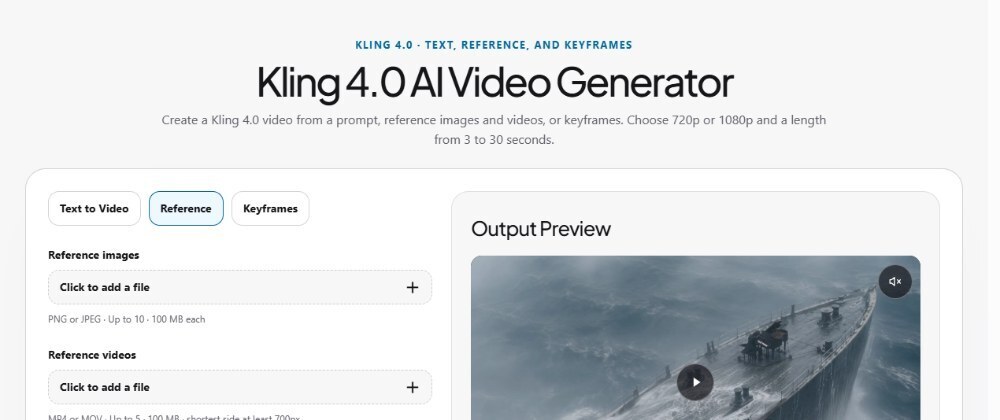
When a team moves from a written brief to moving images, the gap between the idea and the first watchable clip is where most wasted effort hides. Storyboards help, but they rarely survive the jump to motion, and the first generated draft usually exposes problems no static plan predicted. A practical way to close that gap is to treat the first set of clips as review material rather than finished assets. The goal is to see framing, pacing, and subject consistency early, while changes are still cheap. A tool such as Kling 4.0 can turn a short prompt into several seconds of motion that a team can react to, which makes the early review conversation far more concrete than a text description ever could.
Before any generation begins, the brief needs to state the job the clip is meant to do. Is it a product hero shot, a social teaser, a scene test, or a mood study? Each answer changes the constraints that matter: aspect ratio, duration, camera feel, and how far the subject must stay on-model. A narrow brief produces clips that are easier to judge, while a vague one produces output that looks plausible in isolation but fails the actual use case. Writing these constraints down before generation also gives the reviewer a fixed yardstick, so the conversation stays about the clip and not about shifting expectations.
The strongest habit is to generate a small batch instead of a single hero attempt. Three to five variants around one brief reveal whether the problem is the prompt, the reference, or the concept itself. When every option is weak in the same way, the brief is the issue; when one direction clearly leads, the team can refine that single thread instead of restarting. Comparison is the cheap signal that prevents over-investing in a direction that looked good for the wrong reason.
Review should stay concrete. The useful questions are whether the motion reads correctly, whether the subject stays consistent across the few seconds, whether the timing supports the message, and whether the result could survive a cut into the final timeline. None of these require the clip to be perfect; they require it to be legible enough to decide what to keep, what to re-prompt, and what to discard.
A stopping rule keeps the loop from spinning. If a focused revision still misses the brief, change one variable at a time: the camera instruction, the motion description, the reference, or the duration. Changing everything at once hides which adjustment actually helped. The output of this stage is not a publish-ready asset; it is a documented decision about which direction is worth more production time. A simple shared template for this step removes ambiguity: note the failed attempts, the single change that moved the result, and the remaining gap before the next pass.
Human judgment still owns fit and accuracy. AI motion can suggest a direction quickly, but only a person can confirm that the clip matches the brand, the audience, and the legal or creative constraints of the channel. The draft is a proposal, not a release. Keeping that separation is what stops a fast tool from quietly shipping something that looked fine in a thumbnail but fails on a full screen.
The part that compounds is the notes. Capture the brief, the strongest clip, and the reason it won. Those notes turn a one-off generation into a repeatable pattern the next project can borrow, which is the real measure of whether the workflow saved time rather than just produced more files.
The takeaway is simple: use AI video generation to shorten exploration, then let review decide what reaches the timeline. Speed without review produces volume; speed with review produces a direction the team actually believes in.





Top comments (0)