

Choosing the right tennis instructor means evaluating their coaching qualifications, teaching style, experience with adult learners, and ability to align with your specific goals. Look for certified coaches who communicate clearly, personalise their sessions, and demonstrate patience. Avoid instructors who use a one-size-fits-all approach, ignore your feedback, or lack verifiable credentials.
If you are an adult picking up tennis for the first time — or returning after years away from the court — finding the right tennis instructor in Singapore can make or break your progress. The right coach accelerates your development. The wrong one wastes your time, money, and motivation. This guide gives you a practical decision framework to help you choose confidently.
Why Your Choice of Coach Matters More Than You Think
Tennis is a technically complex game. Bad technique learned early is hard to unlearn at a later stage. According to the Singapore Sports Institute, adults who undergo structured, coach-assisted training acquire skills much faster than those who engage in self-learning. The professional coach does not just teach you how to play, but develops your court sense, footwork, and competitive attitude.
Your choice of coach will influence how long you will stay in the game. Those in their twenties to fifties usually have a lot on their hands and little patience for inefficiency. Picking the wrong coach the first time means dropping out of the game, not because tennis is hard but because you didn't enjoy yourself.
Key Traits of an Excellent Tennis Coach
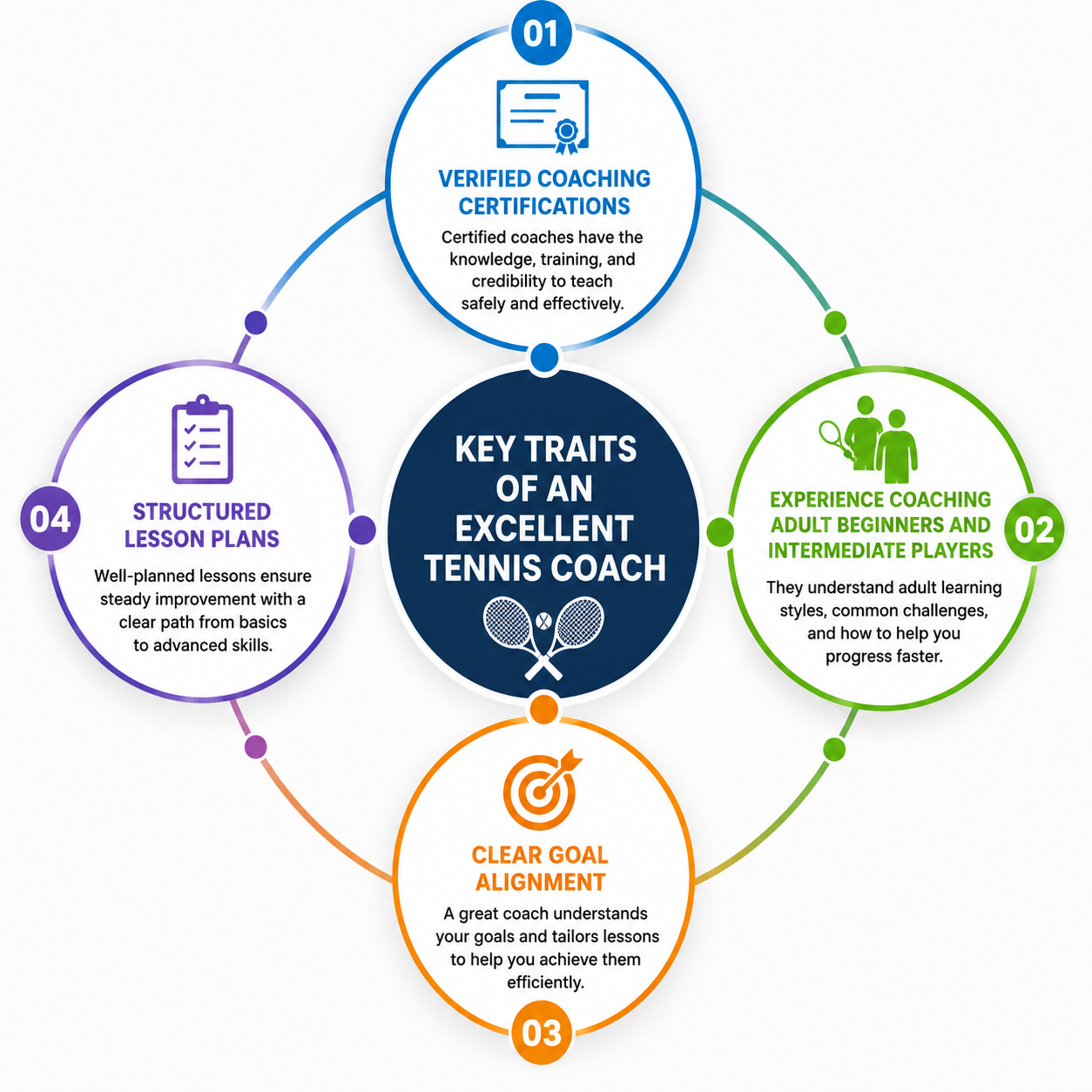
Great coaches share specific characteristics that go beyond simply being able to play the game well. Here is what to look for:
Verified Coaching Certifications
In reputable tennis coaching in singapore are typically certified through Sport Singapore-recognised bodies or international organisations such as the International Tennis Federation (ITF) or Tennis Australia. These certifications indicate that the instructor has undergone formal coach education — covering technique, player development, and safety. Always ask for credentials upfront. A confident, qualified coach will share them willingly.
Experience Coaching Adult Beginners and Intermediate Players
Teaching adults is a different skill set from coaching children. Adults come with pre-existing habits, physical limitations, and high expectations for their own progress. A good instructor understands adult learning psychology — they explain the "why" behind each drill, not just the "what." Ask specifically how many adult students they currently teach and what results those students have achieved.
Clear Goal Alignment
Before your first session, a skilled coach should ask about your goals. Are you playing for fitness? Social tennis? Competitive club matches? Each goal demands a different training approach. If an instructor launches straight into drills without asking what you want to achieve, that is an early warning sign.
Structured Lesson Plans
Good coaching is never ad hoc. Great coaches have lesson plans that are designed to build progressively, beginning with the basics such as grip, stance, and contact point before moving on to rally technique, serving, or even match tactics. Request a sample syllabus or a rough outline of what your initial eight to twelve lessons will cover.
Red Flags to Avoid When Choosing a Tennis Instructor
Knowing what to avoid is just as important as knowing what to look for. Watch out for these warning signs:
- One-size-fits-all sessions: Group drills that do not adapt to individual skill levels suggest the coach is not invested in your specific development.
- No feedback or correction: A coach who watches you hit without providing technique adjustments is not coaching — they are supervising.
- Dismissive of your questions: You should feel comfortable asking why you are practising a specific drill. Coaches who shut down questions often lack the depth to explain their methods.
- Inconsistent availability: Frequent cancellations or last-minute reschedules disrupt your progress and signal a lack of professionalism.
- Overpromising results: "You will be competition-ready in two weeks" is not coaching — it is a sales pitch. Good coaches set realistic timelines.
Questions to Ask Before Booking Your First Lesson
Do not book without asking these questions. They reveal a coach's depth, professionalism, and fit for your needs:
- What is your coaching certification and when was it last updated?
- How do you structure lessons for adult beginners?
- How do you track a student's progress over time?
- Do you offer trial sessions before committing to a package?
- What is your cancellation and rescheduling policy?
- Can I speak with a current student or read testimonials?
A coach who answers these confidently and thoroughly is worth your time. One who deflects or rushes past them is not.
Understanding the Different Types of Tennis Coaching Formats
In Singapore, tennis coaching singapore is offered in several formats. Each suits different goals and budgets:
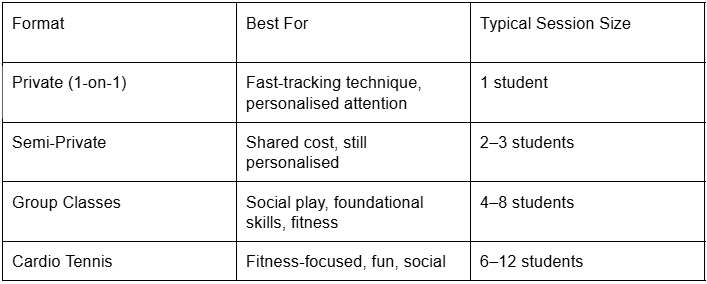
Adults new to the sport often benefit most from private lessons in the first few months, then transition to group formats once the fundamentals are solid. Tennis classes in Singapore at beginner level are widely available across multiple club and public court locations, so format flexibility is rarely a barrier.
How to Evaluate a Trial Session
Most reputable instructors offer a trial or introductory session. Use it as an evaluation, not just a taster. During the session, notice:
- Does the coach observe your natural movement before correcting?
- Are corrections explained clearly, with a reason behind them?
- Does the coach adjust the drill difficulty based on your responses?
- Do you feel encouraged without being patronised?
- Is the coach fully present — or distracted by their phone or other students?
After the session, ask yourself honestly: did I learn something specific? Did I feel seen as an individual? If both answers are yes, that is a strong signal.
The Right Coach Meets You Where You Are
The tennis coach that will suit you and your needs perfectly does not have to be the player with the greatest accomplishments or the coach with the biggest client roster. He or she has to listen to you, teach clearly, and then tailor your lessons based on your lifestyle and needs rather than your backhand alone.
If you are in Singapore and want to improve your tennis skills as an adult through goal-oriented training programs, contact us for specific programs tailored to the needs of adult learners like yourself.
Frequently Asked Questions
What qualifications should a tennis instructor in Singapore have?
A certified tennis coach in Singapore must have a certification from a recognized authority such as the International Tennis Federation, Tennis Australia, or one affiliated with Sport Singapore. This will assure that the coach is adequately trained on proper techniques and coaching methods.
How many lessons does it take for an adult beginner to learn tennis?
Most beginner adults acquire fundamental consistency in rallying, serving, and court positioning in 10-20 coaching sessions. It depends on how frequently your sessions occur, the nature of the coaching provided, and your own personal practice between classes.
Are group tennis classes in Singapore suitable for complete beginners?
Group classes may suit beginners only if there is a limited number of students in a group and the coach provides differentiated instruction. In general, however, individual lessons would be better as the coach will be able to fix the learner’s technique before bad habits develop.
What is the average cost of tennis coaching in Singapore?
Private tennis lessons in Singapore generally cost between SGD 60 and SGD 150 per hour, depending on the expertise of the coach. Classes are less expensive than private lessons and usually cost between SGD 20 and SGD 50 per class.






Top comments (0)