

What if an agent spent less time going back to the model, but did much more useful work inside each turn?
That is the idea I have been testing: let an LLM turn make a decision, then let one batch of commands search, inspect, compare, and verify the result. The goal is not “fewer turns” by itself. The goal is fewer expensive decision loops and more observable work between them.
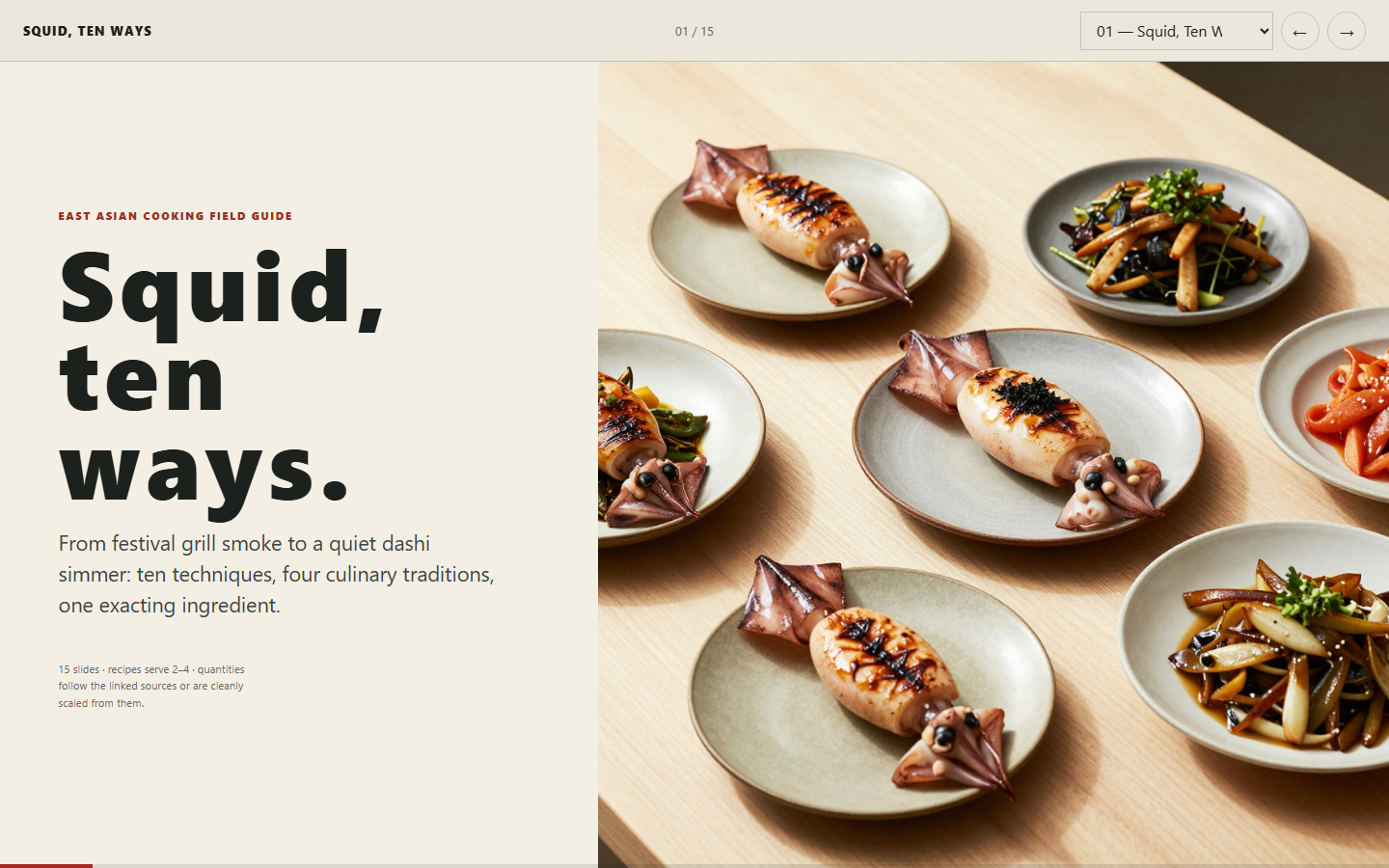
I used a deliberately messy task: build a 15-slide guide to 10 East Asian squid recipes, with illustrations, recipe sources, and cooking videos. This kind of job is easy to make look finished while leaving behind broken links, duplicated videos, missing assets, or a layout that only works on one screen.
Across four runs, the two CLI-style runs averaged 13.5 LLM turns and 10.5 tool calls. The two direct-execution runs averaged 10 LLM turns and 82 tool calls. So, in this small matrix, the direct approach used 25.9% fewer LLM turns while issuing about 7.8× more commands.
The interesting part was not the headline number. In one early turn, the agent launched roughly 20 discovery commands for recipes and matching videos. Later checks confirmed 10 sources, 10 unique video destinations, 15 local assets with none missing, navigation behavior, and rendering at 1440, 768, and 390 pixels. One bad recipe destination was corrected, and the remaining video IDs were validated.
This pattern is useful anywhere the work is “collect, produce, then prove it is usable”: research briefs, slide decks, market maps, buyer guides, travel plans, content migrations, link audits, and QA-heavy reports.
The mental model is simple:
- Use the LLM turn to decide what needs to happen.
- Fan that decision out into many independent commands.
- Gather structured results.
- Use the next turn only when judgment is actually needed.
This is only a four-run case study, not proof that one setup always wins. Runtime was mixed, and token accounting came from different harness sources. But it does show why “turn count” and “command count” should not be treated as the same thing.
The full interactive task and the raw run artifacts are public:
- Task: https://turaai.net/benchmark-task?task=east-asian-squid-recipes-slides
- Results: https://github.com/Tura-AI/benchmark/tree/main/results/design/east-asian-squid-recipes-slides/report-20260711-design-matrix
I maintain Tura and this benchmark. I would be interested to hear: which part of your workflow should be one LLM decision followed by a batch of verifiable commands?






Top comments (0)