

Introduction
Most technology professionals spent the past two decades mastering deterministic systems. Whether building distributed microservices, managing relational databases, or provisioning cloud infrastructure, classical IT rests on a dependable premise: given the same input and state, a program executes the exact same logic and yields the exact same result.
Quantum computing introduces an unfamiliar boundary into that landscape. As quantum processors move from isolated physics laboratories into managed cloud consoles, a noticeable skills gap has emerged—not because quantum processors are about to replace classical servers, but because bridging classical software engineering with probabilistic quantum execution requires a new mental model. Closing that gap begins with understanding where quantum computation actually fits, how modern cloud tools expose it, and what skills technical teams need to build realistically.
Why Quantum Computing Matters to Technology Professionals
Classical CPUs and GPUs excel at high-throughput data movement, web services, storage, and deterministic business logic. Quantum processors are not built to take over those workloads. Instead, they act as specialized co-processors for narrow classes of mathematical problems whose complexity grows exponentially on classical hardware—such as simulating molecular interactions in chemistry, evaluating complex combinatorial optimization graphs, and analyzing cryptographic resilience.
For software developers, cloud architects, and engineering leaders, quantum computing is relevant today for two practical reasons. First, major cloud providers now expose quantum simulators and real Quantum Processing Units (QPUs) through standard APIs and Python libraries, making hands-on experimentation accessible from a regular workstation. Second, long-term cryptographic migration toward post-quantum standards requires architectural awareness long before fault-tolerant quantum machines reach industrial scale.
Essential Foundations: Beyond Binary Logic
Transitioning from classical programming to quantum circuit design starts with four core concepts:
Qubits: Whereas a classical bit holds a strict 0 or 1, a quantum bit (qubit) can exist in a linear combination of both basis states simultaneously until it is measured.
Superposition: Placing qubits into superposition allows a quantum register to represent probability amplitudes across many computational states at once. Rather than testing every possible answer sequentially, quantum algorithms structure wave-like interference so incorrect paths cancel out while high-probability solutions amplify.
Entanglement: Entanglement creates non-classical correlations between two or more qubits so that observing the state of one immediately determines the state of its entangled partner, regardless of physical separation on the processor.
Quantum Gates: Unlike classical logic gates (such as AND, OR, or NAND) that overwrite bits irreversibly, quantum gates are reversible unitary matrix operations. A Hadamard gate places a qubit into equal superposition, while a Controlled-NOT (CNOT) gate entangles two qubits inside a quantum circuit.
Classical Programming vs. Quantum Programming
Because measurement collapses superposition into a single classical bitstring, writing quantum software feels fundamentally different from conventional coding:
- Execution Model: Classical programs run deterministically and produce a single exact output; quantum circuits produce probabilistic samples, requiring engineers to run a circuit hundreds or thousands of times ("shots") to reconstruct a statistical distribution.
- Debugging and State Inspection: Classical developers rely on breakpoints and variable inspection mid-execution. In quantum circuits, observing a qubit mid-run destroys its superposition, so developers validate logic mathematically using statevector simulators before targeting physical hardware.
- Memory and Data Handling: Classical systems copy variables freely across memory, whereas the quantum no-cloning theorem forbids duplicating arbitrary unknown quantum states.
Learning Frameworks and Cloud Experimentation
You do not need on-premises cryogenic hardware to explore quantum programming. Open-source Python frameworks translate high-level circuit logic into hardware-executable instructions:
Qiskit: Maintained by IBM, Qiskit is a comprehensive Python SDK for building, optimizing, and transpiling circuits across simulators and superconducting processors. Enrolling in a structured Qiskit programming course helps developers understand how transpilation maps abstract gates onto physical chip topologies while minimizing two-qubit error rates.
Cirq: Created by Google Quantum AI, Cirq emphasizes fine-grained gate scheduling and topology-aware circuit design tailored for near-term processors.
Those frameworks connect directly to managed cloud ecosystems:
- IBM Quantum: Provides cloud access to superconducting transmon QPUs alongside local and cloud simulators, published calibration metrics, and Qiskit Runtime environments.
- AWS Braket: Operates as a multi-provider quantum service inside Amazon Web Services, allowing teams to benchmark circuits across superconducting, trapped-ion, and neutral-atom hardware under a single SDK. Practical AWS Braket training helps cloud practitioners compare device architectures and manage per-task and per-shot execution costs.
- Azure Quantum: Connects developers to diverse third-party QPU providers alongside Q#, Qiskit, and Cirq workflows, including resource estimation tools for modeling future fault-tolerant workloads.
Engaging with quantum cloud computing training helps engineers compare ideal classical simulators—which run cleanly on CPUs or GPUs up to roughly 30 to 40 qubits—against physical QPUs, where shared queues and physical noise alter execution outcomes.
Algorithms, Hardware Architecture, and Hybrid Computing
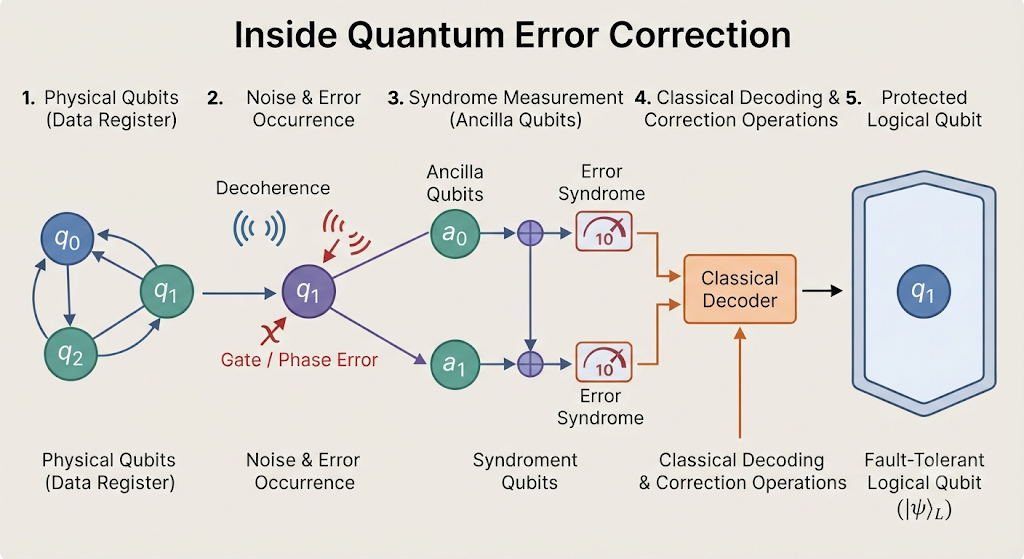
Understanding hardware limits is critical when designing practical experiments. Physical QPUs rely on distinct modalities—such as superconducting circuits, trapped ions, and neutral atoms—each involving trade-offs in qubit count, gate fidelity, connectivity, and coherence time. Today's devices operate in the noisy intermediate-scale quantum (NISQ) regime, meaning environmental decoherence and gate errors accumulate quickly as circuit depth grows.
Because near-term QPUs cannot sustain deep standalone calculations reliably, practical development centers on hybrid quantum classical computing training patterns. In variational algorithms—such as the Variational Quantum Eigensolver (VQE) for molecular simulation and the Quantum Approximate Optimization Algorithm (QAOA) for combinatorial optimization—workloads run in a tight feedback loop. A classical server preprocesses data and initializes circuit parameters, a shallow parameterized quantum circuit runs on a QPU to evaluate a cost function, and measurement statistics return to a classical optimizer to refine parameters iteratively.
Role-Specific Skills and a Realistic Learning Roadmap
Closing the quantum skills gap requires different focus areas across an IT organization:
- Software Engineers: Focus on Python SDKs, linear algebra basics, circuit depth reduction, and simulator noise modeling through dedicated quantum computing for software engineers curricula.
- Cloud Professionals and Architects: Study QPU hardware modalities, cloud job orchestration, hybrid classical-quantum pipelines, and post-quantum cryptographic migration via a quantum computing architecture course.
- IT Managers: Build strategic literacy around realistic hardware timelines, pilot workload selection, and R&D budgeting through quantum computing for IT managers programs.
Professionals can progress steadily through five practical stages:
- Review Core Foundations: Strengthen Python programming, probability distributions, complex numbers, vectors, and matrix operations.
- Build Basic Circuits Locally: Create a two-qubit Bell state in Qiskit or Cirq and run 1,000 simulator shots to verify entanglement statistics.
- Model Hardware Noise: Add realistic device noise models locally to observe how gate errors and circuit depth degrade measurement fidelity.
- Benchmark on Cloud Platforms: Submit identical circuits to cloud backends on IBM Quantum, AWS Braket, or Azure Quantum to compare simulator baselines against physical QPUs.
- Prototype a Hybrid Workflow: Combine a classical Python optimizer with a shallow parameterized circuit to solve a small optimization or chemistry problem.
For learners seeking structured, lab-driven guidance, QuantumOps School serves as an India-based quantum computing education, certification, and consulting platform. Its advertised learning tracks—covering Architect, Engineer, Manager, and Professional pathways—combine instructor-led sessions, practical labs, simulations, case studies, technical assessments, and capstone projects. Completing a structured quantum computing certification course or earning a provider-issued QuantumOps certification helps validate practical familiarity with cloud quantum workflows, while organizations evaluating pilot workloads or architectural readiness can engage quantum computing consulting services for technical guidance.
Conclusion: Continuous Learning with Realistic Expectations
Quantum computing is best approached with technical curiosity balanced by architectural realism. Large-scale fault-tolerant quantum processors remain a multi-year engineering milestone, and classical servers will continue running the vast majority of enterprise software. Yet as hybrid workflows and post-quantum security considerations gradually enter cloud engineering practice, professionals who invest in foundational quantum concepts, open-source frameworks, and disciplined cloud experimentation today will be well prepared for tomorrow's heterogeneous computing landscape.






Top comments (0)