
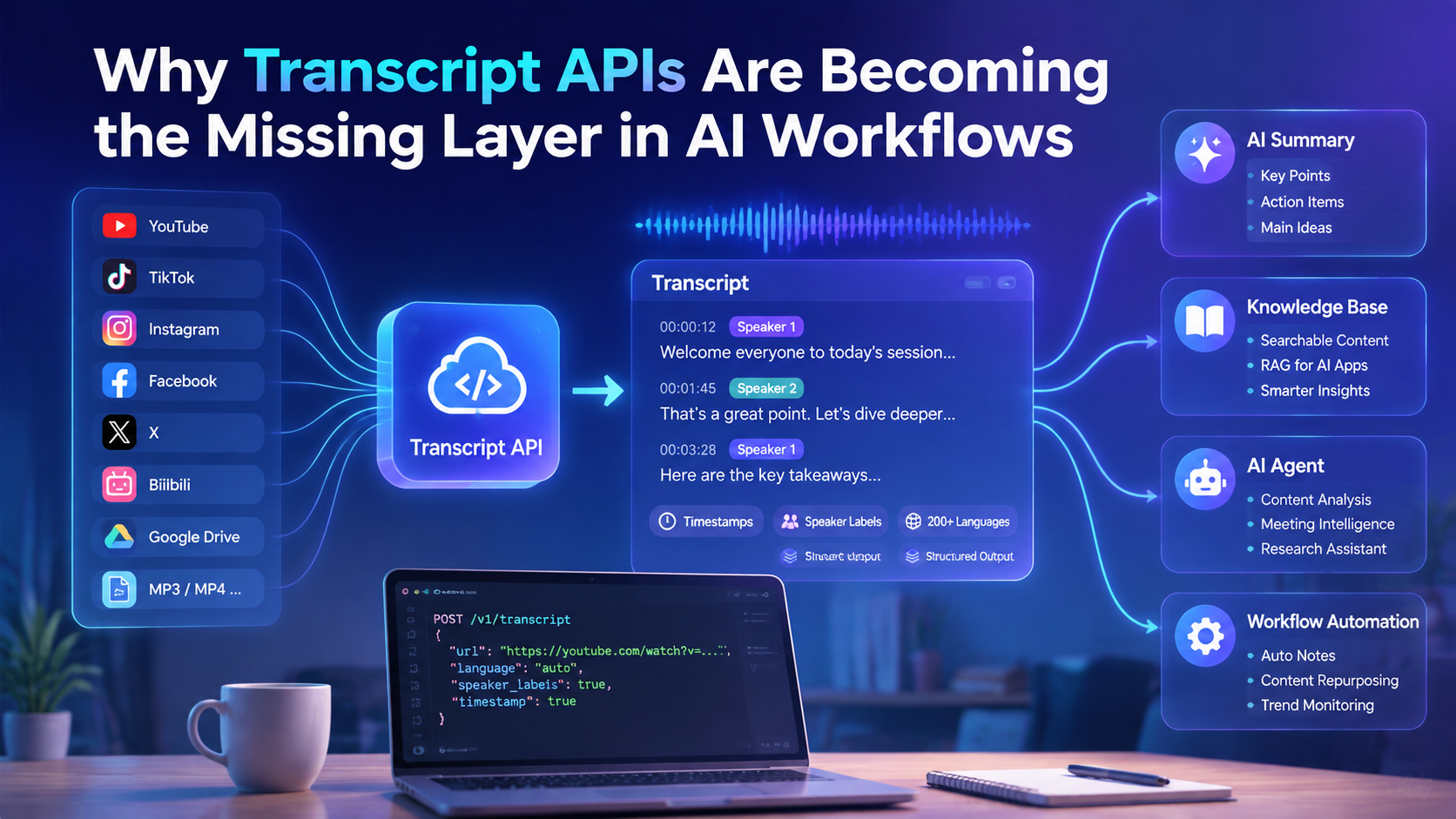

The AI ecosystem is moving beyond simple chat interfaces.
More developers, creators, and businesses are building AI-powered workflows that can summarize meetings, analyze customer conversations, monitor social media trends, and organize knowledge from massive amounts of content.
But there is one problem:
Most valuable information is still trapped inside audio and video.
A podcast episode, YouTube tutorial, customer interview, webinar, or recorded meeting may contain hours of valuable insights, but AI systems cannot easily understand raw media files.
This is where transcript APIs are becoming increasingly important.
Instead of manually converting audio and video into text, developers can use a transcript API to create a bridge between media content and AI applications.
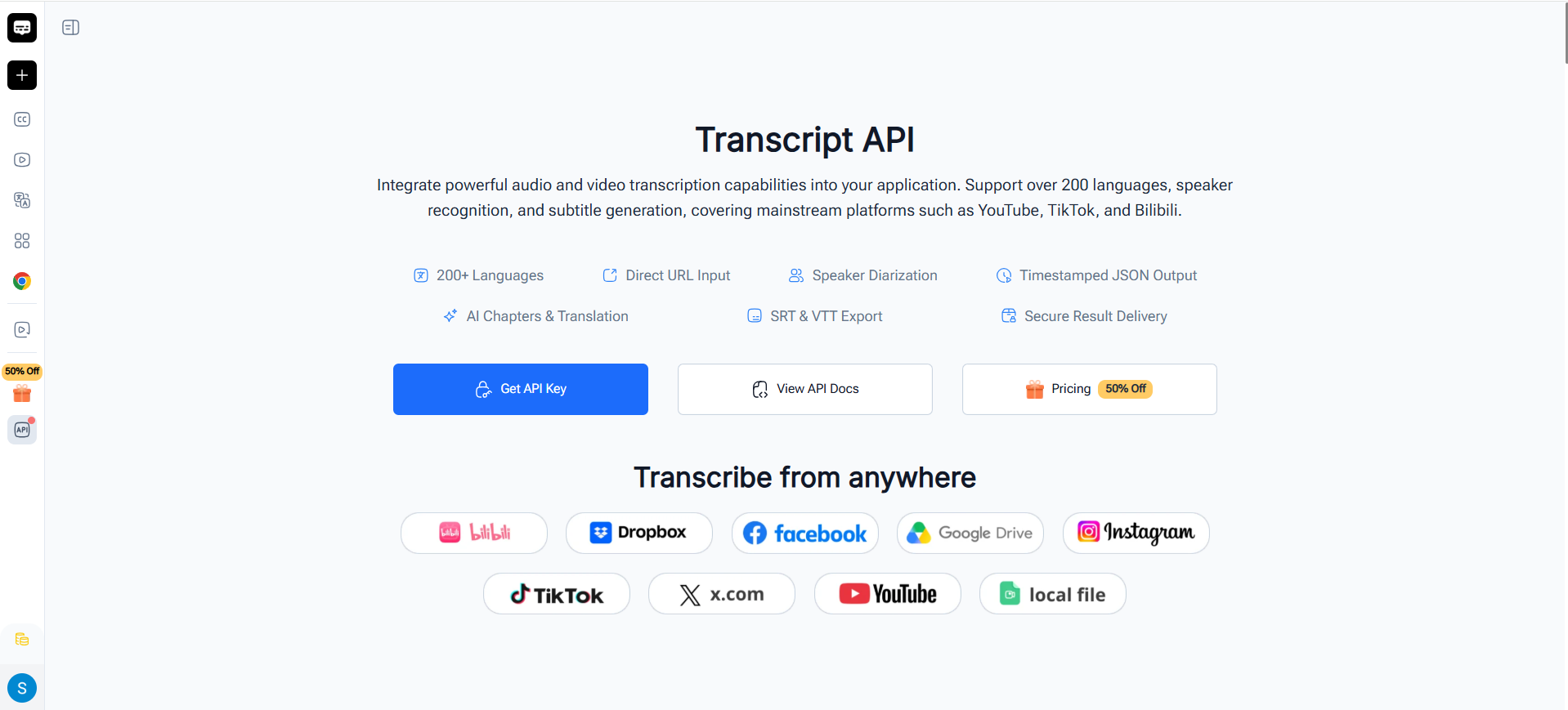
In this article, I'll explore why transcript APIs matter, what developers can build with them, and how tools like Video Transcriber AI's Transcript API fit into modern AI workflows.
The Problem: AI Cannot Understand What It Cannot Access
Large language models are powerful, but they still need structured input.
A business might have:
- Hundreds of customer calls
- Thousands of hours of webinars
- Product tutorials on YouTube
- Internal training recordings
- User-generated videos across social platforms
The information exists, but it is difficult to search, analyze, and reuse.
Traditionally, teams had to:
- Listen to recordings manually
- Create notes
- Extract important points
- Store information in documents
This workflow does not scale.
The challenge is not producing more content.
The challenge is making existing content accessible to AI systems.
A transcript API solves this by converting spoken content into structured text that can be processed, searched, summarized, and connected with other AI tools.
What Is a Transcript API?
A transcript API is a service that allows developers to send audio or video sources and receive automatically generated transcripts.
Instead of building speech recognition infrastructure from scratch, developers can integrate transcription capabilities directly into their applications.
A modern transcript API typically handles:
- Audio and video transcription
- Multiple language recognition
- Timestamp generation
- Speaker identification
- Subtitle creation
- Structured transcript output
The result is a machine-readable version of spoken content.
This allows developers to build applications where AI can understand conversations, videos, and recordings.
Why Transcript APIs Matter for AI Applications
Turning Videos Into Searchable Knowledge
Video content has become one of the largest sources of information online.
However, finding specific information inside a long video is still difficult.
Imagine a research assistant that can instantly answer:
"Which part of this 3-hour conference discusses AI regulation?"
"What were the main complaints mentioned in customer interviews?"
"Which videos contain information about this topic?"
A transcript API makes these experiences possible by transforming videos into searchable text.
Building Smarter AI Agents
AI agents need reliable data sources.
A transcript API can become the first step in an agent workflow:
Audio or Video
↓
Transcript Generation
↓
AI Analysis
↓
Knowledge Base / Automation / Decision Support
For example:
A sales AI agent could analyze recorded sales calls and identify customer objections.
A learning assistant could convert lectures into structured study materials.
A content assistant could analyze competitor videos and discover new content opportunities.
What Developers Can Build With a Transcript API
Content Research and Analysis Tools
Creators and marketers spend significant time researching trends.
A transcript API can help collect and analyze:
- YouTube videos
- Podcasts
- Interviews
- Social media videos
Instead of manually watching hours of content, users can quickly extract topics, keywords, and insights.
Automated Meeting Intelligence
Meetings generate valuable information, but much of it disappears after the conversation ends.
With a transcript API, developers can create systems that automatically:
- Convert meeting recordings into transcripts
- Identify speakers
- Extract decisions
- Generate follow-up tasks
This creates a more searchable and useful knowledge system.
AI-Powered Learning Platforms
Education is another area where transcript APIs can create significant value.
Students often struggle to review long lectures.
A learning platform connected with transcription technology can:
- Convert lectures into notes
- Generate summaries
- Create quizzes
- Answer questions about course materials
The transcript becomes the foundation for personalized learning experiences.
Social Media Content Intelligence
Short-form video platforms produce massive amounts of content every day.
Developers can use transcript APIs to analyze:
- TikTok videos
- YouTube Shorts
- Instagram videos
- Creator content trends
This enables applications for trend tracking, competitor research, and content optimization.
How Video Transcriber AI Transcript API Fits Into These Workflows
When exploring transcript APIs, developers usually care about several practical questions:
- What input sources are supported?
- How accurate is the transcription?
- Can the output work with AI systems?
- How easy is integration?
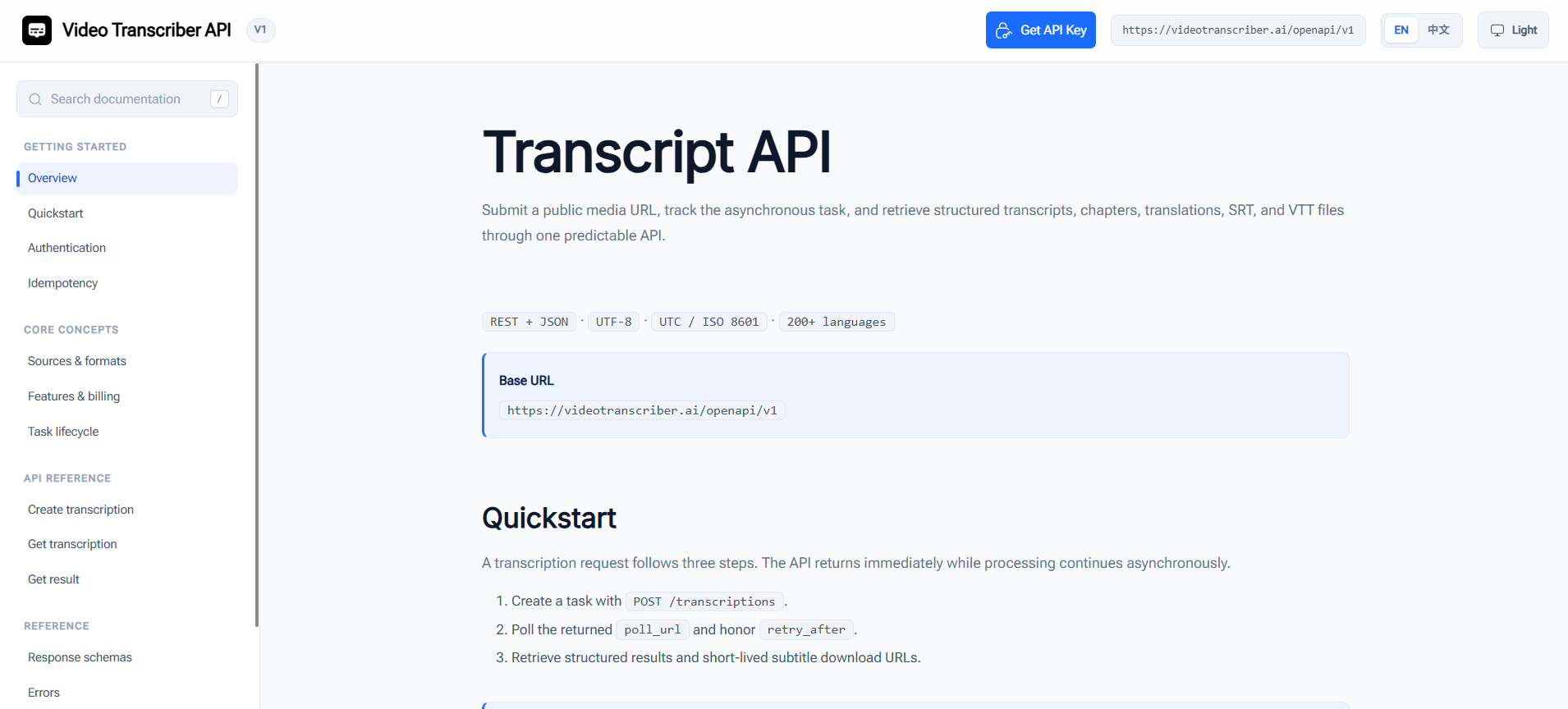
Video Transcriber AI's Transcript API is designed around these workflow requirements.
It supports various video and audio sources, including online video links and uploaded media files, and provides transcript data that can be used for AI analysis, automation, and content workflows.
Developers can use it as a foundation for applications involving:
- Video content analysis
- AI assistants
- Knowledge management systems
- Automated summaries
- Research workflows
For developers who want to quickly test transcript-based applications without building speech recognition infrastructure from scratch, a ready-to-use transcript API can significantly reduce development complexity.
What Makes a Good Transcript API?
Not all transcription solutions are the same.
When evaluating a transcript API, developers should consider several factors.
Language Support
Global content requires multilingual transcription.
A useful transcript API should support different languages and handle diverse accents.
Structured Output
Raw text is often not enough.
Timestamps, speaker labels, and organized transcript formats make downstream AI processing much easier.
Integration Flexibility
The best API is not just accurate.
It should fit naturally into existing workflows, applications, and automation systems.
Scalability
As projects grow, developers need solutions that can handle increasing volumes of content.
The Future of Transcript APIs
Transcript APIs are likely to become a core infrastructure layer for AI applications.
Today, they mainly help convert speech into text.
Tomorrow, they may become part of a larger intelligence pipeline.
Future workflows may look like:
Record conversation
↓
Generate transcript
↓
Understand context
↓
Create knowledge graph
↓
Trigger AI actions automatically
The important shift is that transcripts will no longer be the final product.
They will become the data layer that powers intelligent applications.
Final Thoughts
The future of AI is not only about generating answers.
It is also about giving AI access to more useful information.
Audio and video contain enormous amounts of human knowledge, but without transcription, much of that information remains difficult to use.
A transcript API provides the connection between media content and AI workflows.
For developers building AI applications, content platforms, research tools, or automation systems, transcription is becoming less of a standalone feature and more of an essential infrastructure layer.
The next generation of AI tools will not just read text.
They will understand everything we say, record, and create.





Top comments (0)