


Most published comparisons between two image models tell you almost nothing, because the person running them tuned their prompts on one model for months and the other for an afternoon. This article sets out where FLUX and Ideogram genuinely differ in kind rather than in taste, why hosted models have a structural advantage in casual tests, and how to run a comparison on your own workload that produces an answer you can act on.
The two models are not the same category of thing
FLUX, published by Black Forest Labs in August 2024, is a family with downloadable weights for two of its three variants. Ideogram, whose 2.0 release landed the same month, is a hosted service: you use it through a web app or an API and there are no weights to inspect, fine-tune, or run offline.
That difference propagates into everything else.
| Axis | FLUX | Ideogram |
|---|---|---|
| Where it runs | Your GPU, or any hosting provider | The vendor's infrastructure |
| Custom concepts | LoRA training on your own subjects | Style references and presets only |
| Control tooling | ControlNet, IP-Adapter, inpainting, node graphs | What the interface exposes |
| Prompt handling | Exactly what you typed | May be expanded by an automatic rewriter |
| Output licensing | Depends on the variant, dev is restricted | Governed by the service terms |
| Cost shape | Hardware or per-call rental | Subscription or credits |
| Reproducibility | Pinned weights, stable over time | Changes when the vendor updates the model |
The last row is the one that decides serious production work. An open checkpoint you have on disk generates the same image from the same seed in two years. A hosted model can change under you between one Tuesday and the next, which is fine for exploration and a problem for a brand style guide.

Why casual comparisons favour hosted services
A hosted product is a pipeline, not a model. Before your prompt reaches the weights it may be rewritten and expanded by a language model — Ideogram exposes this as a toggle — and after generation there may be filtering, selection, or an upscale pass. All of it improves the first-try experience of a vague prompt.
So when someone types a five-word prompt into both and posts the results, they are largely measuring prompt expansion, not image quality. The fair versions of that test are either to disable the rewriter, or to write a fully specified prompt that leaves the rewriter nothing to add. Do one or the other before drawing conclusions.
Where the real differences show up
Typography. Ideogram was built around text rendering and it shows on multi-word layouts: posters with a headline and a subhead, packaging, signage where the words need to sit correctly inside a designed composition. FLUX renders short text far better than the models that preceded it, but as text gets longer and the layout more deliberate, the gap widens.
Identity and repeatability. This one runs the other way. If you need the same character, product, or house style across hundreds of images, LoRA training on FLUX solves it directly. A hosted service without fine-tuning can only approximate it through reference images and prompt discipline.
Structural control. Anything requiring a pose, a depth map, a scribble, or a masked region is straightforward on open weights and limited to whatever the hosted interface offers otherwise.
Iteration speed and cost. Local generation costs electricity and your time; hosted generation costs credits but needs no setup and no large download.
A comparison protocol worth running
The only comparison that matters is on your own work. This takes about an hour.
- Collect ten prompts from jobs you have actually done or expect to do. Not showcase prompts — the boring ones.
- Write each prompt fully specified: subject, composition, lighting, style, materials. Leave nothing for an automatic rewriter to invent.
- Turn off prompt expansion on the hosted side, and note that you did.
- Generate four images per prompt per model. One image per prompt measures luck.
- Save everything with no cherry-picking, including the failures.
- Score blind. Strip filenames, shuffle, and rate each image against the brief without knowing which model made it.
- Score on separate axes rather than one overall number: prompt adherence, anatomy, text rendering, style match, and usable-without-editing rate.
That last axis is usually the decisive one. A model that produces a striking image needing thirty minutes of retouching is worse, for production, than one producing a plain image you can ship immediately.
Photographic prompts transfer across both
Prompts written in the Midjourney register — comma-separated photographic and film-stock language — carry over to FLUX unusually well, and they are a good neutral test case because neither model was built specifically around them.
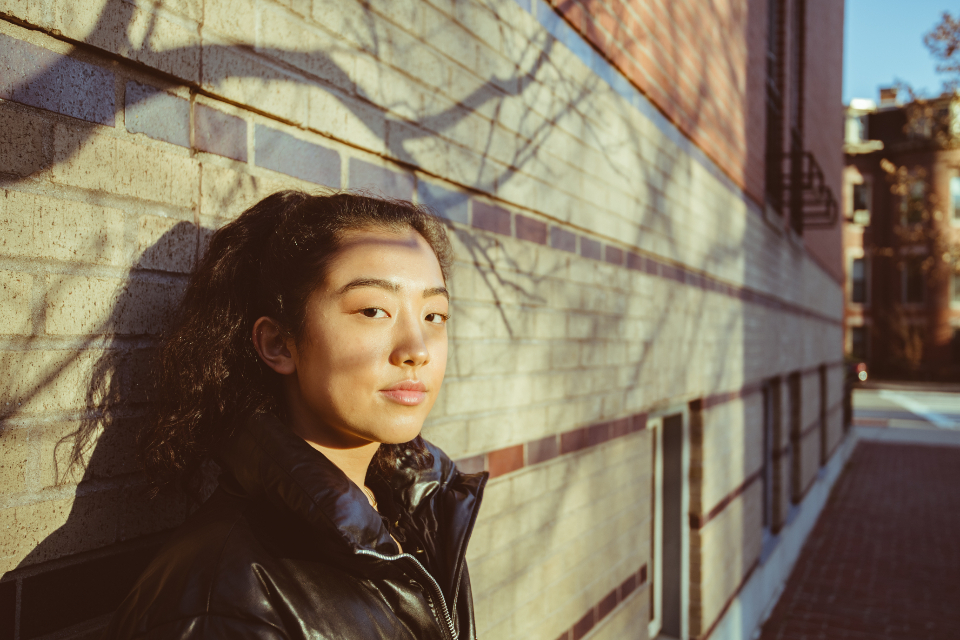
photo of a woman looking at the camera, close-up of the face with lens aberrations, sunlight filtering through shadows onto her face, in the style of instant film, Kodak T-Max 100, added noise and grain
What is doing the work here is the optical and material vocabulary: lens aberrations, filtered sunlight, film grain. Naming a specific film stock is a compact way to request an entire tonal response and grain structure without describing it.
Worth noticing that the original version of this prompt paired a black-and-white film stock with colour negative language. Contradictory stock references usually still produce something, because the model treats them as texture and mood cues rather than as a physical specification — but if you want one look reliably, name one stock and drop the rest. Contradictions are how you get results you cannot reproduce.

Choosing between them
Reach for open weights when you need a trained subject or style, structural control such as ControlNet or inpainting, reproducibility across time, offline operation, or clarity about the licence attached to your output.
Reach for a hosted service when the job is typography-heavy design work, when volume is low enough that a subscription beats hardware, when you need results today with no setup, or when nobody on the team wants to maintain a GPU box.
The honest answer for many teams is both: hosted for fast exploration and text-led layouts, local for the repeatable production runs where consistency matters more than any single striking image.
Practical takeaways
- Compare pipelines fairly: disable prompt rewriting or over-specify the prompt, then test.
- Test on your real briefs, four images per prompt, and score blind on separate axes.
- Track how often output is usable without editing; it predicts real throughput better than quality impressions.
- Pick open weights for custom identity, structural control, and long-term reproducibility.
- Pick a hosted service for typography-led design and for getting work out without infrastructure.






Top comments (0)