

Introduction
Translating text inside images is very different from translating normal documents.
Manga pages, comics, webtoons, screenshots, and visual novels contain text that is:
embedded inside images,
often handwritten or stylized,
sometimes vertical or curved,
and frequently mixed with multiple languages.
This makes traditional translation tools ineffective.
In this post, I’ll share a simple AI-powered workflow to translate text inside images — especially manga and comics — in a fast and practical way.
Step 1: Extract text from the image
The first step is to extract the text from the image using OCR (Optical Character Recognition).
For manga and comics, this is more difficult than standard OCR because:
speech bubbles vary in shape,
fonts are non-standard,
text can be vertical or overlapping.
You’ll want an OCR system that works well with visual content and stylized text.
Step 2: Detect language and structure
Once text is extracted, the system should:
detect the source language automatically,
preserve the reading order (important for dialogue),
group text logically by speech bubbles or panels.
Without this step, translations become confusing or unreadable.
Step 3: Translate the extracted text
Now the extracted and structured text can be translated into your target language.
Important factors here:
contextual awareness (dialogue consistency),
short informal sentence handling,
slang and expressive language.
Large language models tend to perform better than traditional phrase-based translators in this scenario.
Step 4: Review and refine
AI translation is a great first pass, but for high-quality results:
quickly review character names,
adjust slang or cultural references,
fix any layout misunderstandings.
This usually takes far less time than manual translation from scratch.
Example Tool
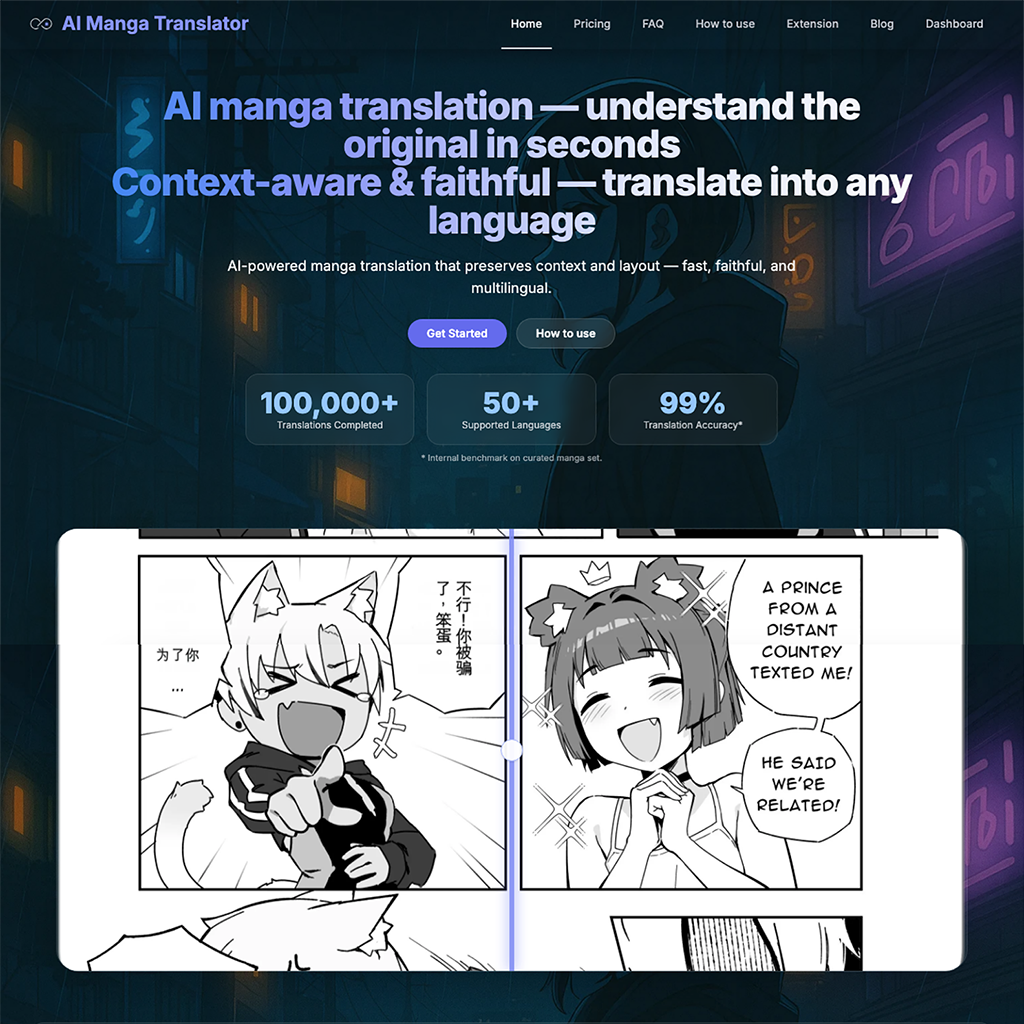
As an example of this workflow in action, I’ve been using a web-based tool called AiMangaTranslate that integrates OCR, language detection, and translation specifically for manga and image-based content.
It allows you to upload an image and get a translated result in one step.
Example: https://aimangatranslate.com
(You can use any similar tool that follows this pipeline.)
When is this workflow useful?
Reading manga or comics in foreign languages
Translating indie comics for global audiences
Learning Japanese, Korean, or Chinese through visual content
Translating screenshots, visual novels, or memes
Localizing marketing visuals or image-based content
Key takeaways
Image translation is a multi-step process: OCR → structure → language → translation.
Preserving reading order is just as important as translation quality.
AI dramatically reduces the manual effort required for this workflow.
Specialized tools outperform general-purpose translators for visual content.
Conclusion
AI makes it possible to unlock large amounts of visual content that were previously inaccessible due to language barriers.
By combining OCR, language detection, and translation into a single workflow, it becomes practical to translate manga, comics, and image-based text at scale.
This opens the door to more global sharing, reading, and creation of visual stories.




Top comments (0)