

I used to save every TikTok that contained a useful idea. My folders filled with marketing breakdowns, editing tips, mini tutorials, and clever hooks. Saving felt productive, but the collection became almost impossible to use. When I needed one specific explanation, I could not remember which thumbnail contained it.
Rewatching did not solve the problem. I would drag the playhead backward, miss the sentence again, and pause every few seconds to type. A thirty-second clip could take several minutes to turn into notes, and I still worried that I had misheard a name or number.
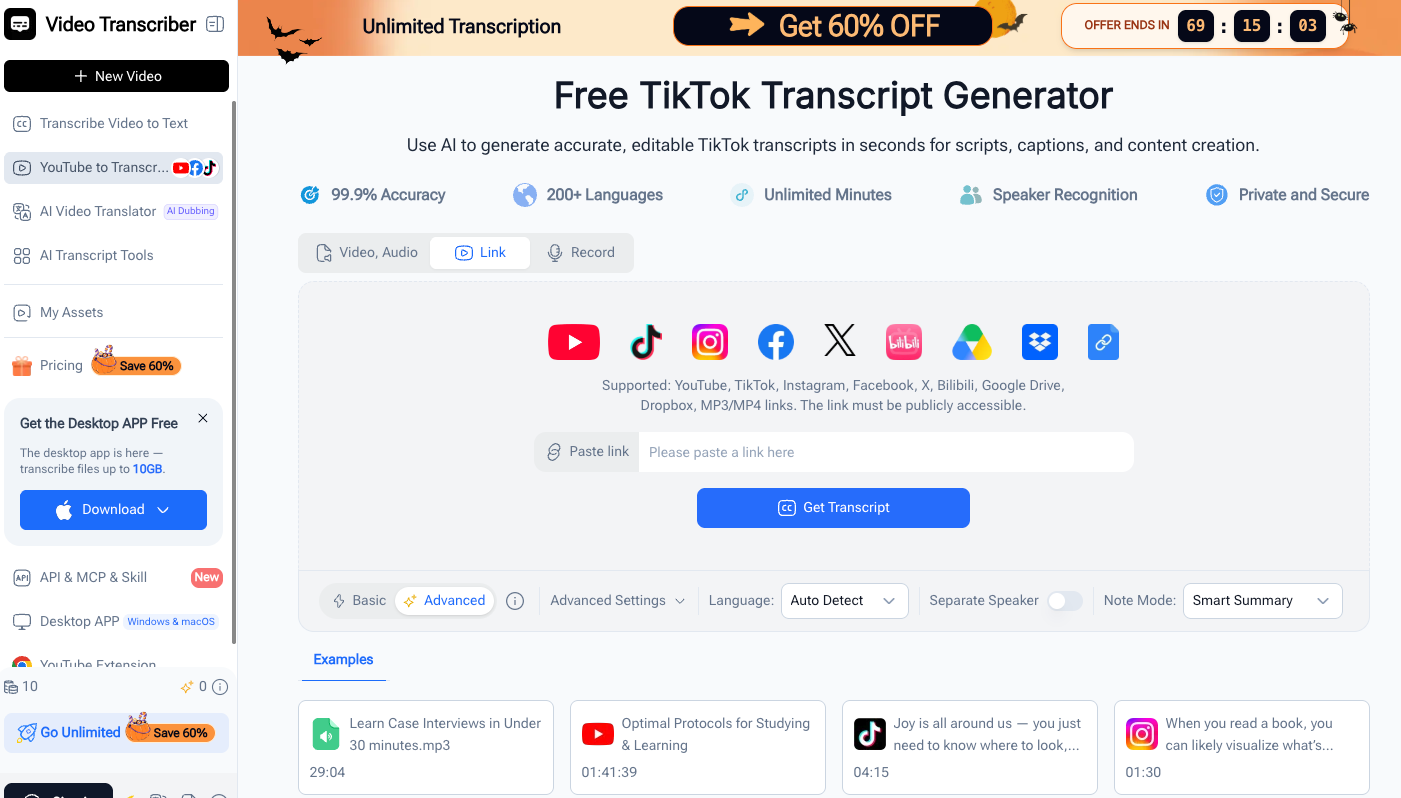
My workflow changed when I began using Video Transcriber AI's TikTok Transcript Generator. Instead of treating saved videos as a library, I started turning selected clips into editable text, checking the important details, and storing only the parts I could actually retrieve later.
1. The Problem Was Retrieval, Not Saving
TikTok makes discovery effortless. It does not automatically make the discovered information useful outside the feed. A saved video remains a sequence of sound and images. I can remember the topic, but I cannot search for a sentence spoken at second nineteen.
This became obvious when I was researching opening hooks. I had dozens of examples, yet comparing them meant replaying every video. I could not quickly answer basic questions: Which clips made a promise immediately? Which opened with a surprising result? Which delayed the main point?
I realized that I did not need a larger collection. I needed a searchable representation of the collection. A transcript could preserve the spoken content while letting me search, highlight, compare, and summarize it.
2. I Defined What a Useful Transcript Meant
At first, I assumed transcription was a single task. In practice, the desired output changes the entire process. Research notes, subtitle files, quotations, and content briefs require different levels of cleanup.
For research, I care about the central claim, examples, names, numbers, and order of ideas. For captions, timing and readable line breaks matter. For an article outline, I want the hook, argument, proof, and call to action. For translation, I need to correct the source text before any mistake travels into another language.
Defining the destination helped me stop over-editing. I no longer polish every spoken sentence when I only need a structural outline. I also avoid using a rough transcript as a public quotation. Each output receives the amount of review its risk justifies.
3. My New Link-to-Text Routine
I begin with the original public TikTok link whenever possible. Reposts may introduce compression, new music, or missing context. I save the source URL, creator name, topic, and capture date before doing anything else. A transcript without its source is difficult to verify later.
I paste the link into the tool, choose the language when I know it, and generate the first draft. I treat that result as a starting point, even when it looks polished. Automatic punctuation can make uncertain audio appear more definitive than it is.
My first review is narrow. I check names, brands, numbers, dates, negations, technical terms, and any sentence I may quote. These details can change the meaning of the entire clip. Only after that pass do I improve paragraphs, punctuation, or repeated speech.
4. I Separated Transcript, Summary, and Adaptation
One of my early mistakes was editing everything in the same document. I removed filler words, shortened explanations, and added my own interpretation. Later, I could not tell which phrasing came from the creator and which came from me.
Now I preserve three layers. The raw transcript records what the system generated. The reviewed transcript contains verified corrections and clearer formatting. The brief contains my summary, questions, and original ideas. This separation makes the research traceable.
It also prevents accidental copying. A transcript is useful source material, but it is not a license to republish another person's work. By moving from verified source text to a separate analysis, I focus on patterns, evidence, and my own angle rather than disguising someone else's words.
5. The Export Format Became Part of the Decision
I once downloaded everything as plain text because it seemed universal. That worked for notes but failed when I needed subtitle timing. Choosing the format according to the next step reduced unnecessary conversion.
TXT is simple for search and drafting. DOCX is useful when a collaborator will edit the material. SRT and VTT retain subtitle timing. CSV works well when I am comparing several videos by consistent fields, such as hook, topic, claim, proof, and call to action.
The transcription page lists these formats among its download options, so I can keep one source workflow while changing the derivative. I also keep filenames explicit, using labels such as raw, reviewed, and captions. A cleaned file never silently replaces the original.
6. Searchable Text Changed How I Studied Hooks
Once several videos were available as text, patterns became visible. I could compare the first sentence across clips without replaying each one. Some creators promised a result. Others challenged a common belief, named a painful problem, or showed evidence before explaining it.
I built a small table with the source URL, opening line, core claim, supporting points, and ending action. The table did not tell me which hook was universally best. It showed which communication pattern matched a topic and audience.
This was more useful than collecting isolated phrases. Copying a successful hook often produces generic work because the context is missing. Studying structure lets me create an original opening that performs the same job without borrowing the same wording.
7. The Workflow Also Exposed Its Limits
Transcription saves time, but it cannot recover information that is not clear in the audio. Background music, overlapping speakers, unusual names, and fast edits still require listening. Visual jokes and on-screen text may carry meaning that the spoken transcript never captures.
I also learned not to treat frequency as importance. A word mentioned once may be the key conclusion, while a repeated transition may add little. Automated summaries can miss caveats because caveats are quieter than bold claims.
For medical, legal, financial, or safety-related content, I verify important statements with authoritative sources. The transcript helps me locate the claim. It does not prove that the claim is correct. Human review remains the boundary between convenient extraction and responsible reuse.
8. From an Archive to a Working Knowledge Base
My saved-video habit was passive. I collected more than I could revisit. The transcript-first habit is selective. I process only videos that support a real project, question, or learning goal.
The routine is now predictable: preserve the source, generate text, review high-risk details, select the right export, and add a separate brief. The result is a smaller collection, but every item is searchable and connected to a purpose.
If your TikTok folders are full but your notes are empty, try this process with one useful clip. Use Video Transcriber AI to transcribe TikTok video, verify the important wording, and turn the result into the format your next task actually needs. The useful outcome is not merely a transcript. It is information you can find, question, and transform without watching the same clip five more times.






Top comments (0)