

Introduction
The CDOA – Certified DataOps Architect certification is designed for professionals who want to build, manage, and scale modern DataOps platforms in a practical, real-world way. It focuses on turning messy, fragmented data pipelines into reliable, automated, and governed data products that support business decisions. This certification helps you learn how to combine DevOps, data engineering, automation, and governance into one structured approach for DataOps success.
*What it is *
The CDOA – Certified DataOps Architect is a vendor-neutral, role-focused certification that validates your skills in architecting DataOps practices, platforms, and workflows for modern data-driven organizations. It covers how to design automated, governed, and observable data pipelines that support analytics, AI, and business intelligence. After this certification, you should be able to drive DataOps adoption and standardization across teams in a structured way.
Who should take it
The CDOA – Certified DataOps Architect certification is ideal for:
- Data Engineers who want to move into architecture and platform design.
- DevOps Engineers who are expanding into data platform automation and DataOps.
- Data Architects who want a modern, DevOps-style approach to data delivery.
- Cloud Engineers working on data platforms, data lakes, and analytics solutions.
- BI / Analytics Leads who want to standardize and industrialize data delivery.
- Technical Leads, Solution Architects, and Engineering Managers responsible for data platforms and data products.
(CDOA – Certified DataOps Architect) Certification Overview
The CDOA – Certified DataOps Architect certification focuses on how to design, implement, and optimize DataOps platforms that combine automation, observability, governance, and collaboration. It does not focus only on tools; instead, it helps you understand how to design an end-to-end system that can support multiple tools, teams, and data use cases. You learn to think like an architect: define standards, patterns, reference architectures, and guardrails for DataOps adoption.
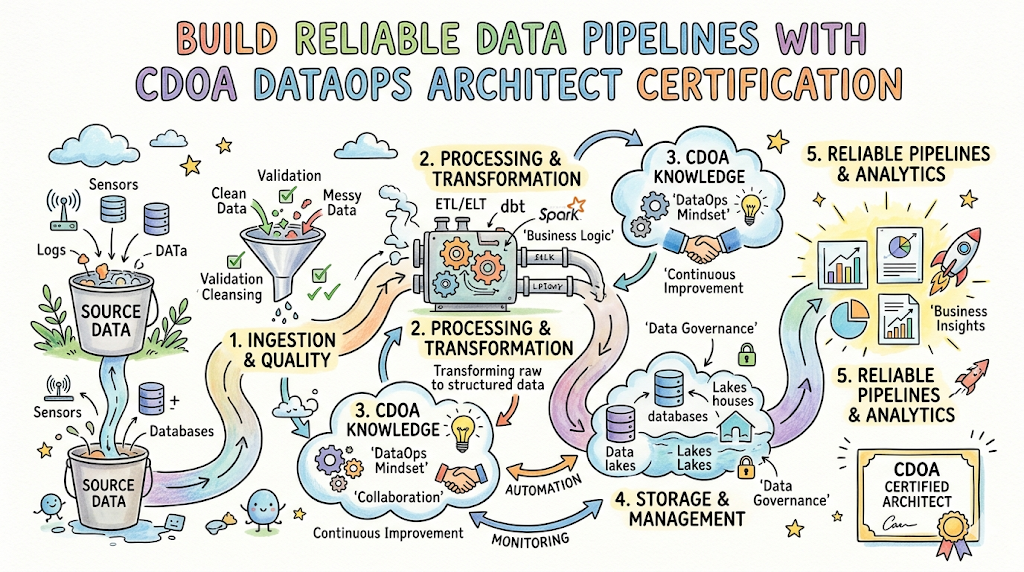
You will understand how to manage the full lifecycle of data from ingestion, transformation, and quality checks to cataloging, observability, and delivery to downstream systems. The program also emphasizes practical aspects like CI/CD for data pipelines, environment strategy, testing, versioning, and deployment patterns along with cost and performance considerations.
Program delivery, levels, and structure
The CDOA – Certified DataOps Architect program is delivered via the official DataOpsSchool certification program listed at: https://dataopsschool.com/certifications/. It is hosted and managed on the DataOpsSchool platform: https://dataopsschool.com/.
In practical terms, the structure can include:
- Foundation-level concepts of DataOps, pipelines, and architectures.
- Intermediate-level coverage of automation, CI/CD, observability, and governance.
- Advanced-level patterns for scaling DataOps across multiple teams, domains, and platforms.
The assessment approach typically combines conceptual checks with scenario-based and architecture-oriented questions that test your ability to apply concepts to real enterprise situations. Ownership of the certification remains with DataOpsSchool, and the curriculum is aligned with industry practices in DevOps, Data Engineering, and modern platform engineering. The structure is designed so a working professional can connect every topic with real problems they face in data projects.
Skills you’ll gain
- Understanding of core DataOps principles, patterns, and lifecycle.
- Ability to design end-to-end DataOps architectures on cloud and hybrid environments.
- Skills to build CI/CD and automation workflows for data pipelines and data products.
- Knowledge of data quality, testing strategies, and validation frameworks in DataOps.
- Capability to integrate observability and monitoring for data flows and pipelines.
- Familiarity with governance, access control, and compliance in data platforms.
- Experience in designing environment strategies (dev, test, prod) for data workloads.
- Practical understanding of collaboration models between data, DevOps, and business teams.
Real-world projects you should be able to do after it
- Design a complete DataOps architecture for a company with multiple data sources and analytics teams.
- Implement CI/CD pipelines for data workflows, including version control, testing, and deployment.
- Define data quality gates, validation rules, and automated checks in the data pipeline.
- Build an observability dashboard for data pipelines, with metrics, logs, and alerts.
- Create a governance model for access control, data classification, and compliance in data projects.
- Migrate a legacy, manual ETL pipeline into a modern, automated DataOps-based system.
- Standardize patterns and templates for data ingestion, transformation, and delivery across teams.
Common mistakes
- Treating DataOps as only tooling instead of a full lifecycle and culture change.
- Ignoring data quality and assuming “pipeline success” means “good data.”
- Not version-controlling data workflows, configs, and schemas.
- Building pipelines without observability, making troubleshooting very hard.
- Focusing only on batch workloads and ignoring streaming or near real-time needs.
- Skipping documentation and standards, which leads to fragile and one-off solutions.
- Ignoring security, access control, and compliance until a late stage.
Best next certification after this
After completing CDOA – Certified DataOps Architect, good next options include:
- A deeper DataOps or Data Engineering specialization to go hands-on with tools and implementation.
- An AIOps / MLOps certification to extend your DataOps skills into AI/ML lifecycle and model operations.
- A leadership or architecture-focused certification in Platform Engineering, Cloud Architecture, or Engineering Management to move toward strategic decision-making and platform ownership.
Complete Topic name Certification Table
CDOA – Certified DataOps Architect sits inside a broader ecosystem of DevOps and related certifications. Below is a simple, easy-to-understand table for different tracks and how they relate to roles and progression.
| Track | Level | Who it’s for | Prerequisites | Skills Covered | Recommended Order | Official Link |
|---|---|---|---|---|---|---|
| DevOps | Intermediate | DevOps / Cloud / Platform Engineers | Basic Linux, Git, CI/CD fundamentals | CI/CD, automation, infrastructure as code, pipelines | After basic cloud skills | — |
| DevSecOps | Intermediate | Security-aware DevOps and Cloud Engineers | DevOps basics, security fundamentals | Secure SDLC, security automation, compliance in pipelines | After DevOps track | — |
| SRE | Intermediate | SREs, Ops Engineers, Platform Engineers | Monitoring and production experience | Reliability, SLIs/SLOs, incident response, error budgets | After DevOps or Cloud | — |
| AIOps/MLOps | Intermediate | DataOps, ML, Platform, and DevOps Engineers | Data / ML basics, CI/CD knowledge | Model lifecycle, monitoring, automation for AI/ML workloads | After DataOps or DevOps | — |
| DataOps | Intermediate | Data Engineers, Data Architects, DevOps Engineers | Data pipelines, SQL, basic scripting | DataOps lifecycle, pipeline automation, governance, quality | Core for data platforms | https://dataopsschool.com/certifications/ |
| FinOps | Intermediate | Cloud Engineers, Finance/IT Collaboration roles | Cloud fundamentals, cost concepts | Cloud cost management, optimization, governance | Parallel to cloud track | — |
Choose your path
To make planning easier, here are six simple learning paths you can follow depending on your interest and role.
- DevOps Path: Start with core DevOps foundations, then move into more advanced CI/CD, infrastructure as code, and platform engineering concepts.
- DevSecOps Path: Begin with DevOps, then focus on integrating security into pipelines, policies, and automated checks across the SDLC.
- SRE Path: Build from DevOps or operations experience into SRE, focusing on reliability, SLIs/SLOs, observability, and incident management.
- AIOps/MLOps Path: Use your DevOps or DataOps foundations to manage AI/ML pipelines, model deployment, monitoring, and governance.
- DataOps Path: Grow from data engineering into designing automated, governed, and observable data platforms and pipelines.
- FinOps Path: Combine cloud engineering with cost management and governance to drive financially responsible cloud usage.
Role → Recommended certifications
Below is a simple mapping of roles to recommended certification directions, with CDOA – Certified DataOps Architect as one of the core options for data-focused profiles.
| Role | Recommended certifications mix |
|---|---|
| DevOps Engineer | DevOps foundations, DevSecOps, SRE, AIOps/MLOps |
| SRE | DevOps, SRE, observability-focused certifications |
| Platform Engineer | DevOps, SRE, DataOps, Platform Engineering or Cloud Architecture |
| Cloud Engineer | Cloud provider certifications, DevOps, FinOps |
| Security Engineer | DevSecOps, cloud security, security governance certifications |
| Data Engineer | Data Engineering, CDOA – Certified DataOps Architect, AIOps/MLOps |
| FinOps Practitioner | Cloud fundamentals, FinOps, governance and reporting-related certifications |
| Engineering Manager | Mix of DevOps, DataOps, SRE, and leadership/architecture certifications |
List of top institutions for Training cum Certifications for CDOA – Certified DataOps Architect
There are several institutions that focus on practical, hands-on training and guidance to help you prepare for the CDOA – Certified DataOps Architect journey. DevOpsSchool offers structured programs that cover DevOps, DataOps, and platform-level skills with real project exposure. Cotocus focuses on enterprise-grade enablement and transformation-based training that aligns with real organizational needs. Scmgalaxy supports practitioners with workshops and mentoring on pipelines, automation, and delivery practices. BestDevOps provides curated learning paths around emerging DevOps and DataOps practices. Devsecopsschool is centered on integrating security into DevOps and DataOps workflows. Sreschool helps you understand reliability engineering concepts that complement DataOps. Aiopsschool connects AIOps practices with modern observability and operations, useful for data-heavy systems. Dataopsschool is focused directly on DataOps-centric concepts, patterns, and certifications like CDOA. Finopsschool supports cost-aware and governance-focused learning, which is critical for data platforms running at scale.
Next certifications to take (3 options: same track, cross-track, leadership)
- Same track (DataOps): An advanced DataOps or specialized data platform certification that goes deeper into tooling, implementation, and complex architectures.
- Cross-track: An AIOps/MLOps or SRE certification to extend your DataOps skills into reliability and AI/ML value delivery.
- Leadership: A platform engineering, cloud architecture, or engineering leadership certification to move into strategic roles where you define standards and roadmaps.
FAQs on CDOA – Certified DataOps Architect
What is the CDOA – Certified DataOps Architect certification?
The CDOA – Certified DataOps Architect certification is a role-based program that validates your ability to design and architect DataOps platforms, practices, and workflows for modern organizations.What are the main skills I will learn in CDOA – Certified DataOps Architect?
You will learn DataOps principles, data pipeline architecture, automation, CI/CD for data, observability, governance, data quality, and collaboration models for data delivery.Who should consider CDOA – Certified DataOps Architect?
Data Engineers, DevOps Engineers, Data Architects, Cloud Engineers, and technical leaders who are involved in data platforms, analytics, and data product delivery should consider this certification.Do I need deep coding experience to take CDOA – Certified DataOps Architect?
While some scripting and familiarity with data tools help, the focus of this certification is on architecture, patterns, and lifecycle, so you mainly need good conceptual understanding and practical experience.How does CDOA – Certified DataOps Architect fit into a DevOps or platform engineering career?
It adds a strong data-focused layer to your DevOps or platform engineering skills, helping you design platforms where data, automation, and reliability come together.Is CDOA – Certified DataOps Architect only for people working with big data?
No, the certification is useful for any data-driven environment, including analytics, BI, reporting, AI/ML, and even smaller-scale data platforms that need reliability and governance.Can CDOA – Certified DataOps Architect help me move into architecture roles?
Yes, it is structured to build an architect mindset, focusing on patterns, standards, end-to-end designs, and governance across tools and teams.What kind of projects should I be able to handle after CDOA – Certified DataOps Architect?
You should be able to design and guide implementation of automated, observable, and governed data pipelines and platforms, including CI/CD workflows and quality gates.How does CDOA – Certified DataOps Architect relate to AIOps/MLOps?
DataOps provides the foundation for reliable data delivery, while AIOps/MLOps builds on that to manage models and AI workloads; the two complement each other very well.What is the best way to prepare for CDOA – Certified DataOps Architect?
The best approach is to combine practical experience on data projects with structured training from specialized institutions and the official DataOpsSchool certification resources.
Why choose Dataopsschool?
Choosing Dataopsschool for the CDOA – Certified DataOps Architect journey gives you access to a platform that is fully focused on DataOps thinking. The curriculum is built to connect theory with real implementation patterns, so you can use what you learn in active projects, not just exams. You benefit from a structured view of how DataOps fits with DevOps, SRE, AIOps/MLOps, and modern cloud platforms, which is essential for long-term career growth. Because the same ecosystem also covers related areas like AI, observability, and governance through different sister brands and tracks, you can continue to grow your skills in a consistent, connected way over time.
Conclusion
The CDOA – Certified DataOps Architect certification is a strong choice if you want to own and shape data platforms instead of just building isolated pipelines. It helps you think in terms of systems, standards, and lifecycle, which is exactly what modern data-driven organizations need. By anchoring your learning with focused providers and a clear path of next certifications, you can steadily move from implementation to architecture and then into strategic leadership roles in DataOps and platform engineering.





Top comments (0)